
[Paper Review] Generalizable Person Re-identification via Balancing Alignment and Uniformity
This paper proposes Balancing Alignment and Uniformity (BAU), a simple yet effective framework for domain generalizable person re-identification that mitigates the polarized effect of data augmentations by balancing alignment and uniformity in the representation space. By applying losses to both original and augmented images, integrating a reliability-weighted alignment loss, and introducing domain-specific uniformity regularization, BAU achieves state-of-the-art performance without complex architectures or training procedures.
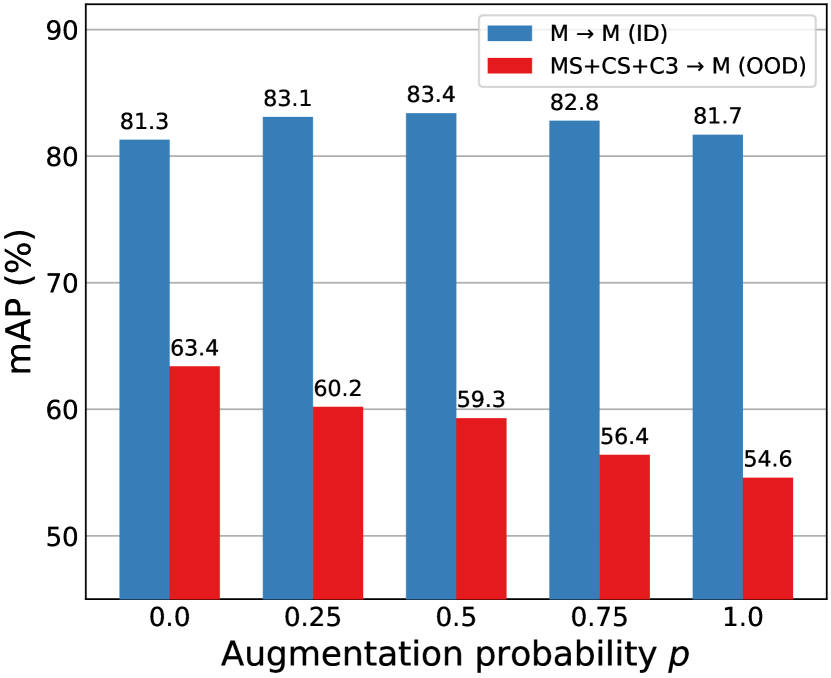
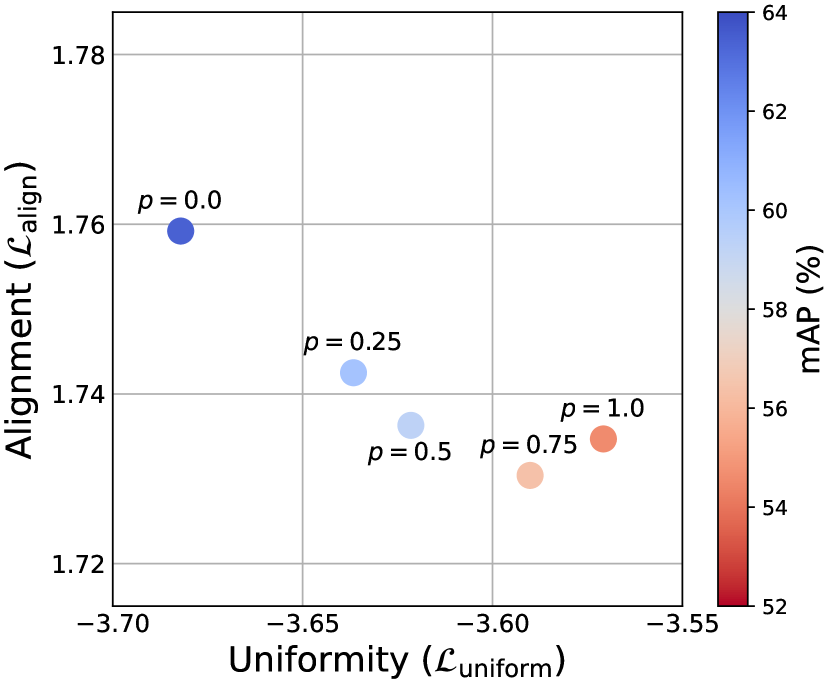
Domain generalizable person re-identification (DG re-ID) aims to learn discriminative representations that are robust to distributional shifts. While data augmentation is a straightforward solution to improve generalization, certain augmentations exhibit a polarized effect in this task, enhancing in-distribution performance while deteriorating out-of-distribution performance. In this paper, we investigate this phenomenon and reveal that it leads to sparse representation spaces with reduced uniformity. To address this issue, we propose a novel framework, Balancing Alignment and Uniformity (BAU), which effectively mitigates this effect by maintaining a balance between alignment and uniformity. Specifically, BAU incorporates alignment and uniformity losses applied to both original and augmented images and integrates a weighting strategy to assess the reliability of augmented samples, further improving the alignment loss. Additionally, we introduce a domain-specific uniformity loss that promotes uniformity within each source domain, thereby enhancing the learning of domain-invariant features. Extensive experimental results demonstrate that BAU effectively exploits the advantages of data augmentation, which previous studies could not fully utilize, and achieves state-of-the-art performance without requiring complex training procedures. The code is available at \url{https://github.com/yoonkicho/BAU}.
Motivation & Objective
- To investigate why certain data augmentations in person re-ID degrade out-of-distribution performance despite improving in-distribution accuracy.
- To reveal that problematic augmentations lead to sparse representation spaces with reduced uniformity, harming generalization.
- To develop a simple framework that balances alignment and uniformity to counteract the polarized effect of data augmentations.
- To enhance domain-invariant representation learning through domain-specific uniformity regularization.
- To achieve state-of-the-art performance in domain generalizable re-ID without complex training or architectures.
Proposed method
- Applying both alignment and uniformity losses to both original and augmented images to regularize the representation space.
- Introducing a reliability-weighted alignment loss that assigns higher weights to augmented samples with higher semantic similarity to their original counterparts.
- Proposing a domain-specific uniformity loss that promotes uniformity within each source domain to encourage domain-invariant feature learning.
- Using a weighting strategy based on feature similarity to dynamically assess the reliability of augmented samples for alignment loss.
- Training the model end-to-end with a combined loss function that balances alignment, uniformity, and domain-specific uniformity.
- Leveraging standard image-level augmentations without adversarial or feature-level augmentations, focusing on representation space balance.
Experimental results
Research questions
- RQ1Why do certain data augmentations in person re-identification lead to a polarized effect, improving in-domain performance while harming out-of-domain generalization?
- RQ2How does the sparsity of representation space, induced by certain augmentations, affect the generalization capability of re-ID models?
- RQ3Can balancing alignment and uniformity in the representation space mitigate the negative impact of data augmentations on out-of-distribution performance?
- RQ4To what extent can domain-specific uniformity regularization improve the learning of domain-invariant features in DG re-ID?
- RQ5Can a simple framework based on loss balancing and sample reliability weighting achieve SOTA performance without complex architectures or training procedures?
Key findings
- The polarized effect of data augmentations in DG re-ID is caused by induced sparse representation spaces with reduced uniformity, which harms generalization.
- The proposed weighting strategy for the alignment loss improves mAP by 1.2% at 0.5 augmentation probability and by 10.0% at 1.0 probability, demonstrating strong gains under high corruption.
- BAU achieves state-of-the-art performance on multiple benchmarks, including MS+CS+C3 → M under Protocol-3, outperforming prior methods without complex training or architectures.
- The domain-specific uniformity loss increases uniformity within each source domain, as evidenced by higher uniformity values reported in parentheses, confirming its effectiveness in learning domain-invariant features.
- Qualitative analysis shows that the weight scores $ w $ in the alignment loss effectively prioritize augmented samples with minimal distortion and high semantic similarity to originals.
- Ablation studies confirm that both the reliability weighting and domain-specific uniformity components are essential for optimal performance, validating the framework's design.
Read this paper
Open the full text in the Nubint reader and ask about any passage as you read.
Read this paper on NubintThis review was generated by AI from the original paper. Please check the paper before citing it.