
[Paper Review] Generalization in Deep RL for TSP Problems via Equivariance and Local Search
This paper proposes eMAGIC, a deep reinforcement learning framework for the traveling salesman problem (TSP) that enhances generalization through equivariance, interleaved local search, and curriculum learning. By training on small instances (up to 50 cities), eMAGIC achieves state-of-the-art performance on larger random and realistic TSP instances (up to 1000 cities), with a generalization gap of only 3.40% on large TSPLIB instances.
Deep reinforcement learning (RL) has proved to be a competitive heuristic for solving small-sized instances of traveling salesman problems (TSP), but its performance on larger-sized instances is insufficient. Since training on large instances is impractical, we design a novel deep RL approach with a focus on generalizability. Our proposition consisting of a simple deep learning architecture that learns with novel RL training techniques, exploits two main ideas. First, we exploit equivariance to facilitate training. Second, we interleave efficient local search heuristics with the usual RL training to smooth the value landscape. In order to validate the whole approach, we empirically evaluate our proposition on random and realistic TSP problems against relevant state-of-the-art deep RL methods. Moreover, we present an ablation study to understand the contribution of each of its component
Motivation & Objective
- Address the poor generalization of deep RL solvers on large TSP instances, which are infeasible to train on due to computational cost.
- Overcome the limitation of existing RL-based TSP solvers that perform poorly when tested on larger instances than those used during training.
- Develop a scalable, generalizable deep RL framework that can be trained on small instances and effectively solve larger ones.
- Investigate how architectural invariance and equivariance, combined with local search and curriculum learning, improve generalization in combinatorial optimization.
- Demonstrate the effectiveness of the proposed method on both synthetic and real-world TSP benchmarks, including TSPLIB instances up to 1002 cities.
Proposed method
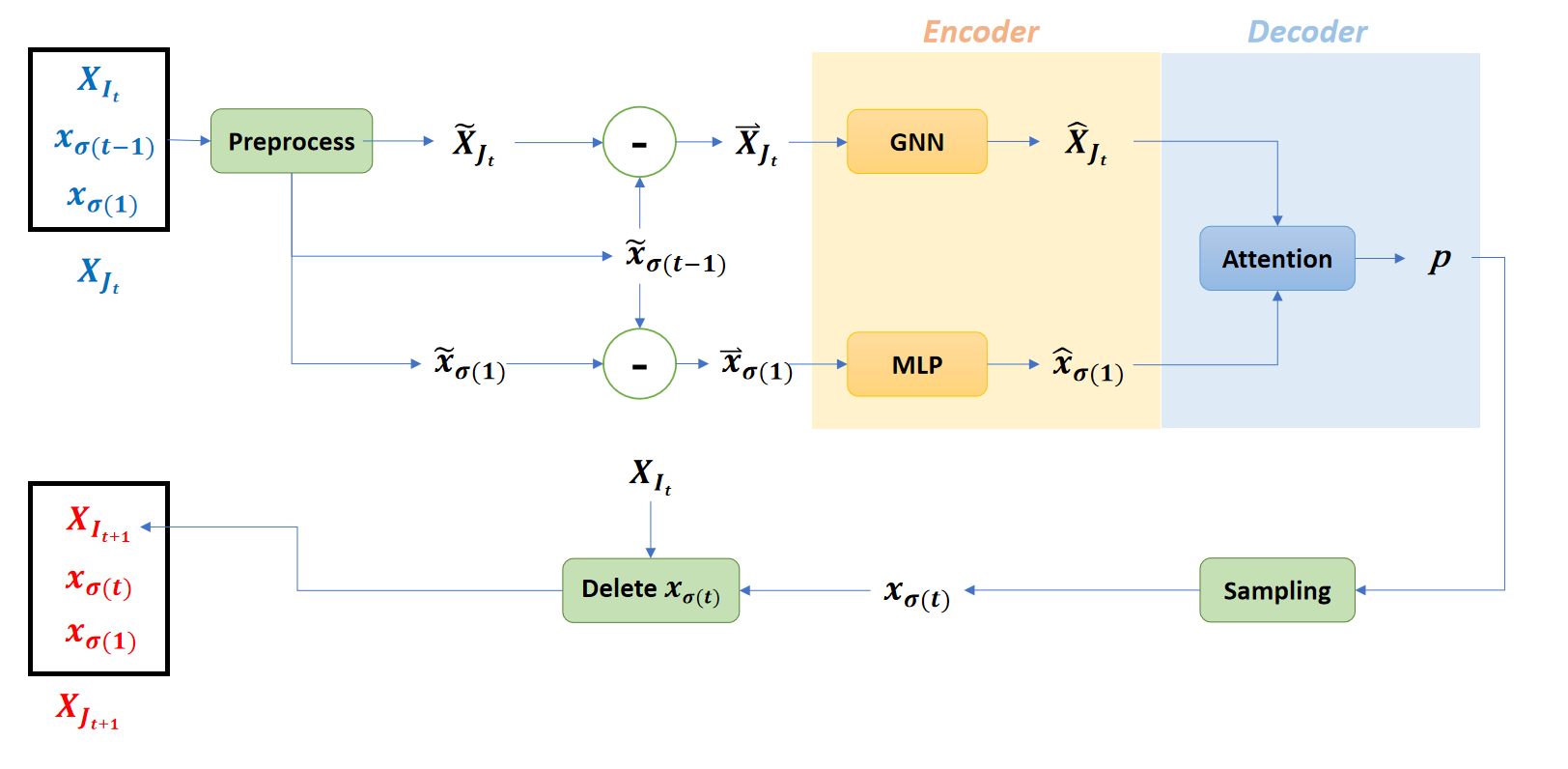
- Introduce equivariance in the model by using relative city positions and permutation-invariant processing to ensure consistent behavior under spatial symmetries.
- Interleave deep RL training with efficient local search heuristics (e.g., 2-opt) to smooth the reward landscape and improve policy optimization.
- Propose a novel policy rollout baseline to reduce variance in policy gradient estimation during training.
- Apply curriculum learning by gradually increasing training instance size from small (e.g., 20 cities) to large (e.g., 1000 cities), improving training stability and generalization.
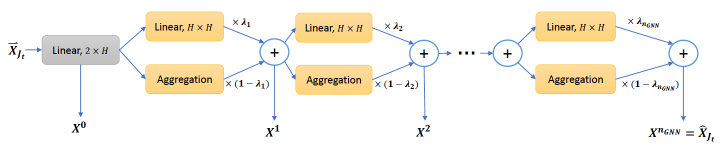
- Design a hybrid model architecture combining a graph neural network (GNN), multi-layer perceptron (MLP), and attention mechanism to process TSP input effectively.
- Use a modified policy gradient update where improved solutions from local search are used as targets to refine the RL policy, enhancing convergence and solution quality.
Experimental results
Research questions
- RQ1Can equivariance in the model architecture improve generalization of deep RL solvers for TSP across different instance sizes?
- RQ2To what extent does interleaving local search with RL training smooth the optimization landscape and improve policy learning?
- RQ3How effective is curriculum learning in enhancing the generalization of RL-based TSP solvers trained on small instances?
- RQ4Does the proposed policy rollout baseline reduce variance in policy gradient estimation compared to standard baselines?
- RQ5Can a model trained on small TSP instances (≤50 cities) achieve competitive performance on large-scale TSP problems (up to 1000 cities) in both random and realistic settings?
Key findings
- eMAGIC achieves a 3.40% average gap to optimality on large realistic TSPLIB instances (400–1002 cities), significantly outperforming other learning-based methods.
- On TSP-1000 instances, eMAGIC achieves a 7.05% average gap, with only a 1.2% increase in gap from TSP-500 (6.01%), indicating strong generalization across sizes.
- The ablation study shows that removing equivariance increases the average gap by 1.4% on TSP-1000, demonstrating its critical role in performance.
- Replacing the policy rollout baseline with a self-critic baseline increases the average gap by 1.1% on TSP-1000, confirming its value in reducing training variance.
- Removing local search during training increases the average gap by 1.6% on TSP-1000, showing that local search enhances policy learning beyond just post-processing.
- eMAGIC generalizes effectively to real-world TSP instances, achieving a 0.46% gap on small TSPLIB instances (50–199 cities), outperforming all other learning-based solvers in this range.
Read this paper
Open the full text in the Nubint reader and ask about any passage as you read.
Read this paper on NubintThis review was generated by AI from the original paper. Please check the paper before citing it.