
[Paper Review] Generalized contact matrices for epidemic modeling
This paper introduces generalized contact matrices that stratify human interactions across multiple dimensions—such as age, socio-economic status (SES), and context—extending traditional age-stratified models. It derives a closed-form expression for the basic reproductive number $R_0$ in such models, proving that multi-dimensional stratification always yields $R_0$ values equal to or higher than single-dimensional models, thus revealing underestimation risks in standard epidemic modeling when SES is ignored.
Contact matrices have become a key ingredient of modern epidemic models. They account for the stratification of contacts for the age of individuals and, in some cases, the context of their interactions. However, age and context are not the only factors shaping contact structures and affecting the spreading of infectious diseases. Socio-economic status (SES) variables such as wealth, ethnicity, and education play a major role as well. Here, we introduce generalized contact matrices capable of stratifying contacts across any number of dimensions including any SES variable. We derive an analytical expression for the basic reproductive number of an infectious disease unfolding on a population characterized by such generalized contact matrices. Our results, on both synthetic and real data, show that disregarding higher levels of stratification might lead to the under-estimation of the reproductive number and to a mis-estimation of the global epidemic dynamics. Furthermore, including generalized contact matrices allows for more expressive epidemic models able to capture heterogeneities in behaviours such as different levels of adoption of non-pharmaceutical interventions across different groups. Overall, our work contributes to the literature attempting to bring socio-economic, as well as other dimensions, to the forefront of epidemic modeling. Tackling this issue is crucial for developing more precise descriptions of epidemics, and thus to design better strategies to contain them.
Motivation & Objective
- Address the limitation in existing epidemic models that neglect socio-economic status (SES) as a structural factor in contact patterns.
- Develop a mathematical framework capable of incorporating any number of demographic and socio-economic dimensions into contact matrices.
- Derive a closed-form analytical expression for the basic reproductive number $R_0$ in models using generalized contact matrices.
- Quantify how multi-dimensional stratification affects $R_0$ and epidemic dynamics compared to single-attribute models (e.g., age-only).
- Demonstrate the model's ability to capture heterogeneous adoption of non-pharmaceutical interventions (NPIs) across SES groups and improve epidemic prediction accuracy.
Proposed method
- Propose a generalized contact matrix $G_{\mathbf{a},\mathbf{b}}$ that combines multiple stratification dimensions (e.g., age and SES) into a single multi-dimensional contact structure.
- Formulate a Susceptible-Exposed-Infectious-Recovered (SEIR) compartmental model where transmission rates are defined by the generalized contact matrix.
- Derive a closed-form analytical expression for the basic reproductive number $R_0$ based on the spectral radius of the generalized contact matrix.
- Use spectral theory to prove that $R_0$ computed from generalized matrices is always greater than or equal to that from single-dimensional matrices.
- Validate the model using synthetic data with controlled mixing patterns (assortative vs. random) and varying activity levels across dimensions.
- Apply the framework to real-world contact data from the MASZK survey in Hungary (April and November 2021) to compare attack rates and epidemic dynamics between standard and generalized models.

Experimental results
Research questions
- RQ1How does including socio-economic status (SES) as a stratification dimension in contact matrices affect the estimated value of $R_0$?
- RQ2To what extent does multi-dimensional stratification (e.g., age + SES) alter epidemic dynamics such as attack rates and peak prevalence compared to age-only models?
- RQ3Can generalized contact matrices better capture heterogeneities in non-pharmaceutical intervention (NPI) adoption across different population subgroups?
- RQ4What is the mathematical relationship between the spectral radius of generalized contact matrices and the resulting $R_0$?
- RQ5How do correlations in contact patterns—such as assortativity and heterogeneous activity—affect $R_0$ in multi-dimensional models?
Key findings
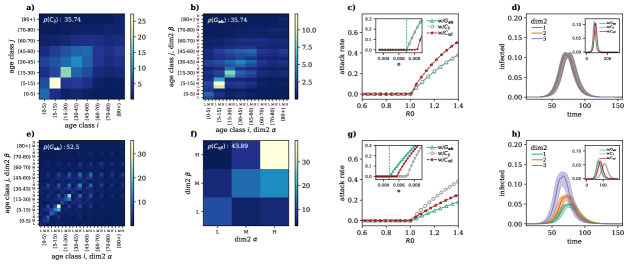
- Generalized contact matrices that include SES dimensions yield $R_0$ values that are always greater than or equal to those from single-dimensional (e.g., age-only) models, with the difference increasing under assortative mixing.
- In synthetic scenarios with three dimensions (age, SES, and activity level), the spectral radius of the generalized matrix was higher than in two-dimensional models, implying a higher critical threshold for disease control.
- For a fixed $R_0$, models using generalized contact matrices predict lower attack rates than standard models, indicating that standard models may overestimate epidemic size when SES is ignored.
- Real-world application to Hungarian contact data (April and November 2021) confirmed that generalized models better capture disparities in incidence across SES groups, which are invisible to standard age-only models.
- The model successfully reproduces heterogeneous NPI adoption patterns, showing that subgroups with different SES levels can exhibit divergent epidemic trajectories even under identical policy interventions.
- In both synthetic and real-world settings, the inclusion of SES in contact matrices leads to more accurate and expressive epidemic forecasts, especially when transmission dynamics are driven by structural inequalities.
Read this paper
Open the full text in the Nubint reader and ask about any passage as you read.
Read this paper on NubintThis review was generated by AI from the original paper. Please check the paper before citing it.