
[Paper Review] Generalized Radon--Nikodym Spectral Approach. Application to Relaxation Dynamics Study
This paper introduces a norm-free spectral approach based on generalized Radon–Nikodym derivatives to extract relaxation dynamics from sampled time series without prior assumptions about the number of relaxation rates. By constructing a virtual Hamiltonian operator from moment-based projections and solving its eigenvalue problem, the method directly yields the distribution of relaxation times and rates, outperforming Fourier, Laplace, and fitting-based methods in accuracy and robustness for non-Gaussian, finite, and non-oscillatory data.
Radon--Nikodym approach to relaxation dynamics, where probability density is built first and then used to calculate observable dynamic characteristic is developed and applied to relaxation type signals study. In contrast with $L^2$ norm approaches, such as Fourier or least squares, this new approach does not use a norm, the problem is reduced to finding the spectrum of an operator (virtual Hamiltonian), which is built in a way that eigenvalues represent the dynamic characteristic of interest and eigenvectors represent probability density. The problems of interpolation (numerical estimation of Radon--Nikodym derivatives is developed) and obtaining the distribution of relaxation rates from sampled timeserie are considered. Application of the theory is demonstrated on a number of model and experimentally measured timeserie signals of degradation and relaxation processes. Software product, implementing the theory is developed.
Motivation & Objective
- To develop a robust, norm-free method for analyzing relaxation dynamics in time series data without relying on $L^2$-norm-based transforms like Fourier or least squares.
- To enable direct estimation of the distribution of relaxation rates, time derivatives, and dynamic characteristics from sampled time series without assuming the number of relaxation components.
- To overcome limitations of traditional methods—such as Laplace transform instability under discretization and Fourier transform’s inability to resolve relaxation rate distributions—especially in non-oscillatory, non-Gaussian, or finite-length signals.
- To provide a numerically stable, software-implemented framework that uses orthogonal polynomial bases (e.g., Chebyshev, Legendre) to compute Radon–Nikodym derivatives and eigenvalue spectra.
- To demonstrate the method’s effectiveness on both synthetic and real-world data, including electrochemical relaxation and stock price change rate distributions.
Proposed method
- Constructs moment-based inner products $\Braket{Q_k f Q_l}$, $\Braket{Q_k \frac{df}{dx} Q_l}$, and $\Braket{Q_k Q_l}$ using a basis $Q_k(x)$ (e.g., Chebyshev or Legendre polynomials) and a weight function $\omega(x)=1$.
- Defines a generalized eigenvalue problem $M^L \vec{\psi} = \lambda M^R \vec{\psi}$, where $M^L$ and $M^R$ are moment matrices derived from the time series, with eigenvalues $\lambda$ representing dynamic characteristics (e.g., relaxation times).
- Uses the eigenvectors $\psi^{[i]}(x)$ to reconstruct probability density functions and estimate $x^{[i]}_{\text{est}} = \frac{\Braket{\psi^{[i]2} x}}{\Braket{\psi^{[i]2}}}$, providing a spatial estimate of the relaxation rate.
- Applies interpolation via $f(x) = \sum_i c_i \psi^{[i]}(x)$, with coefficients $c_i$ derived from moment matching, enabling estimation of $f(x)$ and $df/dx$ at any point.
- Implements numerical integration by parts to compute $\Braket{df/dx Q_k}$ from $\Braket{f Q_k}$, improving numerical stability when $\omega(x)=1$.
- Develops a Java-based software package that reads time series, computes moment matrices, solves the generalized eigenvalue problem, and outputs spectra and interpolated values, with support for multiple bases and numerical/analytical derivative estimation.
Experimental results
Research questions
- RQ1Can a norm-free spectral method based on Radon–Nikodym derivatives extract the distribution of relaxation rates from sampled time series without assuming the number of components?
- RQ2How does the proposed method compare to Fourier, Laplace, and curve-fitting approaches in resolving relaxation dynamics in non-oscillatory, finite-length, and non-Gaussian signals?
- RQ3To what extent does the choice of basis (e.g., Chebyshev vs. monomials) affect numerical stability and accuracy of the computed spectra and interpolations?
- RQ4Can the method reliably estimate time derivatives and relaxation rates from real-world data such as stock price changes or electrochemical degradation signals?
- RQ5Does the generalized eigenvalue formulation of the Radon–Nikodym problem yield consistent results across different numerical implementations (e.g., direct vs. integration-by-parts computation of derivatives)?
Key findings
- The method successfully extracts the distribution of relaxation rates from time series data without requiring prior knowledge of the number of relaxation components, a key limitation of fitting-based approaches.
- The eigenvalue spectrum of the constructed virtual Hamiltonian directly encodes the distribution of dynamic characteristics (e.g., relaxation times), with eigenvalues sorted in ascending order and corresponding to estimated relaxation rates.
- The approach is robust to outliers and non-Gaussian noise because it avoids $L^2$-norm minimization, making it suitable for signals with infinite variance or heavy-tailed distributions.
- For the same time series, the results from direct and integration-by-parts computation of $\Braket{df/dx Q_k}$ are identical within machine precision when the basis and weight function are properly chosen, validating numerical consistency.
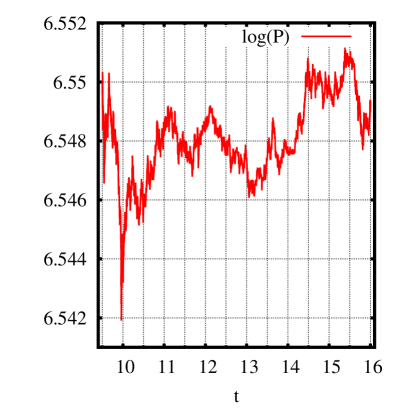
- The software implementation correctly reproduces benchmark results from prior studies (e.g., Ref. [22]) and accurately models the stock price change rate distribution (Fig. 7), confirming the method’s empirical validity.
- Chebyshev and Legendre polynomial bases yield numerically stable results, while monomial bases can lead to instability; the method’s output is invariant to basis choice when numerical precision is sufficient.

Better researchstarts right now
From reading papers to final review, dramatically reduce your research time.
No credit card · Free plan available
This review was created by AI and reviewed by human editors.