
[Paper Review] Generating coherent comic with rich story using ChatGPT and Stable Diffusion
This paper presents a method to generate coherent, story-rich comics using GPT-4 and fine-tuned Stable Diffusion, leveraging prompt engineering and LoRA-based fine-tuning to preserve character fidelity and art style. It achieves state-of-the-art performance in character generation, outperforming Midjourney V5 in SSIM and FID metrics after full fine-tuning sequence.
Past work demonstrated that using neural networks, we can extend unfinished music pieces while maintaining the music style of the musician. With recent advancements in large language models and diffusion models, we are now capable of generating comics with an interesting storyline while maintaining the art style of the artist. In this paper, we used ChatGPT to generate storylines and dialogue and then generated the comic using stable diffusion. We introduced a novel way to evaluate AI-generated stories, and we achieved SOTA performance on character fidelity and art style by fine-tuning stable diffusion using LoRA, ControlNet, etc.
Motivation & Objective
- To develop a pipeline for generating coherent, story-rich comics using large language models and diffusion models.
- To improve character generation fidelity for specific manga characters (e.g., One Piece) using fine-tuned Stable Diffusion.
- To introduce a novel story score metric for evaluating AI-generated comic narratives based on similarity to target and popular manga plots.
- To evaluate and optimize the sequence of fine-tuning steps (LoRA, ControlNet, CFG scheduling) for stable diffusion to achieve high-fidelity character output.
- To benchmark performance against commercial models like Midjourney V5 using SSIM and FID metrics.
Proposed method
- Used GPT-4 and GPT-3.5 to generate comic pages with six panels each, including character dialogue and scene descriptions, using prompts specifying only One Piece characters (Luffy, Zoro, Nami).
- Enhanced story generation with pre-prompted character biographies from One Piece Wiki to improve narrative consistency.
- Proposed a story score metric combining similarity to target manga (One Piece) and plot similarity to a set of popular manga (Naruto, Bleach, etc.) using BERT-based sentence embeddings and cosine similarity.
- Fine-tuned Stable Diffusion using LoRA weights pre-trained on One Piece characters (Lykon's Wano Saga LoRA) to enable accurate character generation.
- Applied a multi-step fine-tuning pipeline: LoRA application, CFG scale adjustment, sampling step optimization, and ControlNet with Canny pose estimation for consistent character poses.
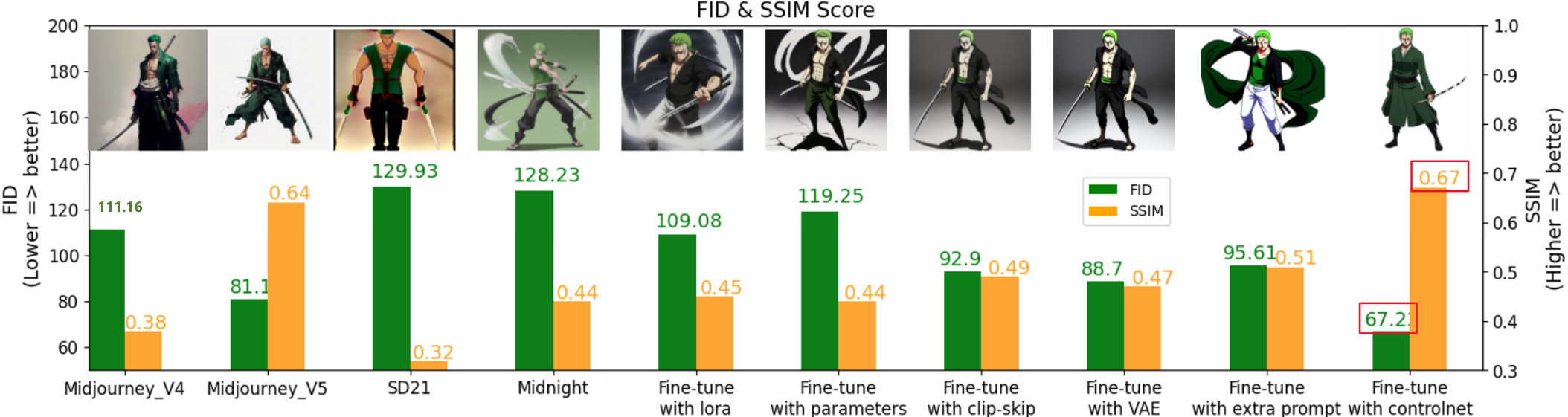
- Evaluated image quality using SSIM and FID metrics by comparing generated outputs against target image batches of Roronoa Zoro.
Experimental results
Research questions
- RQ1Can GPT-4 and GPT-3.5 generate coherent, narrative-rich comic pages with consistent character representation when prompted with specific manga character constraints?
- RQ2Does providing additional character biographical knowledge to the LLM improve the quality and coherence of generated comic stories?
- RQ3Can a fine-tuned Stable Diffusion model using LoRA and ControlNet outperform commercial models like Midjourney V5 in character fidelity and visual consistency?
- RQ4How effective is the proposed story score metric in capturing narrative quality and originality of AI-generated comics?
- RQ5What sequence of fine-tuning steps (LoRA, CFG, sampling steps, ControlNet) yields optimal visual quality in character generation?
Key findings
- GPT-4 with character biography prompts achieved the highest story score (0.62), though the improvement over GPT-3.5 was marginal, and GPT-3.5 without prompts scored 0.60.
- The story score metric effectively captured narrative coherence, with higher scores correlating with human evaluation of story quality and plot relevance.
- Midjourney V5 initially outperformed all base models in SSIM and FID, but after full fine-tuning, the proposed method surpassed Midjourney V5 in both metrics.
- The full fine-tuning pipeline—LoRA, CFG adjustment, sampling step tuning, and ControlNet with Canny pose—resulted in consistent, high-fidelity character generation, with visual quality improving step-by-step.
- The use of BERT-based sentence embeddings for story similarity enabled a computationally efficient and effective story score calculation, validated through human evaluation.
- The final comic generation pipeline successfully produced coherent, visually consistent comic pages with narrative continuity, demonstrating the feasibility of end-to-end AI comic creation.

Read this paper
Open the full text in the Nubint reader and ask about any passage as you read.
Read this paper on NubintThis review was generated by AI from the original paper. Please check the paper before citing it.