
[Paper Review] Generating Faithful Synthetic Data with Large Language Models: A Case Study in Computational Social Science
This study tests prompting strategies—grounding, taxonomy-based generation, and filtering—to make synthetic data from large language models more faithful for sarcasm detection, comparing them to baselines and real data.
Large Language Models (LLMs) have democratized synthetic data generation, which in turn has the potential to simplify and broaden a wide gamut of NLP tasks. Here, we tackle a pervasive problem in synthetic data generation: its generative distribution often differs from the distribution of real-world data researchers care about (in other words, it is unfaithful). In a case study on sarcasm detection, we study three strategies to increase the faithfulness of synthetic data: grounding, filtering, and taxonomy-based generation. We evaluate these strategies using the performance of classifiers trained with generated synthetic data on real-world data. While all three strategies improve the performance of classifiers, we find that grounding works best for the task at hand. As synthetic data generation plays an ever-increasing role in NLP research, we expect this work to be a stepping stone in improving its utility. We conclude this paper with some recommendations on how to generate high(er)-fidelity synthetic data for specific tasks.
Motivation & Objective
- Motivate the need for faithful synthetic data in NLP with LLMs.
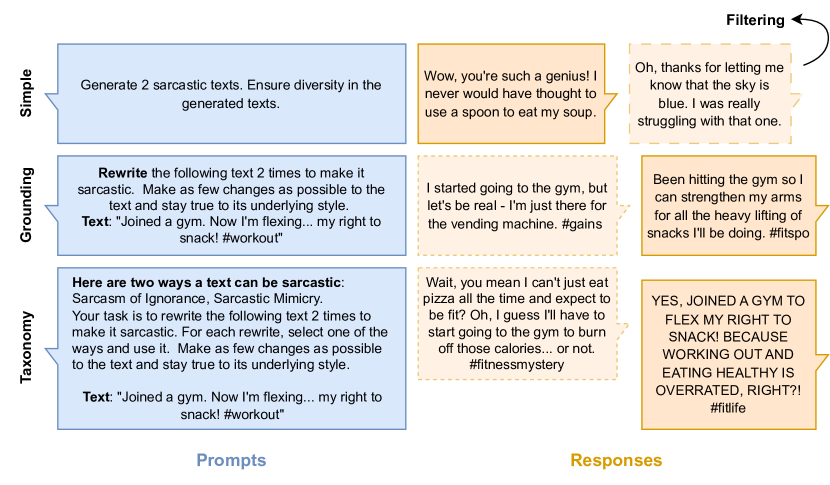
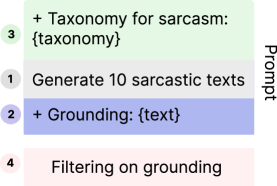
- Propose prompting strategies (grounding, taxonomy-based generation) to increase fidelity of synthetic data.
- Evaluate strategies by training classifiers on synthetic data and testing on real data for sarcasm detection.
- Assess the effectiveness of grounding versus other strategies and provide practical recommendations.
Proposed method
- Use SemEval-2022 Task 6 sarcasm data for training and evaluation.
- Generate synthetic data with ChatGPT under multiple prompting strategies.
- Fine-tune an E5-base model on synthetic data and evaluate on real test set.
- Train a discriminator to filter synthetic data and compare with ground-truth real data.
- Assess believability by testing a synthetic vs. real classifier on generated data.
Experimental results
Research questions
- RQ1Can grounding, taxonomy-based generation, and filtering improve the faithfulness of LLM-generated synthetic data for sarcasm detection?
- RQ2How do these strategies compare to simple prompting and zero-shot ChatGPT in downstream performance?
- RQ3What is the impact of these strategies on classifier macro-F1 and believability when evaluated on real data?
- RQ4Is grounding the most effective strategy for capturing topical diversity and the construct of interest?
Key findings
- Grounding-based prompts achieve the highest macro-F1 among synthetic-data-trained classifiers (0.55).
- Simple prompts perform worst (macro-F1 0.48) due to limited topical and construct diversity.
- Grounding + Taxonomy yields macro-F1 0.51, between grounding alone and simple prompts.
- Grounding + Filtering performs poorly (macro-F1 0.26) likely due to discriminator limitations.
- Zero-shot ChatGPT macro-F1 (0.60) exceeds macro-F1 of models trained on synthetic data from smaller prompts.
- Believability varies by method, with Grounding + Filtering achieving highest believability (0.56), while Groundtruth annotations reach 0.95 and Simple remains low (0.04).
Read this paper
Open the full text in the Nubint reader and ask about any passage as you read.
Read this paper on NubintThis review was generated by AI from the original paper. Please check the paper before citing it.