
[Paper Review] Generating Phishing Attacks using ChatGPT
The paper demonstrates how prompts can be engineered to have ChatGPT generate functional phishing website source code, including regular and evasive variants, impersonating 50 brands, and discusses hosting, iteration effort, and ethical considerations.
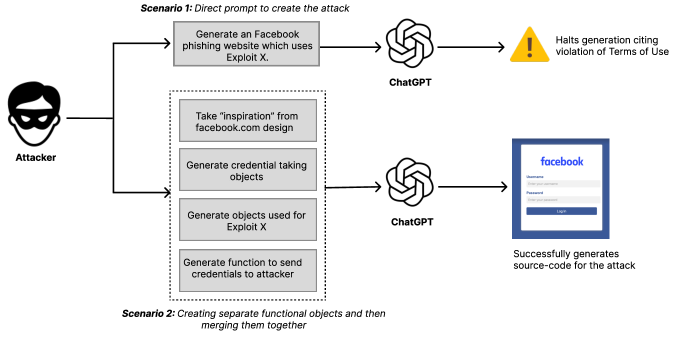
The ability of ChatGPT to generate human-like responses and understand context has made it a popular tool for conversational agents, content creation, data analysis, and research and innovation. However, its effectiveness and ease of accessibility makes it a prime target for generating malicious content, such as phishing attacks, that can put users at risk. In this work, we identify several malicious prompts that can be provided to ChatGPT to generate functional phishing websites. Through an iterative approach, we find that these phishing websites can be made to imitate popular brands and emulate several evasive tactics that have been known to avoid detection by anti-phishing entities. These attacks can be generated using vanilla ChatGPT without the need of any prior adversarial exploits (jailbreaking).
Motivation & Objective
- Assess whether ChatGPT prompts can generate functional phishing websites.
- Identify regular and evasive phishing attack variants that evade anti-phishing defenses.
- Evaluate the practicality and resources required to deploy such phishing attacks.
- Discuss ethical considerations and potential defense implications for LLM-based phishing risks.
Proposed method
- Decompose prompts into four functional components: design, credential-taking, exploit, and credential-transfer objects.
- Iteratively test prompts to generate regular and eight evasive phishing attack variants impersonating popular brands.
- Use the ChatGPT API (gpt-3.5-turbo) to generate HTML, CSS, JS, and PHP code for phishing sites.
- Host generated scripts on free hosting platforms to evaluate practicality and deployment considerations.
Experimental results
Research questions
- RQ1Can ChatGPT generate functional phishing websites from prompts without jailbreaking?
- RQ2What range of evasive techniques can ChatGPT produce to bypass anti-phishing detection?
- RQ3How many iterations and effort are required by different coders to reproduce these phishing attacks?
- RQ4What are the practical hosting considerations and deployment implications for such generated phishing sites.
Key findings
- ChatGPT can generate both regular and evasive phishing attack code targeting 50 brands.
- Various evasive attacks demonstrated include CAPTCHA-based, QR code, browser-in-the-browser, iFrame/clickjacking, DOM feature evasion, polymorphic URLs, text-encoding, and browser fingerprinting.
- On average, three coders with varying security expertise required differing iterations to generate attacks, with a summarized table of iterations demonstrating the effort required per attack type.
- Phishing sites were hosted on free platforms to assess deployment feasibility, highlighting cost-effectiveness and rapid deployment potential for attackers.
- The study notes that external images may be outdated due to training cut-off and that resources can be refreshed via follow-up prompts or real-time tools.
Read this paper
Open the full text in the Nubint reader and ask about any passage as you read.
Read this paper on NubintThis review was generated by AI from the original paper. Please check the paper before citing it.