
[论文解读] Generation, augmentation, and alignment: A pseudo-source domain based method for source-free domain adaptation
本文提出一种无源域自适应方法,通过从接近源模型原型的目标样本中生成伪源域,利用mixup进行数据增强,并应用四种新型损失函数(包括领域对抗损失)实现显式分布对齐。该方法在Digits和VisDA基准上实现了最先进性能,无需访问原始源数据即可有效减少域偏移。
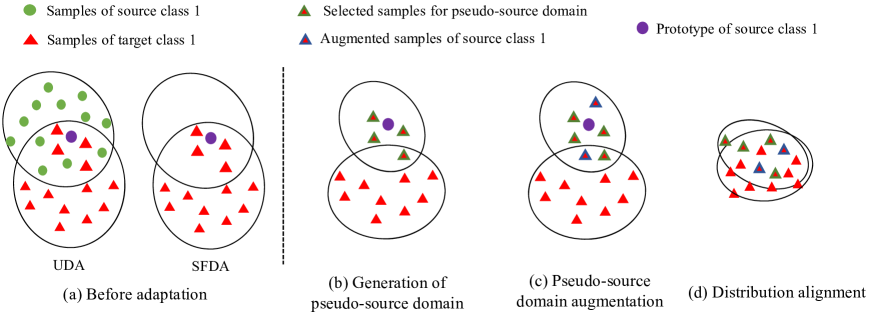
Conventional unsupervised domain adaptation (UDA) methods need to access both labeled source samples and unlabeled target samples simultaneously to train the model. While in some scenarios, the source samples are not available for the target domain due to data privacy and safety. To overcome this challenge, recently, source-free domain adaptation (SFDA) has attracted the attention of researchers, where both a trained source model and unlabeled target samples are given. Existing SFDA methods either adopt a pseudo-label based strategy or generate more samples. However, these methods do not explicitly reduce the distribution shift across domains, which is the key to a good adaptation. Although there are no source samples available, fortunately, we find that some target samples are very similar to the source domain and can be used to approximate the source domain. This approximated domain is denoted as the pseudo-source domain. In this paper, inspired by this observation, we propose a novel method based on the pseudo-source domain. The proposed method firstly generates and augments the pseudo-source domain, and then employs distribution alignment with four novel losses based on pseudo-label based strategy. Among them, a domain adversarial loss is introduced between the pseudo-source domain the remaining target domain to reduce the distribution shift. The results on three real-world datasets verify the effectiveness of the proposed method.
研究动机与目标
- 为解决现有无源域自适应(SFDA)方法未显式减少源域与目标域之间域偏移的局限性。
- 利用与源域相似的目标样本近似源分布,构建伪源域。
- 通过生成和增强伪源域并应用多损失分布对齐,提升SFDA性能。
- 通过对抗训练显式减少伪源域与剩余目标域之间的分布差异。
提出的方法
- 该方法识别出接近源模型原型的目标样本作为伪源样本,从而构建伪源域。
- 通过mixup数据增强技术生成并增强伪源域,以提升其多样性与代表性。
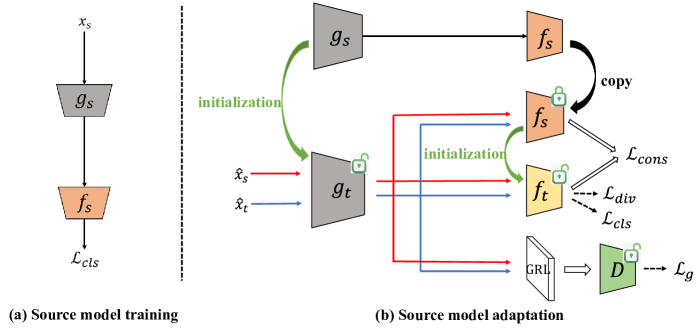
- 在分布对齐过程中应用四种新型损失:分类损失、多样性损失、一致性损失以及领域对抗损失。
- 领域对抗损失专门设计用于最小化伪源域与剩余目标域之间的分布差异。
- 模型采用伪标签进行自训练,实现在无源数据访问条件下从源模型进行知识蒸馏。
- 该方法端到端可训练,仅依赖已训练的源模型和无标签目标数据。
实验结果
研究问题
- RQ1在无真实源数据的情况下,能否有效利用与源域相似的目标样本重建伪源域?
- RQ2在无源设置下,通过mixup增强伪源域是否能提升域自适应性能?
- RQ3显式对齐伪源域与剩余目标域的分布是否能减少域偏移并提升泛化能力?
- RQ4与现有SFDA方法相比,该方法在域差异和分类准确率方面表现如何?
主要发现
- 所提方法在Digits数据集(M→U)上达到98.6%的准确率,在VisDA数据集(P→G)上达到84.1%,优于最先进SFDA方法。
- 消融实验表明,mixup增强可提升性能,完整损失组合配置取得最佳结果。
- 领域对抗损失显著降低A-距离,从79.3(仅源模型)降至84.1(本文方法),表明域偏移减少。
- 该方法对批量大小具有鲁棒性,在伪源域比例α=0.1时达到最优性能,兼顾样本质量与数量。
- t-SNE可视化结果表明,分布对齐有效减少域偏移,使伪源域与目标域特征更具可分性。
- 模型性能优于SHOT及其他SFDA基线方法,尤其在减少域差异方面表现更优,A-距离与准确率指标验证了该结论。
更好的研究,从现在开始
从阅读论文到最终审阅,大幅缩短您的研究时间。
无需绑定信用卡
本解读由 AI 生成,并经人工编辑审核。