
[Paper Review] Generation of scalable many-body Bell correlations in spin chains with short-range two-body interactions
This paper demonstrates that scalable many-body Bell correlations can be dynamically generated in spin-1/2 chains using only short-range two-body interactions, bypassing the need for all-to-all or long-range couplings. The authors identify a critical interaction range (r ≥ 4) and a critical time τc where Bell inequality violation emerges, showing that such quantum resources are accessible in current quantum simulators.
Dynamical generation of strong and scalable quantum resources, like many-body entanglement and Bell correlations, in spin-$1/2$ chains, is possible with all-to-all interactions, either for constant interaction strength realizing one-axis twisting protocol or for power-law decaying potentials. We show, however, that such quantum resources can also be dynamically generated with a finite range of interactions. We identify a necessary critical range and indicate a critical time when scalable quantum correlations appear. Finally, we show that the certification of generated states is accessible in the modern quantum simulator platforms.
Motivation & Objective
- To demonstrate that scalable many-body Bell correlations can be generated in spin-1/2 chains without long-range or all-to-all interactions.
- To identify the minimal interaction range r required for dynamic generation of Bell correlations, independent of system size N.
- To determine the critical time τc at which Bell inequality violation occurs in the system.
- To show that the generated states can be certified using current experimental techniques in quantum simulators.
- To establish a connection between the dynamics of spin inversion and the emergence of nonlocal correlations via multiple quantum coherences.
Proposed method
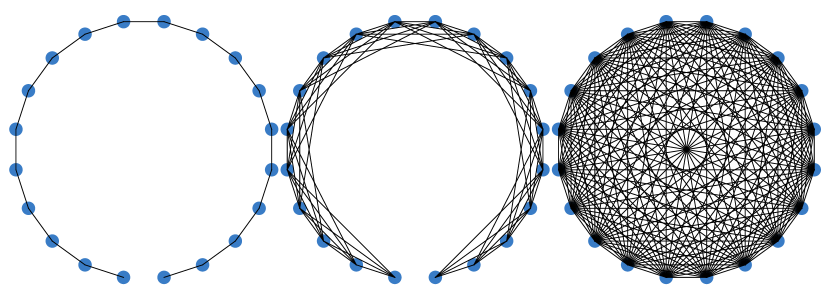
- Uses a one-dimensional spin-1/2 chain with an Ising-type Hamiltonian H = ∑_{k,l} J_{kl} σ_z^{(k)}σ_z^{(l)} with finite-range coupling J_{kl} = 1 for 0 < |k−l| ≤ r.
- Initial state is prepared as a product state polarized along the x-axis, orthogonal to the z-axis defined by the Hamiltonian.
- Time evolution is governed by Û(τ) = exp(−iτĤ), and the state is evolved to analyze population dynamics.
- Employs a perturbative expansion in the interaction strength to compute the coefficients |C₊(τ)|² and |C₋(τ)|², representing the initial and fully inverted spin states.
- Derives an approximate expression for the Bell correlator E_N ≈ P_r² R_r² exp(−β_N τ²) τ^{N+6}, with β_N = 2K − N/2.
- Uses the multiple quantum coherence (MQC) technique with  = (1/2)∑_k σ_x^{(k)} and m = N/2 to measure E_N = I_N(ϱ), directly accessible in experiments.
Experimental results
Research questions
- RQ1Can scalable many-body Bell correlations be generated in spin chains with only short-range two-body interactions?
- RQ2What is the minimal interaction range r required to achieve Bell inequality violation, independent of system size N?
- RQ3At what critical time τc does the Bell inequality violation emerge in the dynamics?
- RQ4Can the dynamically generated Bell-correlated states be certified using current experimental quantum simulation platforms?
- RQ5How does the competition between spin-pair inversion rate and the τ^N suppression factor affect the emergence of nonlocality?
Key findings
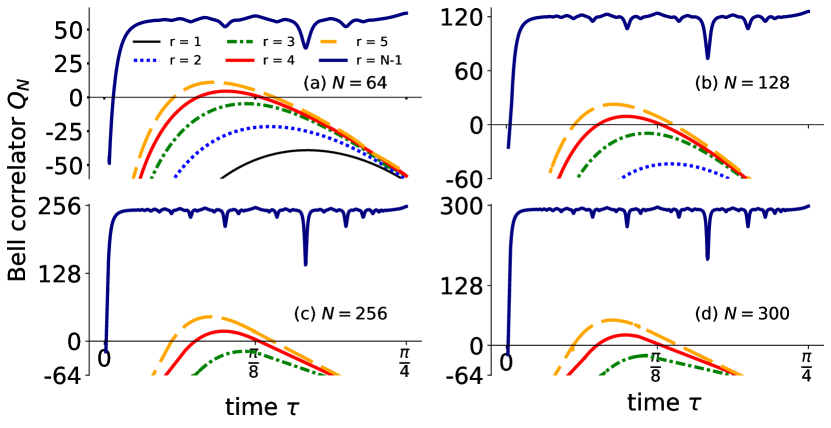
- Bell inequality violation is achieved only for interaction range r ≥ 4, as r ≤ 3 results in negative log-maximum of the scaled correlator, making τc non-physical.
- The critical time τc is derived as τc ≈ τ_max − √(Ẽ_max / (2β_N)), where τ_max is the time of maximum population in the inverted state.
- For r ≥ 4, Ẽ_max ≥ 0, ensuring a physically meaningful τc, with τc decreasing as r increases due to enhanced spin-pair inversion rate.
- The population in the fully inverted state |C₋(τ)|² grows with r due to increased number of contributing Feynman diagrams, enabling faster violation of the Bell limit.
- The multiple quantum coherence (MQC) technique with m = N/2 allows direct experimental measurement of the Bell correlator E_N, making certification feasible in current platforms.
- The analytical approximation E_N ≈ P_r² R_r² exp(−β_N τ²) τ^{N+6} accurately captures the numerical behavior of the system, especially for r ≥ 4.
Read this paper
Open the full text in the Nubint reader and ask about any passage as you read.
Read this paper on NubintThis review was generated by AI from the original paper. Please check the paper before citing it.