
[Paper Review] Generative agent-based modeling with actions grounded in physical, social, or digital space using Concordia
The paper introduces Concordia, a library for building Generative Agent-Based Models (GABMs) where agents act via natural language and a Game Master simulates the environment, enabling grounding in physical, social, or digital spaces and integration with external APIs.
Agent-based modeling has been around for decades, and applied widely across the social and natural sciences. The scope of this research method is now poised to grow dramatically as it absorbs the new affordances provided by Large Language Models (LLM)s. Generative Agent-Based Models (GABM) are not just classic Agent-Based Models (ABM)s where the agents talk to one another. Rather, GABMs are constructed using an LLM to apply common sense to situations, act "reasonably", recall common semantic knowledge, produce API calls to control digital technologies like apps, and communicate both within the simulation and to researchers viewing it from the outside. Here we present Concordia, a library to facilitate constructing and working with GABMs. Concordia makes it easy to construct language-mediated simulations of physically- or digitally-grounded environments. Concordia agents produce their behavior using a flexible component system which mediates between two fundamental operations: LLM calls and associative memory retrieval. A special agent called the Game Master (GM), which was inspired by tabletop role-playing games, is responsible for simulating the environment where the agents interact. Agents take actions by describing what they want to do in natural language. The GM then translates their actions into appropriate implementations. In a simulated physical world, the GM checks the physical plausibility of agent actions and describes their effects. In digital environments simulating technologies such as apps and services, the GM may handle API calls to integrate with external tools such as general AI assistants (e.g., Bard, ChatGPT), and digital apps (e.g., Calendar, Email, Search, etc.). Concordia was designed to support a wide array of applications both in scientific research and for evaluating performance of real digital services by simulating users and/or generating synthetic data.
Motivation & Objective
- Introduce Concordia as a flexible library to construct generative agent-based models (GABMs).
- Describe the modular architecture that mediates between LLM-based action generation and environment grounding.
- Show how environments (Game Master) and agents interact via natural language actions and event-grounded variables.
- Discuss validation, interpretation, and broad applications for science and digital service evaluation.
- Outline best practices and future directions for evaluating generalization and validity of GABMs.
Proposed method
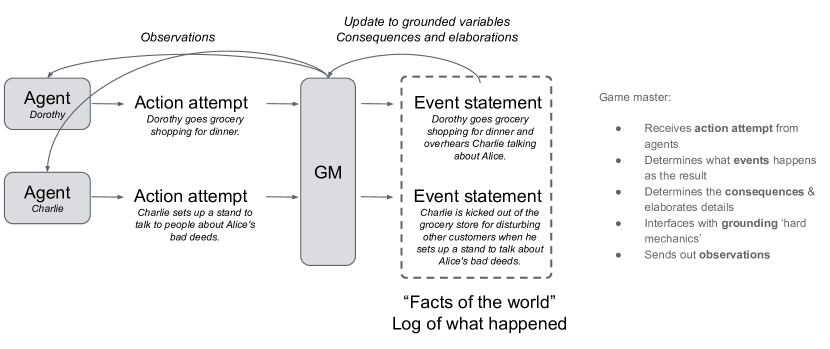
- Agents generate actions in natural language which are grounded by a Game Master (GM).
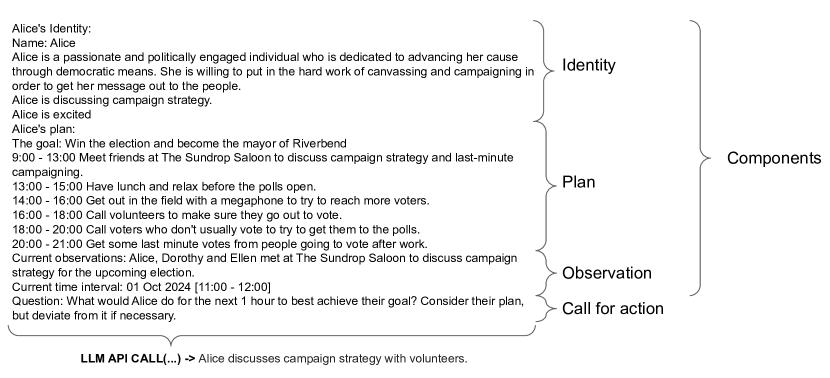
- Actions are produced from a two-step process: (1) context formation from working memories/components, (2) sampling actions conditioned on long-term memory and current state.
- GM translates actions into environment events and emits observations, while maintaining grounded variables and world state.
- Environment and agents are both generative, allowing integration with physical, digital, or financial process models via components (ODEs, FSMs, etc.).
- Digital environments can interface with external apps and services through API calls or mocked representations.
- The memory architecture uses associative memory and component-based context akin to a “society of mind” to condition LLM prompts.
Experimental results
Research questions
- RQ1How can a generative agent-based model realistically ground actions in physical, social, or digital spaces using natural language and LLMs?
- RQ2What architectural components (memory, plans, perception, grounding variables) enable coherent agent behavior and robust environment interaction?
- RQ3How can a Game Master effectively simulate environments and manage grounded variables across agents and actions?
- RQ4What best practices and validation strategies support generalization of GABMs to real-world contexts?
Key findings
- Concordia enables flexible construction of GABMs with natural-language actions and environment-grounded outcomes.
- Agents use modular components and associative memory to condition LLM prompts, producing coherent behavior.
- The GM manages world state, grounded variables, events, and observations, enabling diverse simulations from elections to digital-app interactions.
- Digital environments allow integration with real apps and services via APIs, supporting synthetic data generation and service evaluation.
- The framework discusses validation strategies, including generalization, algorithmic fidelity, model comparison, robustness, and epistemic norms for GABMs.
Better researchstarts right now
From reading papers to final review, dramatically reduce your research time.
No credit card · Free plan available
This review was created by AI and reviewed by human editors.