
[Paper Review] Generative AI-driven Semantic Communication Framework for NextG Wireless Network
This paper proposes a generative AI-driven semantic communication framework for next-generation wireless networks that reduces data transmission by 93.45% through domain-specific semantic extraction using a lightweight Mobile Segment Anything Model (MSAM) and GAN-based reconstruction. The system transmits only meaningful semantic features and background context, enabling high-quality image reconstruction under varying SNR conditions while maintaining low latency and bandwidth efficiency for applications like intelligent transportation systems (ITS).
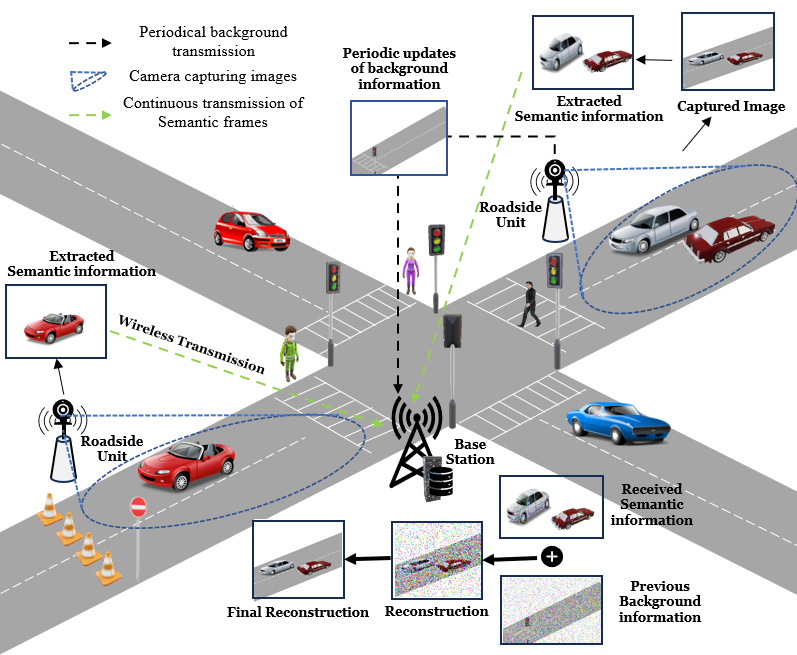
This work designs a novel semantic communication (SemCom) framework for the next-generation wireless network to tackle the challenges of unnecessary transmission of vast amounts that cause high bandwidth consumption, more latency, and experience with bad quality of services (QoS). In particular, these challenges hinder applications like intelligent transportation systems (ITS), metaverse, mixed reality, and the Internet of Everything, where real-time and efficient data transmission is paramount. Therefore, to reduce communication overhead and maintain the QoS of emerging applications such as metaverse, ITS, and digital twin creation, this work proposes a novel semantic communication framework. First, an intelligent semantic transmitter is designed to capture the meaningful information (e.g., the rode-side image in ITS) by designing a domain-specific Mobile Segment Anything Model (MSAM)-based mechanism to reduce the potential communication traffic while QoS remains intact. Second, the concept of generative AI is introduced for building the SemCom to reconstruct and denoise the received semantic data frame at the receiver end. In particular, the Generative Adversarial Network (GAN) mechanism is designed to maintain a superior quality reconstruction under different signal-to-noise (SNR) channel conditions. Finally, we have tested and evaluated the proposed semantic communication (SemCom) framework with the real-world 6G scenario of ITS; in particular, the base station equipped with an RGB camera and a mmWave phased array. Experimental results demonstrate the efficacy of the proposed SemCom framework by achieving high-quality reconstruction across various SNR channel conditions, resulting in 93.45% data reduction in communication.
Motivation & Objective
- Address the high bandwidth consumption and latency in next-generation wireless networks caused by massive transmission of raw video and image data from edge devices.
- Overcome limitations of existing semantic communication methods that rely on complex segmentation, expert labeling, or high-parameter models unsuitable for edge deployment.
- Enable accurate identification of dynamic objects (e.g., vehicles, pedestrians) in ITS while preserving static background context for efficient transmission.
- Ensure robust image reconstruction and denoising under varying signal-to-noise ratio (SNR) conditions using generative AI.
- Design a lightweight, efficient, and scalable semantic communication architecture suitable for real-time applications like metaverse, digital twins, and autonomous driving.
Proposed method
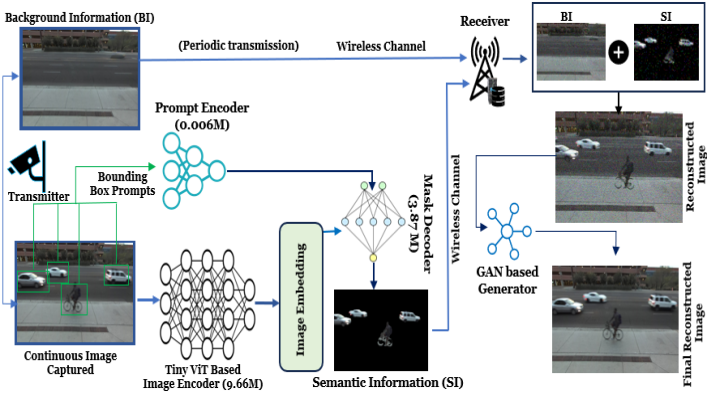
- Design a domain-specific lightweight Mobile Segment Anything Model (MSAM) to extract region-of-interest (ROI) features from surveillance images at the transmitter, reducing transmission overhead.
- Transmit only the semantic embeddings of dynamic objects and periodically send background context, minimizing redundant data transmission.
- Implement a pix-to-pix Generative Adversarial Network (GAN) at the receiver to reconstruct and denoise the received semantic data, leveraging both semantic embeddings and background context.
- Train the GAN using a combined dataset across multiple SNR levels (0 dB, 5 dB, 10 dB) to improve robustness and generalization across diverse channel conditions.
- Use a zero-shot learning capability of MSAM and open-set object detection via the GD model to enable semantic extraction across diverse, unseen datasets.
- Integrate the GAN-based reconstruction with a multi-scale loss function to preserve structural and perceptual quality of reconstructed images.
Experimental results
Research questions
- RQ1How can a lightweight semantic transmitter be designed to extract task-relevant information from surveillance images in ITS while minimizing computational and communication overhead?
- RQ2To what extent can generative AI, specifically GANs, improve image reconstruction quality and noise resilience in semantic communication under varying SNR conditions?
- RQ3Can a combined training strategy across multiple SNR levels enhance the robustness and generalization of the GAN-based reconstruction model?
- RQ4How effective is the proposed framework in reducing data transmission while preserving the semantic fidelity of critical objects such as vehicles and pedestrians?
- RQ5Can the framework maintain high-quality reconstruction and low latency in real-world 6G mmWave and THz-based ITS scenarios?
Key findings
- The proposed framework achieves a 93.45% reduction in data transmission compared to conventional JPEG-compressed images, significantly lowering bandwidth consumption.
- The GAN-based reconstruction model trained on a combined SNR set (0 dB, 5 dB, 10 dB) outperforms models trained on individual SNR levels, demonstrating improved robustness and generalization.
- The PSNR of reconstructed images reaches 36.54 dB when trained and tested at 0 dB SNR, with consistently high performance across all SNR levels when using the combined training approach.
- The MS-SSIM and VIF scores confirm that the GAN-based reconstruction preserves structural and visual fidelity, even under noisy conditions.
- The reconstructed images show minimal perceptual degradation, with clear identification of vehicles, pedestrians, and traffic signs, validating semantic accuracy.
- The system maintains low latency and high efficiency, making it suitable for real-time applications such as ITS, metaverse, and digital twin creation.
Read this paper
Open the full text in the Nubint reader and ask about any passage as you read.
Read this paper on NubintThis review was generated by AI from the original paper. Please check the paper before citing it.