
[Paper Review] Generative AI-empowered Effective Physical-Virtual Synchronization in the Vehicular Metaverse
This paper proposes a generative AI-empowered framework for real-time physical-virtual synchronization in the vehicular Metaverse, leveraging digital twins for future route prediction and generative AI (e.g., TSDreamBooth) to customize personalized AR recommendations. The multi-task enhanced auction-based mechanism ensures strategy-proofness and adverse-selection freedom while increasing social surplus by 50%.
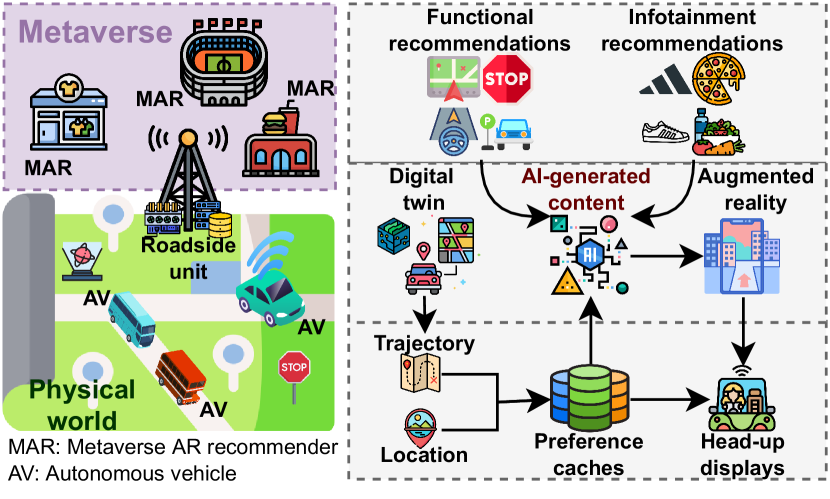
Metaverse seamlessly blends the physical world and virtual space via ubiquitous communication and computing infrastructure. In transportation systems, the vehicular Metaverse can provide a fully-immersive and hyperreal traveling experience (e.g., via augmented reality head-up displays, AR-HUDs) to drivers and users in autonomous vehicles (AVs) via roadside units (RSUs). However, provisioning real-time and immersive services necessitates effective physical-virtual synchronization between physical and virtual entities, i.e., AVs and Metaverse AR recommenders (MARs). In this paper, we propose a generative AI-empowered physical-virtual synchronization framework for the vehicular Metaverse. In physical-to-virtual synchronization, digital twin (DT) tasks generated by AVs are offloaded for execution in RSU with future route generation. In virtual-to-physical synchronization, MARs customize diverse and personal AR recommendations via generative AI models based on user preferences. Furthermore, we propose a multi-task enhanced auction-based mechanism to match and price AVs and MARs for RSUs to provision real-time and effective services. Finally, property analysis and experimental results demonstrate that the proposed mechanism is strategy-proof and adverse-selection free while increasing social surplus by 50%.
Motivation & Objective
- Address the challenge of real-time, high-accuracy physical-virtual synchronization in the vehicular Metaverse for immersive AR experiences.
- Overcome limitations in AV local computation and scarcity of high-quality AR content by offloading DT tasks and leveraging generative AI for content creation.
- Design an incentive mechanism that aligns the interests of AVs, MARs, and RSUs while ensuring fairness and efficiency in task allocation and pricing.
- Enable scalable, personalized AR recommendations through fine-tuned generative models (e.g., TSDreamBooth) trained on traffic sign datasets.
- Ensure the synchronization mechanism is strategy-proof and adverse-selection free to support robust deployment in dynamic vehicular environments.
Proposed method
- Offload AV-generated digital twin (DT) tasks to roadside units (RSUs) for execution, enabling real-time synchronization and future route prediction using historical and current AV data.
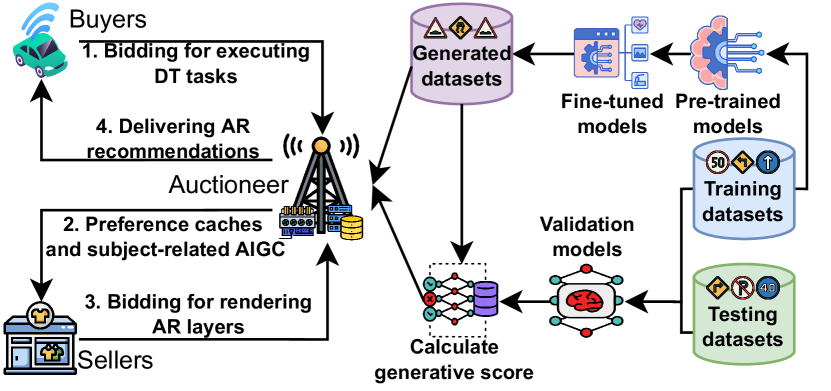
- Utilize generative AI models—specifically TSDreamBooth, a fine-tuned DreamBooth variant—on the BelgiumTS dataset to generate diverse, context-aware AR content for traffic signs.
- Implement a multi-task enhanced auction-based mechanism (MTEPViSA) that matches AVs and MARs based on multi-dimensional requirements, including deadlines and valuation.
- Apply a cost-per-time model for AR rendering and an efficient AIGC-empowered scoring rule to ensure truthful bidding and prevent adverse selection.
- Integrate RSU-level intelligence to refine user preferences, current location, and predicted routes to improve synchronization accuracy and service personalization.
- Leverage stable diffusion and fine-tuning techniques to generate high-fidelity AR content that matches user preferences and environmental context.
Experimental results
Research questions
- RQ1How can generative AI be effectively leveraged to create scalable, personalized AR recommendations for vehicles in the Metaverse?
- RQ2What mechanisms ensure real-time, accurate physical-to-virtual and virtual-to-physical synchronization in a dynamic vehicular environment?
- RQ3How can an auction-based mechanism be designed to fairly and efficiently match AVs and MARs while maintaining strategy-proofness and adverse-selection freedom?
- RQ4To what extent does the proposed framework improve social surplus compared to existing mechanisms?
- RQ5Can generative models like TSDreamBooth produce high-quality, contextually relevant AR content for transportation-related virtual objects?
Key findings
- The proposed MTEPViSA mechanism increases social surplus by approximately 50% compared to baseline mechanisms such as PViSA and EPViSA.
- The generative AI model TSDreamBooth achieves a validation accuracy of around 50% on generated images from the BelgiumTS dataset, indicating moderate but usable performance for real-world application.
- The mechanism is proven to be strategy-proof and adverse-selection free, ensuring truthful bidding and robust incentive compatibility.
- Performance evaluation shows that the proposed mechanism outperforms PViSA in both total and DT-specific revenue, especially under high task loads.
- The integration of future route prediction via RSU-processed DT data improves the accuracy and relevance of location-based AR services.
- The use of a cost-per-time model for AR rendering, combined with AIGC-empowered scoring, enables efficient and fair allocation of resources in the synchronization framework.
Read this paper
Open the full text in the Nubint reader and ask about any passage as you read.
Read this paper on NubintThis review was generated by AI from the original paper. Please check the paper before citing it.