
[Paper Review] Generative AI for Synthetic Data Generation: Methods, Challenges and the Future
The paper surveys how gigantic, fixed LLMs can generate task-specific synthetic data, reviews prompting and adaptation methods, evaluates data quality, and discusses applications and challenges with future directions.
The recent surge in research focused on generating synthetic data from large language models (LLMs), especially for scenarios with limited data availability, marks a notable shift in Generative Artificial Intelligence (AI). Their ability to perform comparably to real-world data positions this approach as a compelling solution to low-resource challenges. This paper delves into advanced technologies that leverage these gigantic LLMs for the generation of task-specific training data. We outline methodologies, evaluation techniques, and practical applications, discuss the current limitations, and suggest potential pathways for future research.
Motivation & Objective
- Motivate synthetic data generation to address data scarcity and privacy in specialized domains.
- Examine how gigantic fixed LLMs can generate task-specific training data without retraining the models.
- Summarize data-generation methodologies, quality evaluation, and downstream training strategies.
- Discuss practical applications and outline future research directions and open challenges.
Proposed method
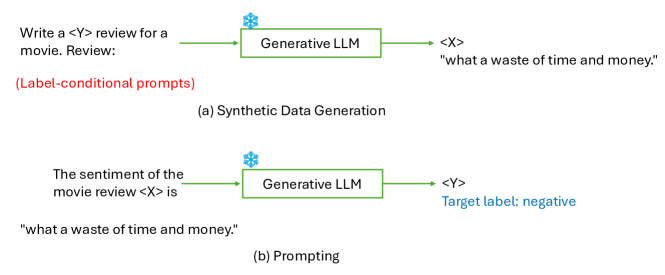
- Explain prompt engineering techniques for task-conditioned data generation, including attribute-controlled prompts and verbalizers.
- Discuss parameter-efficient task adaptation methods (e.g., adapters, prefix/prompt tuning, LoRA) to tailor LLMs for data generation.
- Describe data-quality measurement approaches (diversity, correctness, naturalness) and quality-estimation pipelines.
- Outline training strategies to use synthetic data effectively, including regularization and sample-weighting schemes.
- Provide a taxonomy of data-generation methods and summarize representative systems and benchmarks in NLP.
Experimental results
Research questions
- RQ1What are the main methods to generate task-specific synthetic data from LLMs without retraining them?
- RQ2How can the quality of synthetic data be measured and ensured for downstream training?
- RQ3What are the practical applications and deployment considerations of synthetic data in low-resource or sensitive domains?
- RQ4What challenges and future directions shape the use of synthetic data from generative LLMs?
Key findings
- Several data-generation methods have emerged (e.g., ZeroGen, ProGen, MSP, FewGen) that produce labeled or unlabeled synthetic data for NLP tasks.
- Quality of synthetic data is evaluated along diversity, correctness, and naturalness, with automatic and human evaluation used for correctness.
- Prompt engineering and attribute-controlled prompts improve relevance and diversity of generated data.
- Parameter-efficient adaptation enables task-specific data generation without full model fine-tuning.
- Synthetic data shows promise for low-resource and fast-inference scenarios, including medical and education domains, but faces challenges like hallucination and privacy concerns.
Read this paper
Open the full text in the Nubint reader and ask about any passage as you read.
Read this paper on NubintThis review was generated by AI from the original paper. Please check the paper before citing it.