
[Paper Review] Generative AI for Visualization: State of the Art and Future Directions
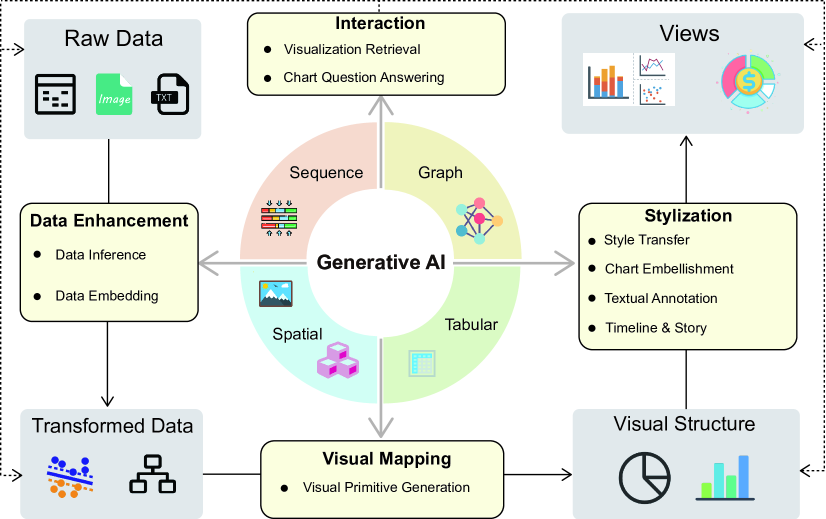
This paper provides a comprehensive survey of generative AI (GenAI) applications in visualization, categorizing GenAI techniques—such as sequence, tabular, spatial, and graph generation—across four stages: data enhancement, visual mapping generation, stylization, and interaction. It identifies key challenges in evaluation, dataset curation, and pipeline integration, and proposes future research directions to bridge the gap between end-to-end GenAI and traditional visualization workflows.
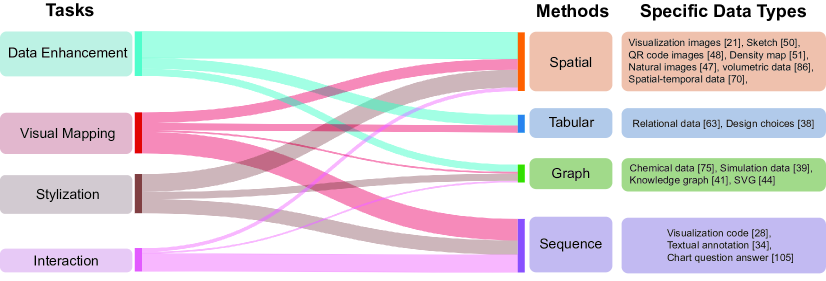
Generative AI (GenAI) has witnessed remarkable progress in recent years and demonstrated impressive performance in various generation tasks in different domains such as computer vision and computational design. Many researchers have attempted to integrate GenAI into visualization framework, leveraging the superior generative capacity for different operations. Concurrently, recent major breakthroughs in GenAI like diffusion model and large language model have also drastically increase the potential of GenAI4VIS. From a technical perspective, this paper looks back on previous visualization studies leveraging GenAI and discusses the challenges and opportunities for future research. Specifically, we cover the applications of different types of GenAI methods including sequence, tabular, spatial and graph generation techniques for different tasks of visualization which we summarize into four major stages: data enhancement, visual mapping generation, stylization and interaction. For each specific visualization sub-task, we illustrate the typical data and concrete GenAI algorithms, aiming to provide in-depth understanding of the state-of-the-art GenAI4VIS techniques and their limitations. Furthermore, based on the survey, we discuss three major aspects of challenges and research opportunities including evaluation, dataset, and the gap between end-to-end GenAI and generative algorithms. By summarizing different generation algorithms, their current applications and limitations, this paper endeavors to provide useful insights for future GenAI4VIS research.
Motivation & Objective
- To systematically review and categorize the application of generative AI (GenAI) in visualization across different data types and visualization stages.
- To identify technical and methodological challenges in applying GenAI to visualization, including evaluation complexity, dataset scarcity, and pipeline integration issues.
- To analyze the limitations of current GenAI4VIS approaches, particularly the disconnect between rule-based visualization pipelines and end-to-end generative models.
- To explore opportunities for improving GenAI4VIS through hybrid modeling, knowledge distillation, and interactive control mechanisms.
- To provide a research roadmap for integrating GenAI more effectively into visualization workflows by leveraging advances in multi-modal models and controllable generation.
Proposed method
- Categorizes GenAI methods by data structure: sequence, tabular, spatial, and graph generation, mapping them to visualization stages.
- Reviews 81 research papers on GenAI for visualization (GenAI4VIS), analyzing techniques across data enhancement, visual mapping, stylization, and interaction.
- Examines specific GenAI models such as diffusion models (e.g., Stable Diffusion), large language models (e.g., GPT, LLaMA), and 3D generation models (e.g., DreamFusion).
- Proposes a framework for integrating GenAI into visualization pipelines by combining end-to-end learning with intermediate control mechanisms.
- Draws inspiration from control-based GenAI methods like ControlNet and LayoutDiffusion to enable structural consistency in generated visualizations.
- Suggests using real-world rendered visualization images with text annotations as training data to bypass explicit chart element extraction.
Experimental results
Research questions
- RQ1How have different types of generative AI—sequence, tabular, spatial, and graph models—been applied to various stages of the visualization pipeline?
- RQ2What are the key challenges in evaluating GenAI-generated visualizations beyond image similarity, particularly concerning data integrity and efficiency?
- RQ3Why is the integration of end-to-end GenAI with traditional rule-based visualization pipelines inherently difficult, and how can this gap be bridged?
- RQ4How can GenAI models be adapted to preserve structural accuracy and semantic fidelity in visualization generation, especially when using image-based diffusion models?
- RQ5What research opportunities exist in combining the strengths of GenAI and visualization through knowledge distillation, interactive control, and multi-modal learning?
Key findings
- GenAI has been successfully applied to all four stages of visualization: data enhancement, visual mapping generation, stylization, and interaction, using diverse generation techniques.
- Despite progress, evaluation of GenAI4VIS remains complex due to factors beyond visual similarity, including data fidelity, efficiency, and interpretability.
- Existing GenAI4VIS pipelines often separate structural generation from stylization (e.g., LIDA), leading to loss of data-structure alignment in the final output.
- The gap between rule-based visualization systems and end-to-end GenAI models limits full exploitation of GenAI’s potential, highlighting a need for integrated, learnable pipelines.
- Recent advances in multi-modal models (e.g., vision-language models) enable direct training on real rendered visualizations with text prompts, bypassing manual chart element extraction.
- Future integration of GenAI and visualization can be enhanced through techniques like knowledge distillation and control-based generation (e.g., ControlNet), enabling both performance and controllability.
Read this paper
Open the full text in the Nubint reader and ask about any passage as you read.
Read this paper on NubintThis review was generated by AI from the original paper. Please check the paper before citing it.