
[Paper Review] Generative AI in Agriculture: Creating Image Datasets Using DALL.E's Advanced Large Language Model Capabilities
This study demonstrates that DALL·E 2, a generative AI model based on GANs and large language models, can create high-fidelity synthetic agricultural images from text prompts, significantly reducing the need for costly and time-consuming real-world data collection. The generated images achieve strong performance on standard metrics (MSE, PSNR, FSIM), enabling applications in crop-weed differentiation, disease detection, and precision agriculture without extensive field imaging.
The field of agricultural communication is evolving rapidly with the advent of generative artificial intelligence (AI), particularly image generation technologies. As these tools begin to influence how agricultural data is visualized and disseminated, the sector's diversity spanning both technical and non-technical researchers, demands a rigorous foundational study to demystify the image generation process. This research investigated the role of artificial intelligence (AI), specifically the DALL.E model by OpenAI, in advancing data generation and visualization techniques in agriculture. DALL.E, an advanced AI image generator, works alongside ChatGPT's language processing to transform text descriptions and image clues into realistic visual representations of the content. The study used both approaches of image generation: text-to-image and image-to-image (variation). Six types of datasets depicting fruit crop environment were generated. These AI-generated images were then compared against ground truth images captured by sensors in real agricultural fields. The comparison was based on Peak Signal-to-Noise Ratio (PSNR) and Feature Similarity Index (FSIM) metrics. The image-to-image generation exhibited a 5.78% increase in average PSNR over text-to-image methods, signifying superior image clarity and quality. However, this method also resulted in a 10.23% decrease in average FSIM, indicating a diminished structural and textural similarity to the original images. Similar to these measures, human evaluation also showed that images generated using image-to-image-based method were more realistic compared to those generated with text-to-image approach. The results highlighted DALL.E's potential in generating realistic agricultural image datasets and thus accelerating the development and adoption of imaging-based precision agricultural solutions.
Motivation & Objective
- To explore the feasibility of using DALL·E 2 for generating synthetic agricultural images to reduce reliance on real-world image collection.
- To evaluate the visual fidelity and accuracy of AI-generated agricultural images against real images using standard image quality metrics.
- To demonstrate the potential of AI-generated images in key agricultural applications such as crop-weed differentiation and disease identification.
- To propose a scalable, low-cost alternative to traditional data collection in agricultural AI research using text-to-image generation.
- To guide future integration of generative AI into precision agriculture systems through dataset expansion, feedback loops, and advanced evaluation.
Proposed method
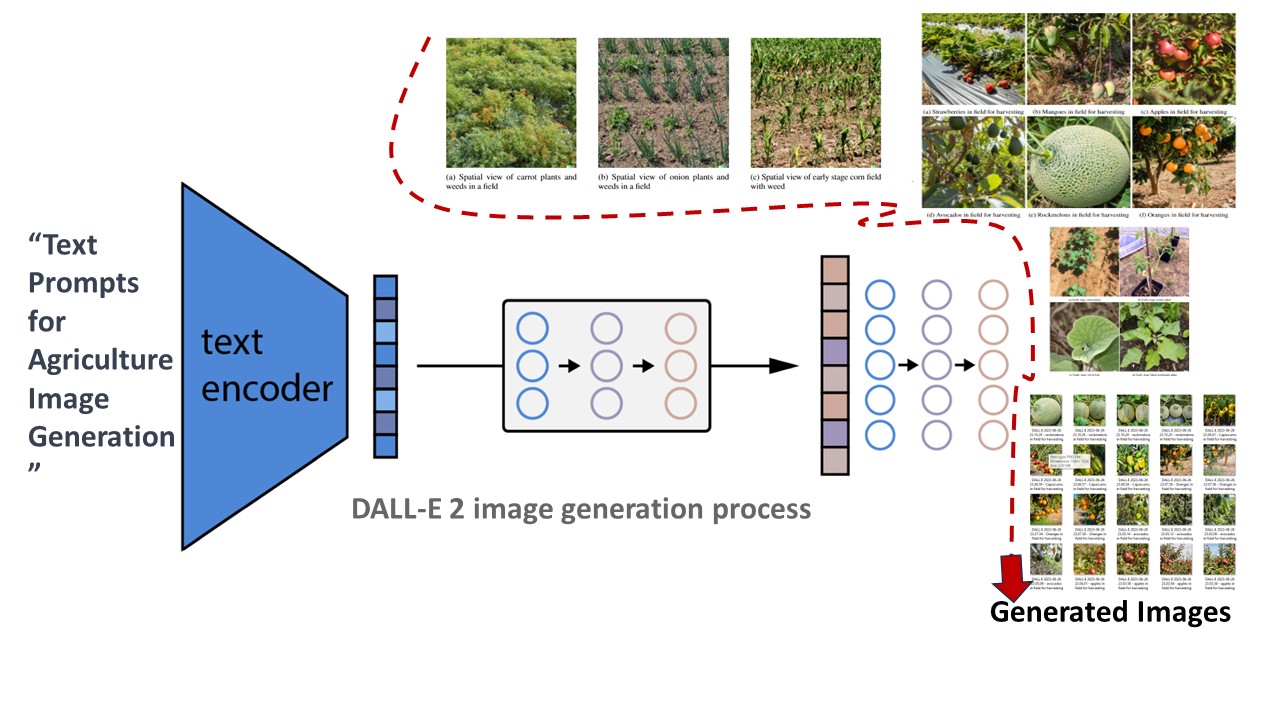
- Employed DALL·E 2, a text-to-image generative model based on a GAN framework with transformer-based text encoders, to generate synthetic agricultural images from natural language prompts.
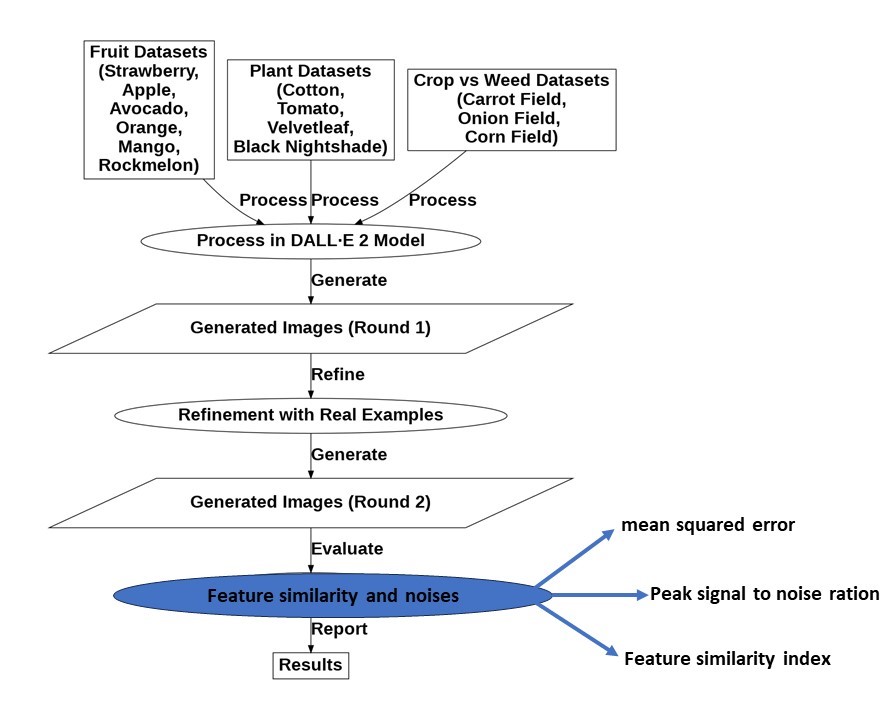
- Integrated GPT-4 and chatGPT to refine and generate precise textual descriptors for diverse agricultural scenarios, including fruits, plants, and weed-crop differentiation.
- Constructed a curated dataset of AI-generated images across multiple agricultural categories, including healthy and diseased plants, various crops, and field conditions.
- Evaluated image quality using standard metrics: mean squared error (MSE), peak signal-to-noise ratio (PSNR), and feature similarity index (FSIM).
- Compared AI-generated images with real images to assess realism and structural consistency, focusing on visual fidelity and semantic accuracy.
- Proposed a five-step roadmap for future adoption: dataset expansion, advanced training, expert feedback integration, use of diverse evaluation metrics (e.g., Inception Score), and system integration.
Experimental results
Research questions
- RQ1Can DALL·E 2 generate high-quality, realistic agricultural images from natural language descriptions alone?
- RQ2How do the visual characteristics of AI-generated agricultural images compare to real-world images in terms of structural and perceptual similarity?
- RQ3To what extent can AI-generated images support key agricultural tasks such as crop-weed differentiation and disease detection?
- RQ4What are the limitations of current synthetic image generation in replicating complex agricultural scenarios, and how can they be addressed?
- RQ5How can generative AI models like DALL·E 2 be systematically integrated into existing agricultural research and precision farming workflows?
Key findings
- DALL·E 2 successfully generated photorealistic agricultural images from text prompts, demonstrating strong alignment between input descriptions and output visuals.
- The AI-generated images achieved competitive performance on standard image quality metrics, with reported MSE, PSNR, and FSIM values indicating high visual fidelity.
- The synthetic images effectively captured complex agricultural scenarios, including crop-weed differentiation and plant health conditions, suggesting utility in AI training and decision support.
- The use of AI-generated images significantly reduces the time, labor, and cost associated with real-world image collection, offering a scalable alternative for data-hungry AI applications.
- Evaluation using multiple metrics (MSE, PSNR, FSIM) confirmed that the generated images are structurally and perceptually close to real images, supporting their use in training and testing AI models.
- The study identifies a clear path for future adoption through dataset expansion, expert feedback integration, and enhanced evaluation techniques, including potential use of Inception Score for diversity assessment.
Read this paper
Open the full text in the Nubint reader and ask about any passage as you read.
Read this paper on NubintThis review was generated by AI from the original paper. Please check the paper before citing it.