
[Paper Review] Generative AI Meets Semantic Communication: Evolution and Revolution of Communication Tasks
The paper presents a unified view of deep generative models in semantic communication, showing how diffusion, VAEs, GANs, and flow models enable new tasks, applications, and architecture paradigms beyond traditional bit-recovery. It discusses challenges and future directions for efficient, reliable, and explainable generative semantic communication.
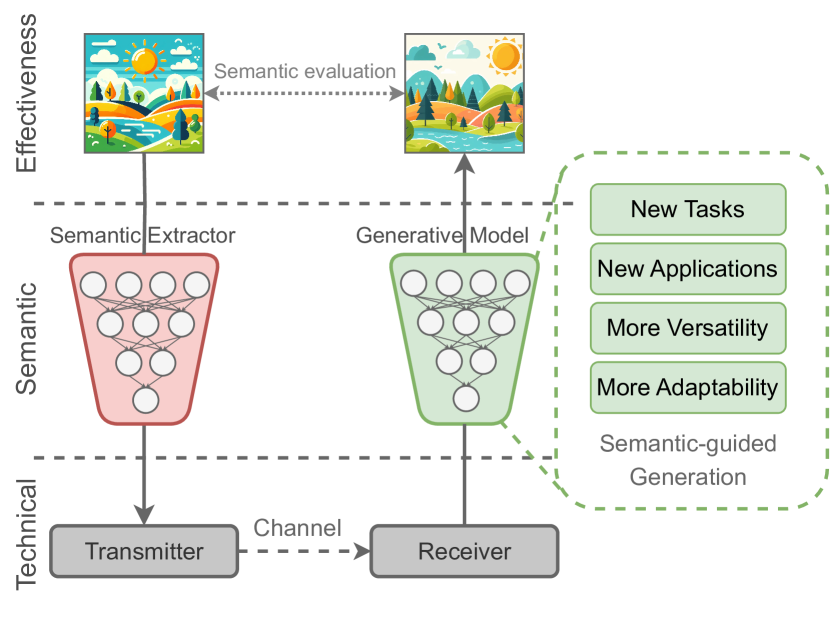
While deep generative models are showing exciting abilities in computer vision and natural language processing, their adoption in communication frameworks is still far underestimated. These methods are demonstrated to evolve solutions to classic communication problems such as denoising, restoration, or compression. Nevertheless, generative models can unveil their real potential in semantic communication frameworks, in which the receiver is not asked to recover the sequence of bits used to encode the transmitted (semantic) message, but only to regenerate content that is semantically consistent with the transmitted message. Disclosing generative models capabilities in semantic communication paves the way for a paradigm shift with respect to conventional communication systems, which has great potential to reduce the amount of data traffic and offers a revolutionary versatility to novel tasks and applications that were not even conceivable a few years ago. In this paper, we present a unified perspective of deep generative models in semantic communication and we unveil their revolutionary role in future communication frameworks, enabling emerging applications and tasks. Finally, we analyze the challenges and opportunities to face to develop generative models specifically tailored for communication systems.
Motivation & Objective
- Provide a unified perspective on deep generative models in semantic communications and their role in future 6G.
- Show how generative models enable revolutionizing semantic tasks and applications beyond classic communication problems.
- Discuss challenges and propose pathways to efficient, tailored generative semantic communication frameworks.
Proposed method
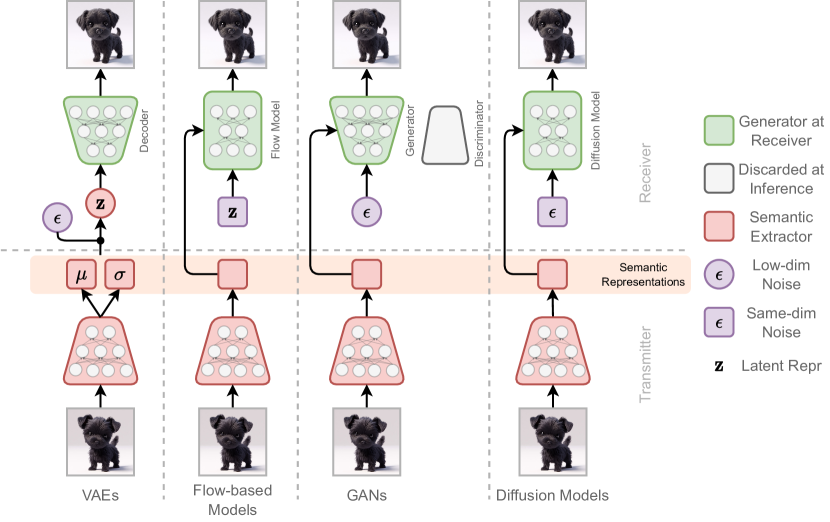
- Classify generative model architectures for semantic communication (VAEs, Flow-based, GANs, Diffusion).
- Explain semantic-conditioning as the core mechanism guiding generation at the receiver of the Weaver-based semantic communication framework.
- Describe how semantic representations and conditioning influence reconstruction quality and robustness under imperfect channels.
Experimental results
Research questions
- RQ1How can deep generative models be integrated into semantic communication to go beyond bit-recovery?
- RQ2What are the advantages and limitations of VAEs, flow models, GANs, and diffusion models in semantic communication?
- RQ3How does semantic conditioning affect generation quality under channel imperfections?
- RQ4What architectural shifts (modular vs end-to-end) arise when using generative models for semantic communication?
- RQ5What future applications and challenges arise when leveraging generative AI for semantic tasks in 6G-era networks?
Key findings
- Generative models enable semantic compression and content regeneration without exact bit recovery, enabling cost-efficient communications.
- VAEs, flow models, GANs, and diffusion models offer trade-offs in compression, sampling speed, and training stability for semantic tasks.
- Semantic conditioning is critical; accurate conditioning aligns generation with transmitted meaning, while imperfect conditioning can degrade outputs.
- Generative models support non-end-to-end, modular architectures within the OSI stack, enabling denoising, restoration, and inverse problems.
- Emerging applications include content creation, multimodal generation, personalized and multi-user communications, and LLM-aided workflows.
Better researchstarts right now
From reading papers to final review, dramatically reduce your research time.
No credit card · Free plan available
This review was created by AI and reviewed by human editors.