
[Paper Review] Generative AI on the Edge: Architecture and Performance Evaluation
The paper evaluates various LLMs on a CPU-only Raspberry Pi edge cluster using a K3s-managed Docker-based setup, quantifying throughput, latency, memory/CPU usage, and accuracy to assess edge viability of GenAI without cloud reliance.
6G's AI native vision of embedding advance intelligence in the network while bringing it closer to the user requires a systematic evaluation of Generative AI (GenAI) models on edge devices. Rapidly emerging solutions based on Open RAN (ORAN) and Network-in-a-Box strongly advocate the use of low-cost, off-the-shelf components for simpler and efficient deployment, e.g., in provisioning rural connectivity. In this context, conceptual architecture, hardware testbeds and precise performance quantification of Large Language Models (LLMs) on off-the-shelf edge devices remains largely unexplored. This research investigates computationally demanding LLM inference on a single commodity Raspberry Pi serving as an edge testbed for ORAN. We investigate various LLMs, including small, medium and large models, on a Raspberry Pi 5 Cluster using a lightweight Kubernetes distribution (K3s) with modular prompting implementation. We study its feasibility and limitations by analyzing throughput, latency, accuracy and efficiency. Our findings indicate that CPU-only deployment of lightweight models, such as Yi, Phi, and Llama3, can effectively support edge applications, achieving a generation throughput of 5 to 12 tokens per second with less than 50\% CPU and RAM usage. We conclude that GenAI on the edge offers localized inference in remote or bandwidth-constrained environments in 6G networks without reliance on cloud infrastructure.
Motivation & Objective
- Motivate and quantify the feasibility of running Generative AI on resource-constrained edge devices in 6G/ORAN contexts.
- Assess performance trade-offs (throughput, latency, memory, CPU usage, accuracy) of different LLM sizes on edge hardware.
- Provide an extensible edge AI testbed and methodology for future GenAI experimentation at the network edge.
- Offer concrete guidance for selecting models and configurations for edge deployments based on empirical results.
Proposed method
- Edge testbed built with four Raspberry Pi 5 nodes orchestrated by K3s (lightweight Kubernetes).
- Dockerized PromptAI services with a modular API-based architecture for model selection and inference routing.
- Quantized 4-bit GGUF models deployed from Hugging Face via a Docker-based workflow.
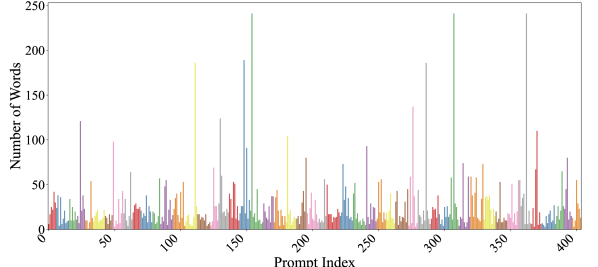
- Evaluation uses a subset of OpenAssistant/oasst1 prompts (50 dialogues, 5+ turns) to measure memory, CPU, latency, accuracy, and throughput.
- Performance analysis employed the llama.cpp framework for deterministic inference with a cap of 500 generated tokens per prompt.
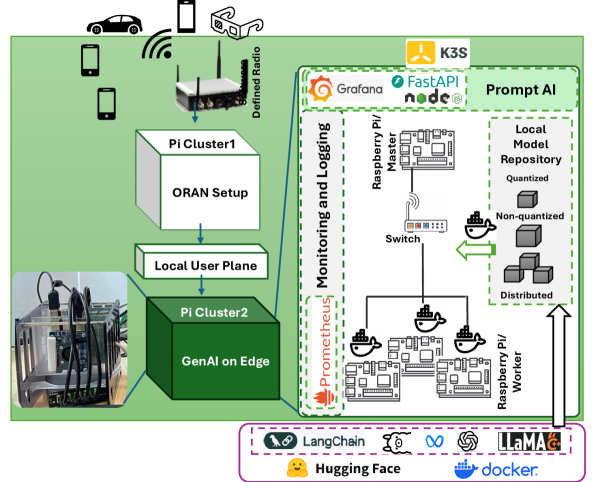
Experimental results
Research questions
- RQ1Can CPU-only edge devices (Raspberry Pi cluster) run LLM inference effectively for conversational AI tasks?
- RQ2How do model size (large, medium, small) and quantization (4-bit GGUF) impact throughput, latency, memory, CPU, and accuracy on edge hardware?
- RQ3What are the stability and context-sensitivity characteristics of edge-deployed LLMs in real-time dialogue scenarios?
- RQ4What deployment architectures and tooling (K3s, Docker, PromptAI) best support scalable, modular edge GenAI experimentation?
Key findings
- Lightweight models (Yi, Phi) achieve practical throughput and latency on CPUs, with generation around 5–12 tokens per second and under 50% CPU and RAM usage.
- End-to-end latency and throughput vary by model size; small models like Yi show the fastest end-to-end total times (e.g., Yi significantly faster than InternLM for total time per token), while larger models offer higher accuracy at the cost of latency.
- Memory usage generally increases with model size (InternLM, Mistral, Llama2 > 0.66–3.14 GB) while CPU usage centers around ~50% across models.
- Accuracy varies by model on the Winogrande benchmark, with InternLM ~0.8, Gemma ~0.7, Llama3 ~0.69, while Yi and Zephyr are around 0.49 and 0.46 respectively (non-fine-tuned variants).
- Throughput CV analyses show different context-length sensitivities; some models (Mistral, InternLM) are stable across varying prompt lengths, while others (Llama3, Phi, Yi) exhibit more variability in Prefill/Decode phases.
- The system demonstrated robustness with no out-of-memory errors or restarts during deployment, and quantization successfully reduces memory usage while accepting some accuracy degradation.
Read this paper
Open the full text in the Nubint reader and ask about any passage as you read.
Read this paper on NubintThis review was generated by AI from the original paper. Please check the paper before citing it.