
[Paper Review] Generative Multimodal Models are In-Context Learners
This paper introduces Emu2, a 37B-parameter generative multimodal model trained with a unified autoregressive objective on large-scale multimodal sequences (text, images, video). It demonstrates strong in-context learning abilities across vision-language tasks, achieving state-of-the-art few-shot performance on VQA benchmarks and enabling zero-shot visual prompting and subject-driven image generation, establishing it as a general-purpose foundation model for multimodal understanding and generation.
The human ability to easily solve multimodal tasks in context (i.e., with only a few demonstrations or simple instructions), is what current multimodal systems have largely struggled to imitate. In this work, we demonstrate that the task-agnostic in-context learning capabilities of large multimodal models can be significantly enhanced by effective scaling-up. We introduce Emu2, a generative multimodal model with 37 billion parameters, trained on large-scale multimodal sequences with a unified autoregressive objective. Emu2 exhibits strong multimodal in-context learning abilities, even emerging to solve tasks that require on-the-fly reasoning, such as visual prompting and object-grounded generation. The model sets a new record on multiple multimodal understanding tasks in few-shot settings. When instruction-tuned to follow specific instructions, Emu2 further achieves new state-of-the-art on challenging tasks such as question answering benchmarks for large multimodal models and open-ended subject-driven generation. These achievements demonstrate that Emu2 can serve as a base model and general-purpose interface for a wide range of multimodal tasks. Code and models are publicly available to facilitate future research.
Motivation & Objective
- To investigate whether large-scale generative multimodal models can exhibit in-context learning capabilities similar to those seen in large language models.
- To overcome the limitations of task-specific architectures and supervised fine-tuning by enabling zero-shot or few-shot generalization across diverse multimodal tasks.
- To develop a unified, scalable multimodal foundation model that supports both understanding and generation across text, images, and video.
- To evaluate the model's performance on unseen multimodal tasks under few-shot and instruction-tuning settings.
- To analyze the societal implications of such powerful generative models and advocate for responsible deployment.
Proposed method
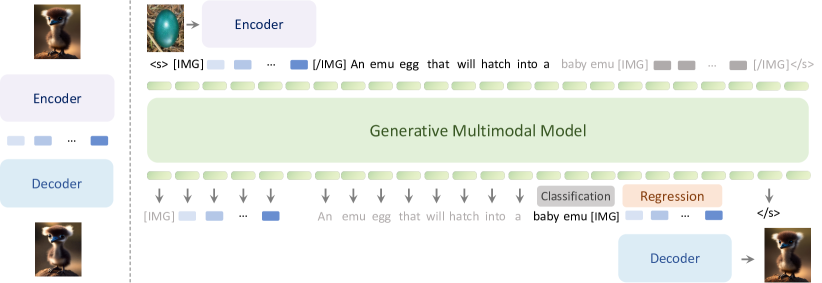
- Train Emu2 with a unified autoregressive objective: predict the next multimodal element (text token or visual embedding) in a sequence.
- Use a three-part architecture: visual encoder (EVA-02-CLIP-E-plus), multimodal modeling head (LLaMA-33B), and visual decoder (SDXL).
- Tokenize input images into 8×8 patches via mean pooling and project them into the multimodal sequence for autoregressive modeling.
- Pretrain on diverse datasets including LAION-2B, WebVid-10M, MMC4, YT-Storyboard-1B, and GRIT-20M to enable broad multimodal understanding.
- Fine-tune the model via instruction tuning on conversational and instruction-following data to improve zero-shot and few-shot performance.
- Use diffusion-based generation with classifier-free guidance (scale=3.0) and EulerDiscreteScheduler for image and video generation tasks.
Experimental results
Research questions
- RQ1Can a large-scale generative multimodal model learn to perform diverse multimodal tasks through in-context learning without task-specific fine-tuning?
- RQ2How does increasing model scale enhance in-context learning capabilities in multimodal settings, especially for reasoning-intensive tasks like visual prompting?
- RQ3To what extent can a unified autoregressive objective enable joint understanding and generation across text, images, and video?
- RQ4Can instruction tuning further improve the model’s ability to follow complex instructions in multimodal generation and question-answering tasks?
- RQ5What are the limitations and risks of such powerful in-context learning models in real-world deployment?
Key findings
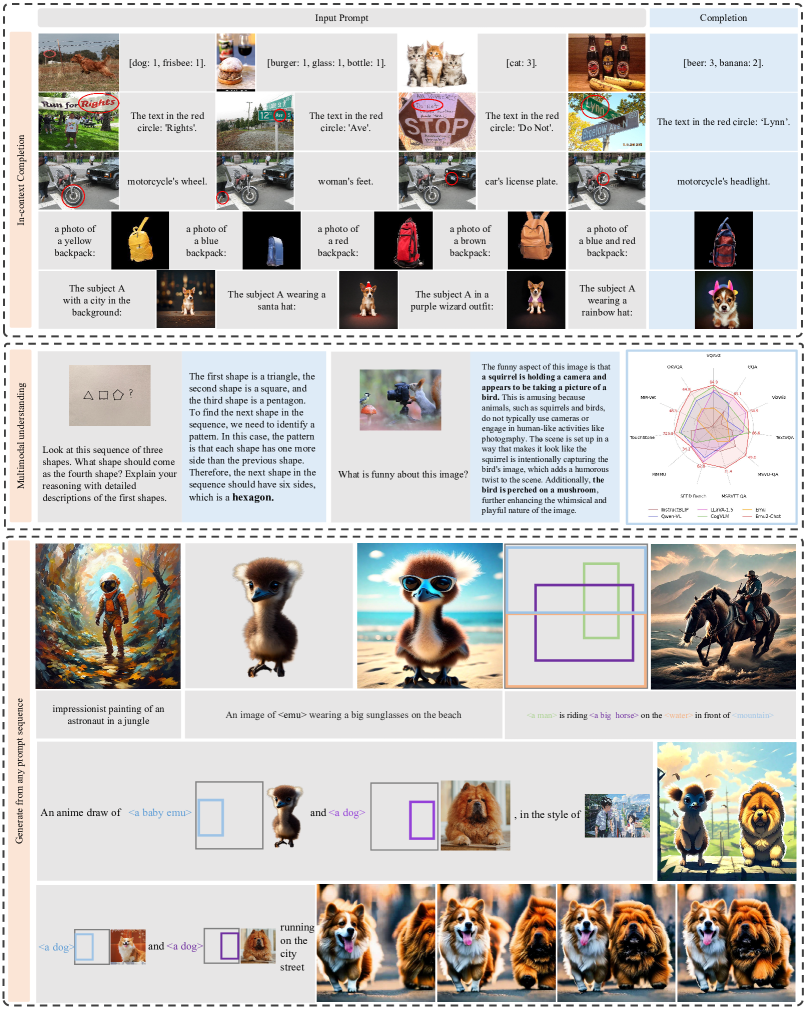
- Emu2 achieves state-of-the-art few-shot performance on multiple vision-language benchmarks, including VQAv2, VizWiz, GQA, and OKVQA, demonstrating strong in-context learning.
- The model exhibits emergent reasoning abilities, such as visual prompting and object-grounded image generation, even in zero-shot or few-shot settings.
- After instruction tuning, Emu2 surpasses previous models on visual question-answering benchmarks, achieving new SOTA results despite a simpler architecture.
- Emu2 enables high-quality controllable visual generation using mixed inputs (text, image, layout), with results on DreamBench showing strong alignment with human preferences.
- Performance improves with increasing context window size, indicating that in-context learning is scalable and data-efficient.
- The model demonstrates strong generalization to unseen tasks, including open-ended image and video generation, with GPT-4 evaluations showing high-quality outputs.
Read this paper
Open the full text in the Nubint reader and ask about any passage as you read.
Read this paper on NubintThis review was generated by AI from the original paper. Please check the paper before citing it.