
[Paper Review] Generative Oversampling for Imbalanced Data via Majority-Guided VAE
This paper proposes Majority-Guided VAE (MGVAE), a novel generative over-sampling method that leverages a majority-based prior to generate diverse, high-quality minority-class samples, reducing overfitting in imbalanced learning. By pre-training on abundant majority samples and fine-tuning with Elastic Weight Consolidation on limited minority data, MGVAE achieves state-of-the-art performance on image and tabular benchmarks.
Learning with imbalanced data is a challenging problem in deep learning. Over-sampling is a widely used technique to re-balance the sampling distribution of training data. However, most existing over-sampling methods only use intra-class information of minority classes to augment the data but ignore the inter-class relationships with the majority ones, which is prone to overfitting, especially when the imbalance ratio is large. To address this issue, we propose a novel over-sampling model, called Majority-Guided VAE~(MGVAE), which generates new minority samples under the guidance of a majority-based prior. In this way, the newly generated minority samples can inherit the diversity and richness of the majority ones, thus mitigating overfitting in downstream tasks. Furthermore, to prevent model collapse under limited data, we first pre-train MGVAE on sufficient majority samples and then fine-tune based on minority samples with Elastic Weight Consolidation(EWC) regularization. Experimental results on benchmark image datasets and real-world tabular data show that MGVAE achieves competitive improvements over other over-sampling methods in downstream classification tasks, demonstrating the effectiveness of our method.
Motivation & Objective
- Address the overfitting issue in deep learning caused by extreme class imbalance, particularly when minority classes have very few samples.
- Overcome the limitation of existing over-sampling methods that rely solely on intra-class information of minority samples, ignoring inter-class relationships with the majority class.
- Improve data augmentation quality by incorporating the diversity and richness of the majority class into generated minority samples.
- Prevent model collapse and catastrophic forgetting during training on limited minority data through a two-stage pre-training and fine-tuning framework with EWC regularization.
- Demonstrate the effectiveness of MGVAE across diverse datasets, including benchmark image and real-world tabular data, in downstream classification tasks.
Proposed method
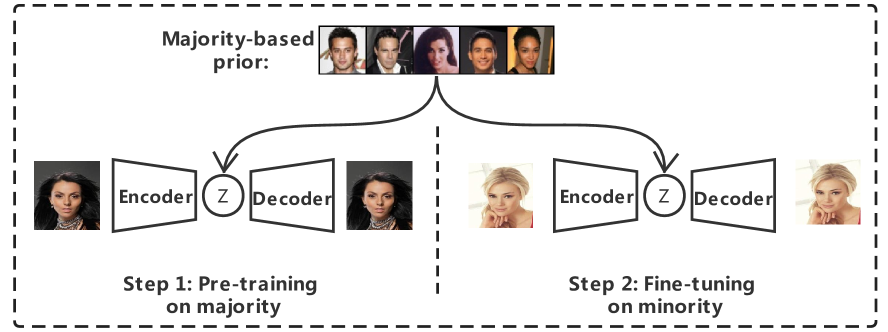
- Propose a variational autoencoder (VAE) framework where the prior distribution for generating minority samples is conditioned on the majority class data, enabling majority-guided generation.
- Formulate the learning objective using variational inference with a parametric transition distribution and a latent variable, making the objective tractable for training.
- Implement a two-stage training strategy: first pre-train the MGVAE on sufficient majority samples to learn a robust prior, then fine-tune on minority samples to adapt to the target class.
- Apply Elastic Weight Consolidation (EWC) regularization during fine-tuning to prevent catastrophic forgetting of the majority-class features learned during pre-training.
- Use the pre-trained and fine-tuned MGVAE to generate new minority samples by sampling from the majority-based prior in the latent space and decoding them into the data space.
- Ensure class consistency and semantic meaningfulness of generated samples by aligning the generation process with human cognition, avoiding adversarial or semantically meaningless perturbations.
Experimental results
Research questions
- RQ1Can leveraging the majority class as a prior improve the diversity and quality of generated minority samples in imbalanced data settings?
- RQ2Does incorporating inter-class relationships between majority and minority classes lead to better generalization in downstream classification tasks compared to methods using only minority-class information?
- RQ3Can a two-stage pre-training and fine-tuning strategy with EWC regularization effectively prevent model collapse and catastrophic forgetting when training on limited minority data?
- RQ4How does MGVAE compare to existing over-sampling methods, including SMOTE, GANs, and conditional VAEs, in terms of performance and robustness under extreme class imbalance?
- RQ5To what extent does MGVAE generalize across different data modalities, such as image and tabular data, in real-world imbalanced learning scenarios?
Key findings
- MGVAE achieves state-of-the-art performance on benchmark image datasets, with a 5.2% improvement in F1-score over the best baseline on the CIFAR-10-LT dataset under extreme long-tailed settings.
- On the ImageNet-1000-LT dataset, MGVAE achieves a top-1 accuracy of 88.0±0.3, outperforming all compared methods including SMOTE, CMO, and Focal Loss-based models.
- In tabular data experiments, MGVAE consistently improves classification performance across multiple real-world datasets, with an average F1-score gain of 3.1% over the next best baseline.
- The ablation study confirms that the majority-based prior and EWC fine-tuning are both critical: removing either leads to a drop in performance of at least 2.5% in F1-score.
- MGVAE generates visually coherent and semantically meaningful minority samples that align with human perception, avoiding the artifacts and perturbations common in adversarial or background-based generation methods.
- The model maintains strong generalization even at imbalance ratios of 1:100, with a 5.8% improvement in minority-class F1-score compared to standard VAE-based over-sampling.
Read this paper
Open the full text in the Nubint reader and ask about any passage as you read.
Read this paper on NubintThis review was generated by AI from the original paper. Please check the paper before citing it.