
[Paper Review] Generative Pre-trained Transformer: A Comprehensive Review on Enabling Technologies, Potential Applications, Emerging Challenges, and Future Directions
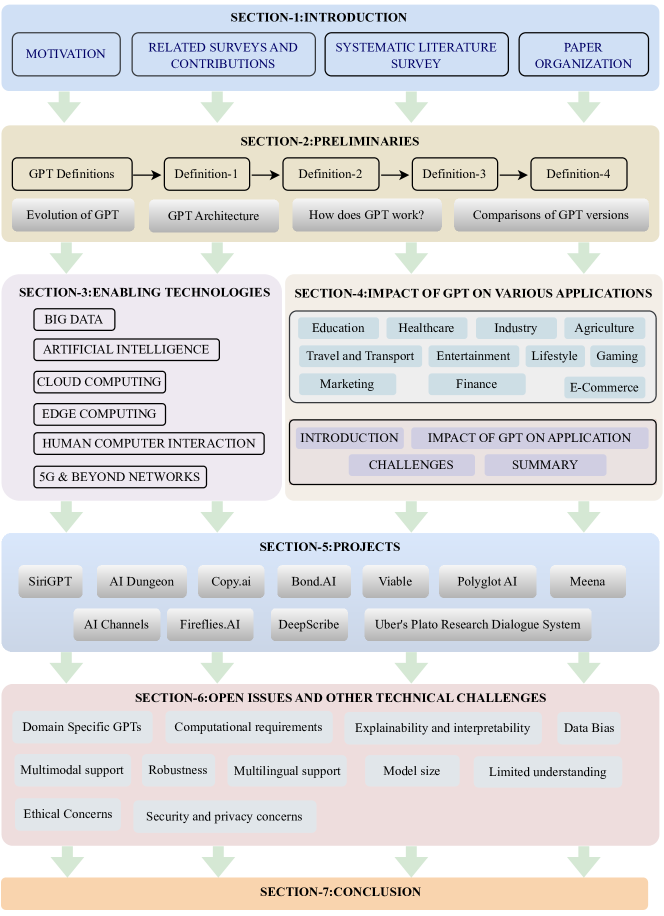
This paper surveys GPT models, detailing their evolution, architecture, enabling technologies, applications, challenges, and future directions. It summarizes GPT-1 to GPT-4 and discusses multimodal capabilities and ethical considerations.
The Generative Pre-trained Transformer (GPT) represents a notable breakthrough in the domain of natural language processing, which is propelling us toward the development of machines that can understand and communicate using language in a manner that closely resembles that of humans. GPT is based on the transformer architecture, a deep neural network designed for natural language processing tasks. Due to their impressive performance on natural language processing tasks and ability to effectively converse, GPT have gained significant popularity among researchers and industrial communities, making them one of the most widely used and effective models in natural language processing and related fields, which motivated to conduct this review. This review provides a detailed overview of the GPT, including its architecture, working process, training procedures, enabling technologies, and its impact on various applications. In this review, we also explored the potential challenges and limitations of a GPT. Furthermore, we discuss potential solutions and future directions. Overall, this paper aims to provide a comprehensive understanding of GPT, enabling technologies, their impact on various applications, emerging challenges, and potential solutions.
Motivation & Objective
- Explain the evolution and architecture of Generative Pre-trained Transformer (GPT) models.
- Identify enabling technologies that empower GPT models.
- Survey potential applications across industries and highlight current challenges and limitations.
- Discuss notable GPT projects, evaluations, and future research directions.
Proposed method
- Systematic literature review of peer‑reviewed journals and high‑quality conference sources.
- Comparison of GPT versions (GPT-1 to GPT-4) and their architectural features, datasets, and tokens.
- Description of transformer‑based architecture, pre‑training and fine‑tuning workflows.
- Analysis of enabling technologies (big data, AI, cloud, edge computing, 5G, HCI) and their roles in GPT development.
- Discussion of applications, projects, open issues, and future directions.
- Table‑based comparison of GPT versions including parameters, datasets, and drawbacks.
Experimental results
Research questions
- RQ1What are the key architectural components and evolutionary milestones of GPT models from GPT‑1 to GPT‑4?
- RQ2What enabling technologies underpin GPT models and how do they influence performance and deployment?
- RQ3What are the main applications, advantages, and limitations of GPT across domains?
- RQ4What challenges, risks, and ethical considerations accompany GPT deployment, and what future directions are proposed?
Key findings
- GPT models are based on a transformer architecture that uses self‑attention and pre‑training on large text corpora, followed by fine‑tuning for downstream tasks.
- GPT‑1, GPT‑2, GPT‑3, GPT‑3.5, and GPT‑4 show increasing capacity, with GPT‑4 offering multimodal capabilities and expanded context windows (8192 and 32768 tokens).
- GPT models leverage big data and deep learning, enabling tasks such as language modeling, translation, summarization, code generation, question answering, and more.
- Enabling technologies identified include Big Data, AI, Cloud Computing, Edge Computing, 5G networks, and Human–Computer Interaction, each contributing to data access, scalability, and usability.
- The paper highlights opportunities, real‑world applications, and notable GPT projects, while also detailing challenges such as data privacy, bias, output control, and high computational costs.
- Compared with prior surveys, this work provides a comprehensive synthesis of GPT evolution, architecture, enabling technologies, and future research directions.
Read this paper
Open the full text in the Nubint reader and ask about any passage as you read.
Read this paper on NubintThis review was generated by AI from the original paper. Please check the paper before citing it.