
[Paper Review] Generative Proxemics: A Prior for 3D Social Interaction from Images
This paper introduces BUDDI, a denoising diffusion model that learns a 3D generative prior for social proxemics—how two people position themselves in close interaction—using SMPL-X body parameters. By conditioning on noisy 2D-to-3D estimates, BUDDI refines plausible 3D human meshes from single images without contact annotations, outperforming state-of-the-art methods in reconstruction accuracy and realism.
Social interaction is a fundamental aspect of human behavior and communication. The way individuals position themselves in relation to others, also known as proxemics, conveys social cues and affects the dynamics of social interaction. Reconstructing such interaction from images presents challenges because of mutual occlusion and the limited availability of large training datasets. To address this, we present a novel approach that learns a prior over the 3D proxemics two people in close social interaction and demonstrate its use for single-view 3D reconstruction. We start by creating 3D training data of interacting people using image datasets with contact annotations. We then model the proxemics using a novel denoising diffusion model called BUDDI that learns the joint distribution over the poses of two people in close social interaction. Sampling from our generative proxemics model produces realistic 3D human interactions, which we validate through a perceptual study. We use BUDDI in reconstructing two people in close proximity from a single image without any contact annotation via an optimization approach that uses the diffusion model as a prior. Our approach recovers accurate and plausible 3D social interactions from noisy initial estimates, outperforming state-of-the-art methods. Our code, data, and model are availableat our project website at: muelea.github.io/buddi.
Motivation & Objective
- To learn a data-driven generative prior for 3D social interactions between two people from image data.
- To address the challenge of reconstructing plausible 3D human poses and shapes in close proximity from single images, especially when mutual occlusion and lack of contact annotations hinder performance.
- To develop a method that leverages a diffusion model as a prior to refine noisy initial 3D mesh estimates without requiring ground-truth contact supervision.
- To validate the realism of generated samples through perceptual studies and demonstrate the effectiveness of the prior in downstream 3D reconstruction tasks.
- To provide a foundation for synthesizing socially plausible human interactions from images, advancing digital human modeling and social behavior understanding.
Proposed method
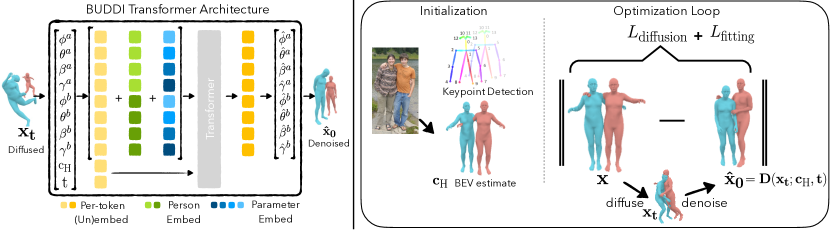
- Train a denoising diffusion model (BUDDI) on SMPL-X body parameters of interacting people, using 3D poses reconstructed from image datasets with contact annotations and MoCap data.
- Condition BUDDI on estimated 3D body parameters from a multi-person mesh regressor via concatenation along the token dimension to guide refinement.
- Use a Score-Distillation-inspired loss to guide optimization by iteratively refining the 3D mesh estimate toward more plausible social interactions.
- Initialize optimization with BUDDI samples conditioned on initial regressor outputs, then optimize SMPL-X pose, shape, and translation to match 2D joint detections.
- Integrate BUDDI’s generative prior into the overall objective function to enforce social plausibility during reconstruction.
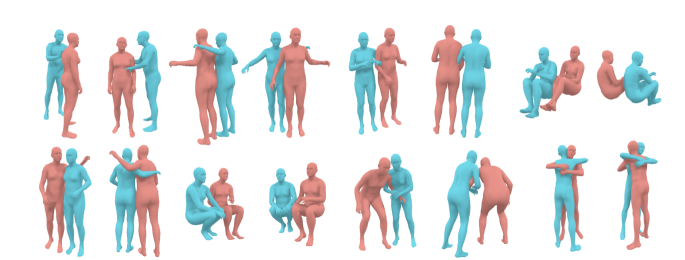
- Leverage the model’s ability to generate unconditional samples of realistic 3D social interactions for perceptual validation.
Experimental results
Research questions
- RQ1Can a diffusion model learn a realistic, data-driven prior for 3D social proxemics between two interacting people from image data?
- RQ2How effective is BUDDI as a generative prior in improving 3D human mesh reconstruction from single images without contact annotations?
- RQ3To what extent do BUDDI-generated samples match real social interactions in terms of perceptual realism?
- RQ4Can the optimization-based reconstruction pipeline with BUDDI prior outperform state-of-the-art methods in accuracy and plausibility?
- RQ5Does the use of SMPL-X parameters instead of joint locations better capture interpersonal contact and proximity in 3D interactions?
Key findings
- BUDDI generates 3D human interactions that are perceived as realistic in 44.4% of comparisons against real samples, approaching the 50% benchmark where humans cannot distinguish real from fake.
- The proposed optimization method significantly improves the performance of the baseline multi-person mesh regressor [67], both quantitatively and qualitatively, on FlickrCI3D, CHI3D, and Hi4D datasets.
- The method outperforms state-of-the-art approaches in 3D human mesh reconstruction from single images, especially in handling occlusions and ensuring socially plausible configurations.
- The use of SMPL-X parameters enables better modeling of surface-level interactions and proximity than joint-only representations.
- The diffusion model's ability to refine noisy initial estimates via a score-based loss leads to more accurate and stable 3D reconstructions.
- The approach generalizes across diverse social interaction types—standing, hugging, playing sports—demonstrating robustness to varied proxemic patterns.
Read this paper
Open the full text in the Nubint reader and ask about any passage as you read.
Read this paper on NubintThis review was generated by AI from the original paper. Please check the paper before citing it.