
[Paper Review] Generative Retrieval as Dense Retrieval
This paper proposes Tied-Atomic, a generative retrieval model that reinterprets generative retrieval as dense retrieval by tying document identifier embeddings to text representations and training with contrastive loss. It achieves competitive performance on NQ320k and MSMARCO while enabling efficient index updates and scaling to large collections, outperforming prior generative models in scalability without sacrificing effectiveness.
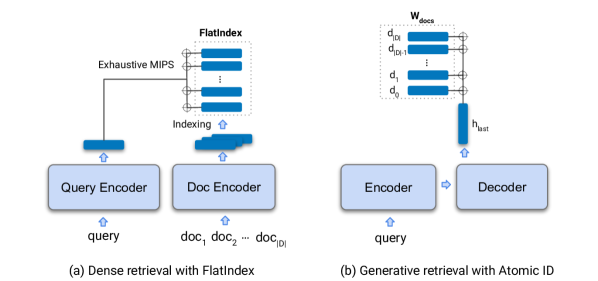
Generative retrieval is a promising new neural retrieval paradigm that aims to optimize the retrieval pipeline by performing both indexing and retrieval with a single transformer model. However, this new paradigm faces challenges with updating the index and scaling to large collections. In this paper, we analyze two prominent variants of generative retrieval and show that they can be conceptually viewed as bi-encoders for dense retrieval. Specifically, we analytically demonstrate that the generative retrieval process can be decomposed into dot products between query and document vectors, similar to dense retrieval. This analysis leads us to propose a new variant of generative retrieval, called Tied-Atomic, which addresses the updating and scaling issues by incorporating techniques from dense retrieval. In experiments on two datasets, NQ320k and the full MSMARCO, we confirm that this approach does not reduce retrieval effectiveness while enabling the model to scale to large collections.
Motivation & Objective
- To analyze whether generative retrieval can be conceptually understood as a form of dense retrieval.
- To address the limitations of existing generative retrieval models in updating indexes and scaling to large collections.
- To propose a new model architecture, Tied-Atomic, that combines the strengths of generative and dense retrieval.
- To validate that the new approach maintains retrieval effectiveness while enabling scalability and efficient index updates.
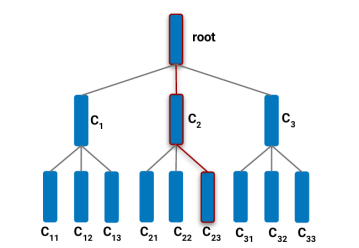
- To demonstrate that atomic document identifiers, when combined with contrastive training and embedding tying, can achieve performance comparable to hierarchical identifiers.
Proposed method
- The model treats document identifiers as learnable embeddings tied to their corresponding text representations, enabling joint optimization of text and identifier embeddings.
- It uses a contrastive loss during training to align query representations with relevant document embeddings, similar to dense retrieval.
- The document encoder is trained with a contrastive objective using in-batch negatives, improving generalization and alignment.
- The model leverages a T5-based transformer architecture with tied embeddings between the vocabulary and document identifiers.
- During inference, retrieval is performed via dot-product similarity between query and document vectors, emulating dense retrieval.
- The method supports efficient index updates by freezing document embeddings and retraining only query encoders, enabling scalability to large collections.
Experimental results
Research questions
- RQ1To what extent can generative retrieval be viewed as a form of dense retrieval?
- RQ2Can a generative retrieval model with atomic document identifiers achieve performance comparable to models using hierarchical semantic identifiers?
- RQ3Does incorporating contrastive loss and embedding tying improve generalization and scalability in generative retrieval?
- RQ4Can the model support efficient index updates and scale to large document collections without performance degradation?
- RQ5How does the proposed Tied-Atomic model compare to dense retrieval baselines in effectiveness and efficiency?
Key findings
- Tied-Atomic achieves R@1 of 65.26 on NQ320k, outperforming DSI Atomic (60.00) and matching NCI (65.86) despite using simpler atomic identifiers.
- On NQ320k, Tied-Atomic achieves MRR@100 of 74.67, outperforming the dense retrieval baseline with distilBERT (73.33) and matching its performance on R@100 (96.16 vs. 95.18).
- On the full MSMARCO dataset with ~8 million documents, Tied-Atomic (small) achieves MRR@10 of 33.42, outperforming DSI Atomic (base) by 38% (24.20).
- The model maintains competitive performance while enabling efficient index updates and scaling to large collections, unlike prior generative retrieval models.
- The use of contrastive loss and tied embeddings significantly improves training efficiency and generalization, especially for unseen documents.
- The results confirm that generative retrieval can be effectively reinterpreted as dense retrieval, enabling scalable and updatable retrieval systems.
Read this paper
Open the full text in the Nubint reader and ask about any passage as you read.
Read this paper on NubintThis review was generated by AI from the original paper. Please check the paper before citing it.