
[Paper Review] Generative Retrieval via Term Set Generation
This paper proposes AutoTSG, a novel auto-regressive search framework that uses unordered term sets as document identifiers and enables set-oriented generation to relax the strict requirement of exact sequence generation. By allowing any permutation of the term set to retrieve the correct document, AutoTSG significantly reduces false pruning and achieves state-of-the-art performance on Natural Questions and MS MARCO, with notable gains over existing auto-regressive models.
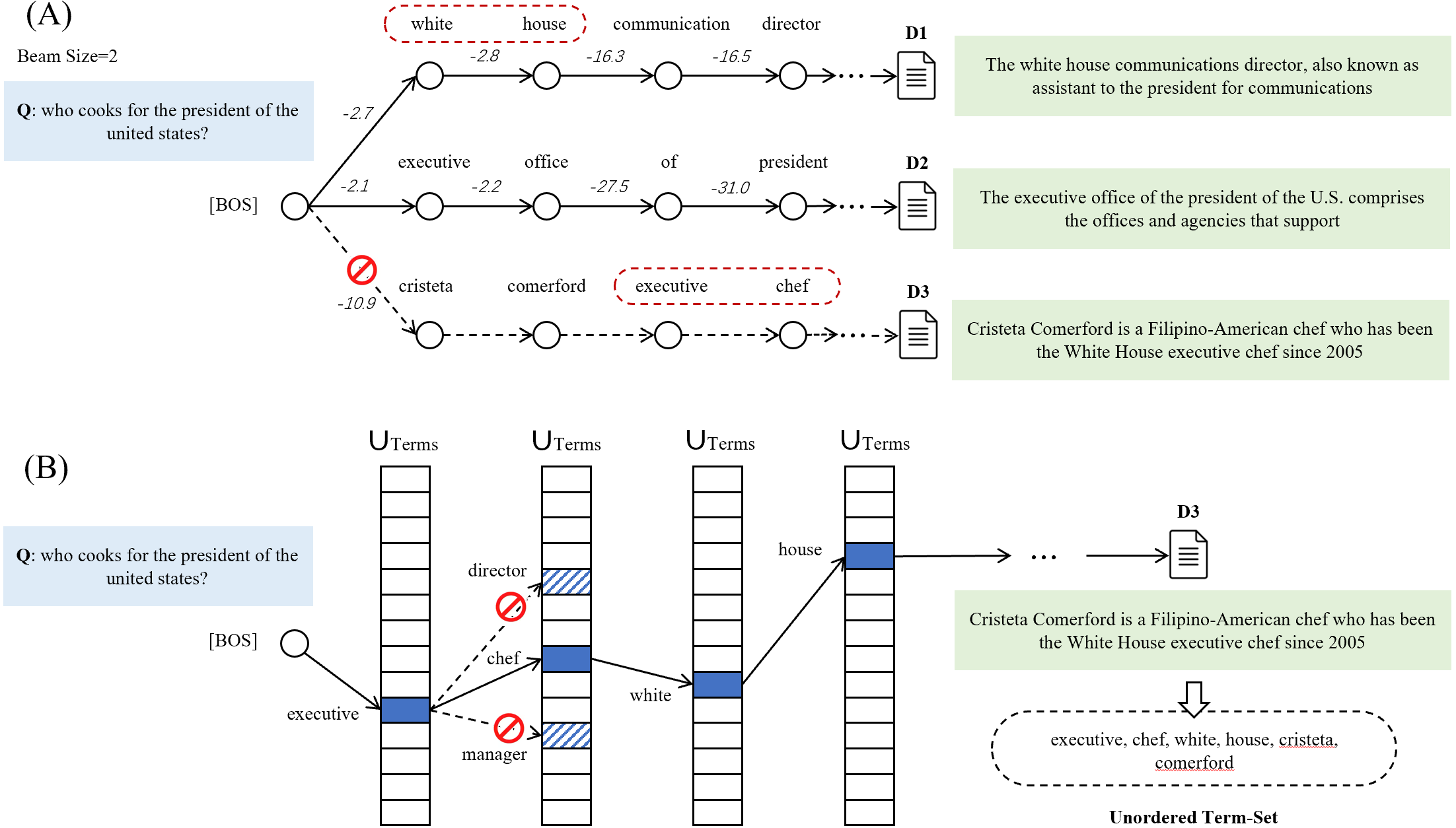
Recently, generative retrieval emerges as a promising alternative to traditional retrieval paradigms. It assigns each document a unique identifier, known as DocID, and employs a generative model to directly generate the relevant DocID for the input query. A common choice for DocID is one or several natural language sequences, e.g. the title or n-grams, so that the pre-trained knowledge of the generative model can be utilized. However, a sequence is generated token by token, where only the most likely candidates are kept and the rest are pruned at each decoding step, thus, retrieval fails if any token within the relevant DocID is falsely pruned. What's worse, during decoding, the model can only perceive preceding tokens in DocID while being blind to subsequent ones, hence is prone to make such errors. To address this problem, we present a novel framework for generative retrieval, dubbed Term-Set Generation (TSGen). Instead of sequences, we use a set of terms as DocID, which are automatically selected to concisely summarize the document's semantics and distinguish it from others. On top of the term-set DocID, we propose a permutation-invariant decoding algorithm, with which the term set can be generated in any permutation yet will always lead to the corresponding document. Remarkably, TSGen perceives all valid terms rather than only the preceding ones at each decoding step. Given the constant decoding space, it can make more reliable decisions due to the broader perspective. TSGen is also resilient to errors: the relevant DocID will not be pruned as long as the decoded term belongs to it. Lastly, we design an iterative optimization procedure to incentivize the model to generate the relevant term set in its favorable permutation. We conduct extensive experiments on popular benchmarks, which validate the effectiveness, the generalizability, the scalability, and the efficiency of TSGen.
Motivation & Objective
- Address the challenge of false pruning in auto-regressive search engines, where incorrect generation of a document’s sequential identifier leads to retrieval failure.
- Overcome the rigidity of fixed sequential document identifiers by introducing unordered term sets as identifiers, enabling any permutation to retrieve the correct document.
- Improve retrieval quality by allowing the Seq2Seq model to explore the optimal permutation of document identifiers during generation.
- Design a learning framework that adapts the generation process to favorable permutations, enhancing generalization across diverse queries.
- Demonstrate that term-set-based identifiers and set-oriented generation yield superior retrieval performance with minimal impact on inference efficiency.
Proposed method
- Replace traditional sequential document identifiers with unordered term sets extracted from document titles and first paragraphs using a matching-oriented term selection strategy.
- Introduce a set-oriented generation pipeline that treats the document identifier as a set, allowing any permutation of terms to retrieve the correct document.
- Employ constrained greedy search to generate the optimal permutation of the term set during inference, guided by query-dependent likelihood scores.
- Design a likelihood-adapted Seq2Seq learning objective that dynamically adjusts the target permutation during training to align with the most plausible generation paths.
- Use importance-based initialization for term permutations, where terms are ordered by estimated relevance to the query to improve training stability and convergence.
- Integrate query generation via off-the-shelf models (e.g., DocT5) for data augmentation, enhancing model generalization without altering the core framework.
Experimental results
Research questions
- RQ1Can unordered term sets serve as robust and discriminative document identifiers in auto-regressive search engines?
- RQ2Does allowing flexible permutation of document identifiers reduce false pruning and improve retrieval accuracy?
- RQ3How does likelihood-adapted training improve the generation of optimal term-set permutations during inference?
- RQ4What impact does initialization strategy (random, likelihood-based, importance-based) have on model performance and convergence?
- RQ5To what extent does AutoTSG maintain efficiency while outperforming existing auto-regressive search methods?
Key findings
- AutoTSG achieves state-of-the-art performance on the Natural Questions and MS MARCO benchmarks, with a 0.766 recall@10 and 0.938 recall@100 on NQ320k.
- The likelihood-adapted training method significantly improves retrieval quality by dynamically aligning the generation target with favorable permutations during training.
- Importance-based initialization of term sets yields superior performance compared to random or likelihood-based initialization, due to better alignment with query-document relevance.
- Query generation via DocT5 substantially enhances retrieval performance, but AutoTSG maintains its advantage even without data augmentation.
- Scaling the backbone T5 model to large size further improves performance, and AutoTSG maintains its relative gain over baselines across model sizes.
- Efficiency analysis shows AutoTSG incurs minimal overhead, with 35MB memory usage and 0.06s latency (beam size 10), comparable to other methods and significantly lower than memory-heavy alternatives like SEAL.
Read this paper
Open the full text in the Nubint reader and ask about any passage as you read.
Read this paper on NubintThis review was generated by AI from the original paper. Please check the paper before citing it.