
[Paper Review] Generative Sequential Recommendation with GPTRec
GPTRec is a GPT-2–based generative sequential recommender that uses SVD-based sub-item tokenisation to reduce memory, introduces Next-K generation, and matches SASRec in ranking while enabling memory efficiency and flexible generation.
Sequential recommendation is an important recommendation task that aims to predict the next item in a sequence. Recently, adaptations of language models, particularly Transformer-based models such as SASRec and BERT4Rec, have achieved state-of-the-art results in sequential recommendation. In these models, item ids replace tokens in the original language models. However, this approach has limitations. First, the vocabulary of item ids may be many times larger than in language models. Second, the classical Top-K recommendation approach used by these models may not be optimal for complex recommendation objectives, including auxiliary objectives such as diversity, coverage or coherence. Recent progress in generative language models inspires us to revisit generative approaches to address these challenges. This paper presents the GPTRec sequential recommendation model, which is based on the GPT-2 architecture. GPTRec can address large vocabulary issues by splitting item ids into sub-id tokens using a novel SVD Tokenisation algorithm based on quantised item embeddings from an SVD decomposition of the user-item interaction matrix. The paper also presents a novel Next-K recommendation strategy, which generates recommendations item-by-item, considering already recommended items. The Next-K strategy can be used for producing complex interdependent recommendation lists. We experiment with GPTRec on the MovieLens-1M dataset and show that using sub-item tokenisation GPTRec can match the quality of SASRec while reducing the embedding table by 40%. We also show that the recommendations generated by GPTRec on MovieLens-1M using the Next-K recommendation strategy match the quality of SASRec in terms of NDCG@10, meaning that the model can serve as a strong starting point for future research.
Motivation & Objective
- Motivate the use of generative models for sequential recommendation to address large item vocabularies and flexible objectives beyond Top-K.
- Introduce a memory-efficient tokenisation via SVD to split item ids into sub-item tokens.
- Propose a Next-K generation strategy to enable interdependent recommendation lists and complex objectives.
- Present GPTRec architecture based on GPT-2 and compare against SASRec and BERT4Rec on MovieLens-1M.
Proposed method
- Adopt GPT-2 decoder architecture with cross-entropy loss for sequence modelling of item tokens.
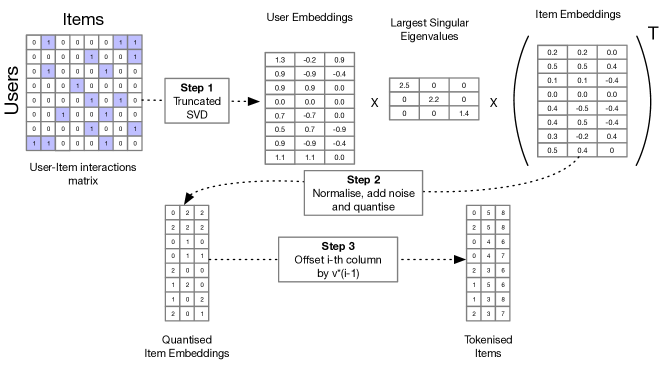
- Introduce SVD Tokenisation that creates t sub-item tokens per item from a quantised SVD embedding of the user-item matrix.
- Allow one-token-per-item and multi-token-per-item modes to balance memory usage and generation.
- Implement Top-K and Next-K generation strategies, including generation-by-generation scoring for Next-K.
- Evaluate on MovieLens-1M using a leave-one-out setup and 3-layer Transformer with max sequence length 100.
- Compare GPTRec variants (GPTRec-TopK, GPTRec-NextK) against SASRec and BERT4Rec using Recall@10 and NDCG@10.
Experimental results
Research questions
- RQ1How does GPTRec perform in one-token-per-id mode compared to BERT4Rec and SASRec?
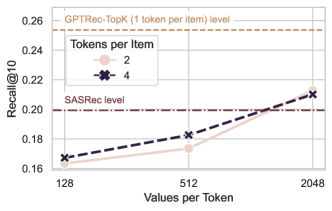
- RQ2What are the effects of the number of tokens and the number of values per token in the multi-token-per-item mode in GPTRec?
- RQ3What is the effect of cutoff level K on the GPTRec performance in the Next-K recommendation mode?
Key findings
- GPTRec-NextK achieves Recall@10 0.157 and NDCG@10 0.105 on MovieLens-1M, competitive with SASRec which has Recall@10 0.199 and NDCG@10 0.108.
- GPTRec-TopK achieves Recall@10 0.254 and NDCG@10 0.146, outperforming SASRec on these metrics in the Top-K setting.
- BERT4Rec has Recall@10 0.282 and NDCG@10 0.152, higher than GPTRec variants in the reported table.
- SVD Tokenisation dramatically reduces embedding memory usage (e.g., t=8, v=2048 leads to 16 MB vs over 10 GB for one-token-per-item on some scales).
- GPTRec in Next-K mode provides a flexible generation framework that can address complex objectives while maintaining competitive ranking quality.
Read this paper
Open the full text in the Nubint reader and ask about any passage as you read.
Read this paper on NubintThis review was generated by AI from the original paper. Please check the paper before citing it.