
[Paper Review] Generator-Retriever-Generator Approach for Open-Domain Question Answering
This paper proposes Generator-Retriever-Generator (GRG), a novel open-domain question answering framework that first uses a large language model (LLM) to generate contextually relevant documents from a question, while simultaneously retrieving external documents via a dense vector retriever. A second LLM then synthesizes the generated and retrieved documents to produce the final answer, achieving state-of-the-art performance on TriviaQA, Natural Questions (NQ), and WebQ, outperforming prior methods by up to +5.2 points in F1 score.
Open-domain question answering (QA) tasks usually require the retrieval of relevant information from a large corpus to generate accurate answers. We propose a novel approach called Generator-Retriever-Generator (GRG) that combines document retrieval techniques with a large language model (LLM), by first prompting the model to generate contextual documents based on a given question. In parallel, a dual-encoder network retrieves documents that are relevant to the question from an external corpus. The generated and retrieved documents are then passed to the second LLM, which generates the final answer. By combining document retrieval and LLM generation, our approach addresses the challenges of open-domain QA, such as generating informative and contextually relevant answers. GRG outperforms the state-of-the-art generate-then-read and retrieve-then-read pipelines (GENREAD and RFiD) improving their performance by at least by +5.2, +4.2, and +1.6 on TriviaQA, NQ, and WebQ datasets, respectively. We provide code, datasets, and checkpoints at https://github.com/abdoelsayed2016/GRG.
Motivation & Objective
- To address the limitations of existing open-domain QA pipelines, such as noisy document chunks and shallow interaction between questions and documents.
- To improve answer relevance and informativeness by integrating LLM-generated context with dense passage retrieval.
- To reduce dependency on fixed, potentially irrelevant document chunks by generating contextually tailored documents.
- To enhance the model's ability to capture complex question-document dependencies through joint processing of generated and retrieved documents.
- To provide a reproducible, open-source solution with code, datasets, and model checkpoints for future research.
Proposed method
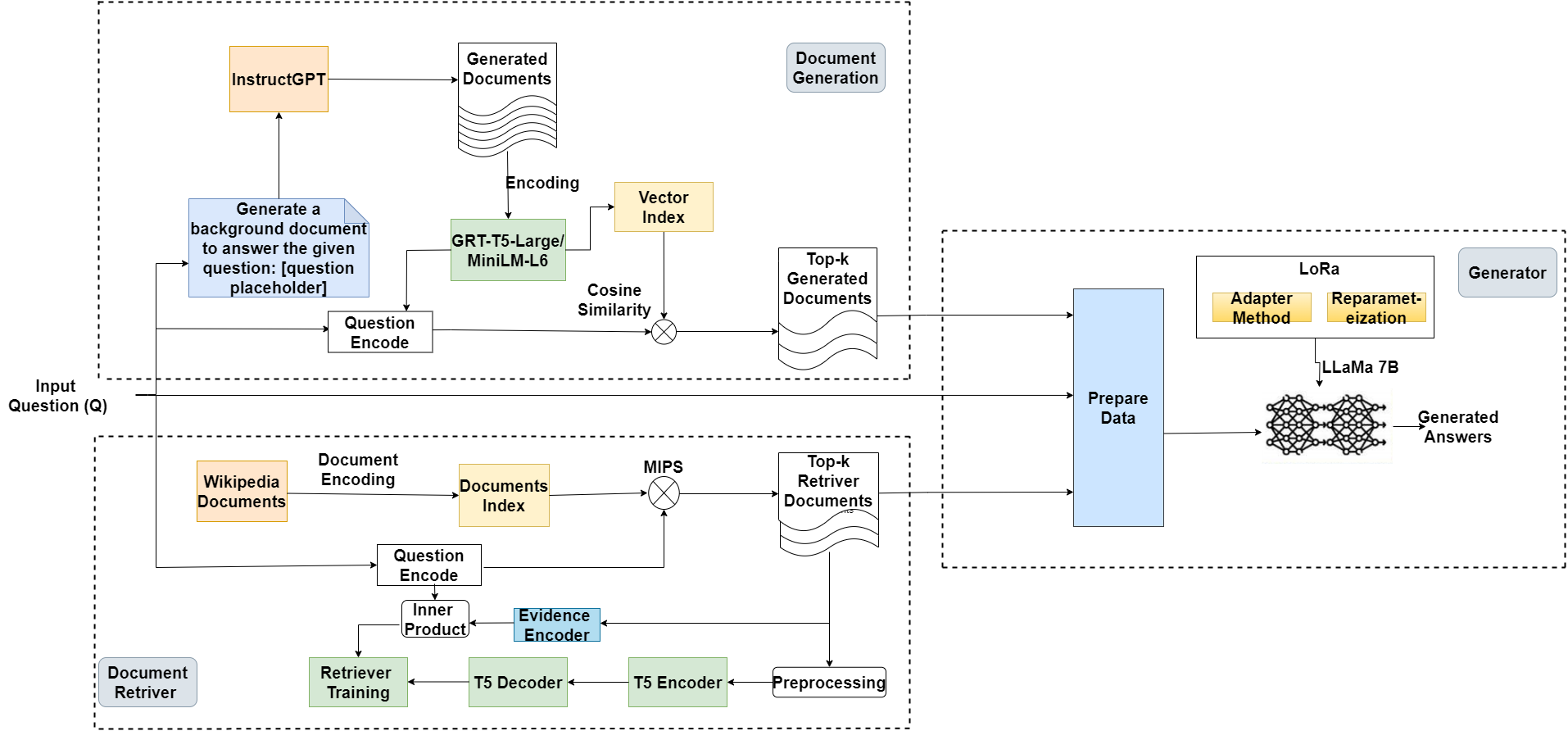
- The GRG framework employs a two-stage process: first, an instruct-tuned LLM (e.g., InstructGPT) generates synthetic, contextually rich documents based on the input question.
- Simultaneously, a dual-encoder dense passage retriever (e.g., DPR-based) retrieves relevant documents from an external corpus using semantic similarity.
- The generated and retrieved documents are concatenated and fed into a second LLM, which produces the final answer through a unified reasoning process.
- The Vector Index Retriever is introduced as an efficient, vector-based retrieval mechanism to improve knowledge coverage and answer likelihood.
- The method is trained end-to-end with a focus on balancing quality and diversity of answers, particularly handling ambiguous or multi-fact questions.
- The approach is evaluated on TriviaQA, NQ, and WebQ, with ablation studies to analyze component contributions.

Experimental results
Research questions
- RQ1Can combining LLM-generated context with external document retrieval improve answer accuracy in open-domain QA?
- RQ2How does the interaction between generated and retrieved documents affect answer relevance and informativeness?
- RQ3Does the GRG framework outperform existing generate-then-read and retrieve-then-read pipelines in terms of F1 and exact match scores?
- RQ4What is the impact of document generation quality and retrieval precision on the final answer generation?
- RQ5How well does GRG handle ambiguous or multi-fact questions compared to baseline models?
Key findings
- GRG achieves state-of-the-art performance on TriviaQA, improving F1 scores by at least +5.2 points over the best baseline (RFiD).
- On the Natural Questions (NQ) dataset, GRG improves F1 by +4.2 points compared to the strongest prior method.
- On WebQ, GRG achieves a +1.6 F1 point improvement over the current SOTA, demonstrating consistent gains across diverse benchmarks.
- The model generates multiple correct answers for ambiguous questions, such as identifying both 'Moonwalk' and 'Moonwalk (disambiguation)' for Michael Jackson’s autobiography, reflecting enhanced knowledge coverage.
- Ablation studies confirm that both document generation and retrieval contribute significantly to performance, with the combined use yielding the best results.
- The framework demonstrates robustness in handling nuanced questions, correctly identifying Jamie Lee Curtis’s star sign as Scorpio, matching the gold standard.
Read this paper
Open the full text in the Nubint reader and ask about any passage as you read.
Read this paper on NubintThis review was generated by AI from the original paper. Please check the paper before citing it.