
[Paper Review] Geographic Location Encoding with Spherical Harmonics and Sinusoidal Representation Networks
This paper introduces a global location encoder using spherical harmonic embeddings paired with Sinusoidal Representation Networks (SirenNets), showing strong, especially polar-region, performance and arguing SirenNets act as learned DFS embeddings.
Learning representations of geographical space is vital for any machine learning model that integrates geolocated data, spanning application domains such as remote sensing, ecology, or epidemiology. Recent work embeds coordinates using sine and cosine projections based on Double Fourier Sphere (DFS) features. These embeddings assume a rectangular data domain even on global data, which can lead to artifacts, especially at the poles. At the same time, little attention has been paid to the exact design of the neural network architectures with which these functional embeddings are combined. This work proposes a novel location encoder for globally distributed geographic data that combines spherical harmonic basis functions, natively defined on spherical surfaces, with sinusoidal representation networks (SirenNets) that can be interpreted as learned Double Fourier Sphere embedding. We systematically evaluate positional embeddings and neural network architectures across various benchmarks and synthetic evaluation datasets. In contrast to previous approaches that require the combination of both positional encoding and neural networks to learn meaningful representations, we show that both spherical harmonics and sinusoidal representation networks are competitive on their own but set state-of-the-art performances across tasks when combined. The model code and experiments are available at https://github.com/marccoru/locationencoder.
Motivation & Objective
- Motivate robust geographic location representations across domains like remote sensing, ecology, and epidemiology.
- Address artifacts from DFS-based embeddings on a spherical Earth, especially near the poles.
- Propose a spherical harmonic (SH) based positional embedding and pair it with Sinusoidal Representation Networks (SirenNets).
- Systematically evaluate SH+SirenNet across diverse synthetic and real-world datasets (interpolation, classification, and multi-variable regression).
Proposed method
- Define a global location encoding using SH basis functions Y_l^m with trainable weights w_l^m and a maximum degree L (eq. 3).
- Represent f(λ,φ) on the sphere as a weighted sum of SHs and learn the weights via a neural network (linear layer or more complex nets).
- Use Sinusoidal Representation Networks (SirenNets) as the neural backbone to learn complex mappings from SH embeddings, interpreting SirenNet as a learned DFS embedding.
- Compare SH with SirenNet against DFS-based embeddings (Wrap, Grid, SphereC, SphereM, etc.) across multiple tasks.
- Provide analytic/pre-computed SH implementations and discuss computational efficiency relative to DFS-based approaches.
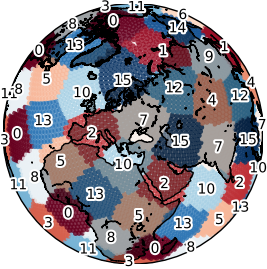
Experimental results
Research questions
- RQ1Do spherical harmonic embeddings with neural networks outperform DFS-based encodings on global geolocation tasks?
- RQ2How does the combination of SH embeddings with SirenNets compare to other NN architectures across diverse datasets (synthetic, climate, land/ocean, and iNaturalist)?
- RQ3Can SH embeddings reduce polar artifacts evident with DFS-based encodings and improve polar-region predictions?
- RQ4What are the computational trade-offs of SH implementations (analytic/pre-computed vs closed-form) for large SH degrees?
Key findings
- SH embeddings perform robustly across networks, including simple Linear layers, and achieve strong accuracy across datasets.
- SirenNet consistently delivers high performance and, when combined with SH, sets new state-of-the-art on several tasks, including iNaturalist and checkerboard datasets.
- SH embeddings substantially mitigate polar artifacts seen with DFS-based encodings, maintaining stable performance near the poles.
- In ERA5 multi-variable interpolation, SH with FcNet achieved the best results in the study, with SH+SirenNet also performing competitively across tasks.
- SH encodings enable learning implicit neural representations of geographic data that are globally defined and polar-friendly, outperforming traditional DFS-based approaches in key scenarios.
Better researchstarts right now
From reading papers to final review, dramatically reduce your research time.
No credit card · Free plan available
This review was created by AI and reviewed by human editors.