
[Paper Review] Geometric Wide-Angle Camera Calibration: A Review and Comparative Study
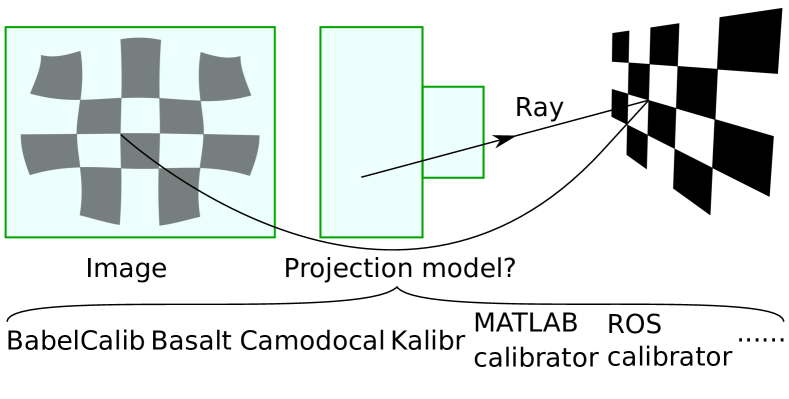
This paper reviews and evaluates six major geometric camera calibration tools—BabelCalib, Basalt, Camodocal, Kalibr, MATLAB calibrator, and OpenCV-based ROS calibrator—on wide-angle and fisheye lenses using simulated and real data. It identifies the KB-8 model as most reliable for large-angle cameras due to superior stability and accuracy, while highlighting parameter redundancy in the Mei model and tool-specific failure rates in optimization-based calibration.
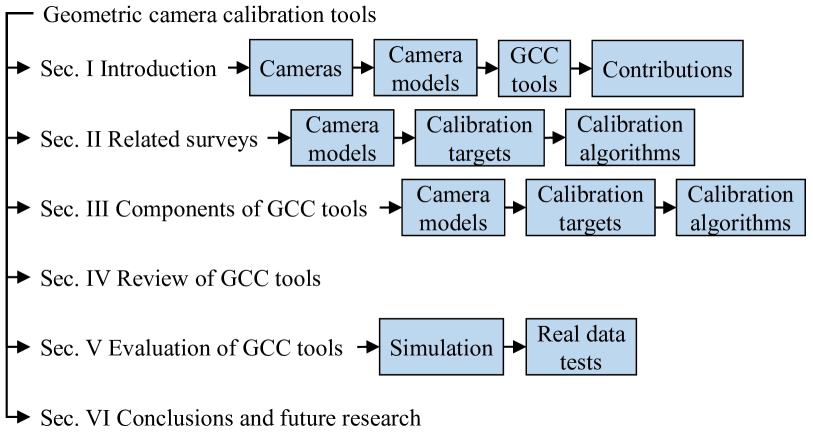
Wide-angle cameras are widely used in photogrammetry and autonomous systems which rely on the accurate metric measurements derived from images. To find the geometric relationship between incoming rays and image pixels, geometric camera calibration (GCC) has been actively developed. Aiming to provide practical calibration guidelines, this work surveys the existing GCC tools and evaluates the representative ones for wide-angle cameras. The survey covers camera models, calibration targets, and algorithms used in these tools, highlighting their properties and the trends in GCC development. The evaluation compares six target-based GCC tools, namely, BabelCalib, Basalt, Camodocal, Kalibr, the MATLAB calibrator, and the OpenCV-based ROS calibrator, with simulated and real data for wide-angle cameras described by four parametric projection models. These tests reveal the strengths and weaknesses of these camera models, as well as the repeatability of these GCC tools. In view of the survey and evaluation, future research directions of wide-angle GCC are also discussed.
Motivation & Objective
- To address the challenge practitioners face in selecting appropriate camera calibration tools due to the proliferation of diverse tools and camera models.
- To evaluate the consistency, repeatability, and accuracy of six widely used calibration tools on cameras with wide-angle and fisheye lenses.
- To assess the performance of three traditional camera models—pinhole radial tangential, KB-8, and Mei—under both simulated and real-world conditions.
- To identify key limitations in current calibration tools, particularly in outlier handling, parameter initialization, and optimization robustness.
- To guide future research by proposing directions such as interactive calibration, static calibration with active targets, and calibration-aware reconstruction pipelines.
Proposed method
- The study evaluates six calibration tools: BabelCalib, Basalt, Camodocal, Kalibr, MATLAB calibrator, and OpenCV-based ROS calibrator, using both synthetic and real datasets from four wide-angle and fisheye lenses.
- Simulated data were generated using three standard camera models: pinhole radial tangential, KB-8, and Mei, with known ground-truth parameters to assess accuracy and stability.
- Real datasets were collected using four lenses (BM4218, BM4018, BT2120, MTV185) across nine sequences each, with planar calibration targets and controlled imaging conditions.
- Reprojection error (RMS) and parameter consistency (mean, standard deviation) across sequences were used as primary metrics to evaluate tool performance.
- Outlier detection and handling were analyzed by examining corner detection errors, particularly in blurry or low-contrast images.
- The evaluation focused on parameter stability, convergence rates, and failure cases, especially for models like Mei that exhibit parameter redundancy.
Experimental results
Research questions
- RQ1Which geometric camera model—pinhole radial tangential, KB-8, or Mei—yields the most stable and accurate calibration results for wide-angle and fisheye lenses?
- RQ2How do the six major calibration tools (BabelCalib, Basalt, Camodocal, Kalibr, MATLAB, ROS/OpenCV) compare in terms of reprojection error and parameter consistency across real and simulated data?
- RQ3What causes failure in optimization-based calibration tools, and how do outlier detection and initialization affect calibration robustness?
- RQ4How do parameter redundancy and non-uniqueness in models like the Mei model impact calibration reliability and repeatability?
- RQ5What are the key limitations in current calibration pipelines, and what future research directions can improve calibration robustness and usability?
Key findings
- The KB-8 model demonstrated superior stability and accuracy for cameras with a diagonal angle of view (DAOV) >100°, making it the preferred choice for wide-angle and fisheye lenses.
- The Mei model exhibited high parameter variance despite low RMS reprojection errors, indicating instability due to parameter redundancy, especially in real-world data.
- Camodocal, Kalibr, and the MATLAB calibrator showed strong performance on the pinhole radial tangential model, while BabelCalib and Camodocal performed well on the KB-8 model.
- Basalt failed in 7–8 out of 9 sequences for certain lenses (BM4218, MTV185), indicating poor robustness in optimization, likely due to initialization or convergence issues.
- Outlier detection was critical; corners displaced by a few pixels from true locations significantly affected calibration, but most tools handled them effectively.
- The EUCM model provided consistent parameter estimates (e.g., α, β), while the Mei model’s k1 parameter showed high variability, underscoring its instability.
Better researchstarts right now
From reading papers to final review, dramatically reduce your research time.
No credit card · Free plan available
This review was created by AI and reviewed by human editors.