
[Paper Review] GES: Generalized Exponential Splatting for Efficient Radiance Field Rendering
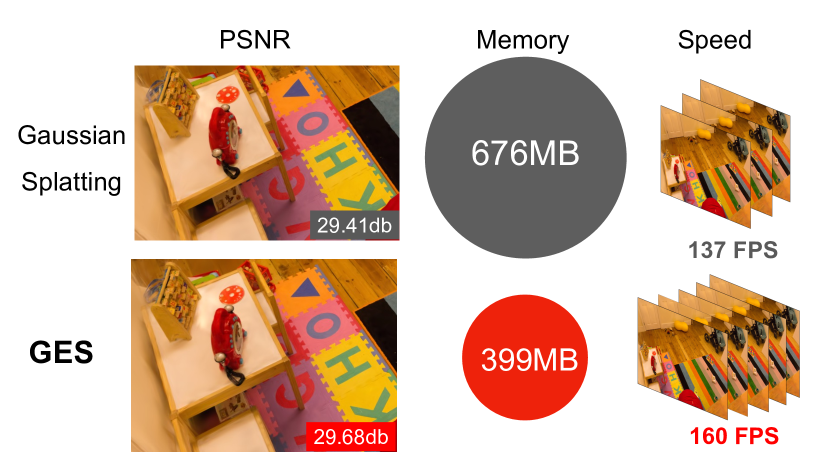
GES (Generalized Exponential Splatting) replaces 3D Gaussians with learnable Generalized Exponential Functions (GEFs) to model scenes more efficiently, enabling sharper edge representation with fewer components. It achieves up to 50% lower memory usage and 39% faster rendering than Gaussian Splatting while maintaining competitive novel-view synthesis performance via a frequency-modulated loss for progressive high-frequency detail learning.
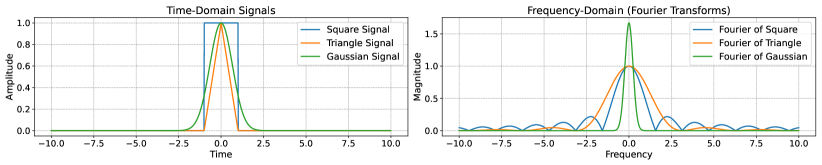
Advancements in 3D Gaussian Splatting have significantly accelerated 3D reconstruction and generation. However, it may require a large number of Gaussians, which creates a substantial memory footprint. This paper introduces GES (Generalized Exponential Splatting), a novel representation that employs Generalized Exponential Function (GEF) to model 3D scenes, requiring far fewer particles to represent a scene and thus significantly outperforming Gaussian Splatting methods in efficiency with a plug-and-play replacement ability for Gaussian-based utilities. GES is validated theoretically and empirically in both principled 1D setup and realistic 3D scenes. It is shown to represent signals with sharp edges more accurately, which are typically challenging for Gaussians due to their inherent low-pass characteristics. Our empirical analysis demonstrates that GEF outperforms Gaussians in fitting natural-occurring signals (e.g. squares, triangles, and parabolic signals), thereby reducing the need for extensive splitting operations that increase the memory footprint of Gaussian Splatting. With the aid of a frequency-modulated loss, GES achieves competitive performance in novel-view synthesis benchmarks while requiring less than half the memory storage of Gaussian Splatting and increasing the rendering speed by up to 39%. The code is available on the project website https://abdullahamdi.com/ges .
Motivation & Objective
- To address the high memory footprint of 3D Gaussian Splatting, which requires excessive Gaussians to represent sharp edges due to their inherent low-pass filtering property.
- To develop a more efficient and accurate 3D representation that better models high-bandwidth signals like sharp discontinuities in shape and appearance.
- To enable faster, memory-efficient novel-view synthesis by replacing Gaussians with Generalized Exponential Functions (GEFs) that have superior fitting capabilities for non-band-limited signals.
- To design a frequency-modulated loss that guides GES to progressively learn high-frequency details, improving reconstruction fidelity without increasing component count.
- To provide a plug-and-play alternative to Gaussian Splatting that maintains compatibility with existing Gaussian-based rendering and optimization pipelines.
Proposed method
- GES uses Generalized Exponential Functions (GEFs) of the form $ f_{\beta}(x) = A e^{-\left( \frac{|x - \mu|}{\alpha} \right)^\beta} $, where $\beta$ is a learnable shape parameter, to represent 3D scene components instead of Gaussians.
- The method employs a differentiable splatting renderer that projects GEFs into 2D image space for rendering, enabling end-to-end training.
- A novel frequency-modulated image loss $\mathcal{L}_{\omega}$ is introduced, which applies masks to focus optimization on specific frequency bands, promoting progressive learning of high-frequency details.
- The shape parameter $\beta$ is optimized during training, allowing GEFs to adaptively model both smooth and sharp features, with $\beta=2$ reducing to the Gaussian case.
- The framework supports plug-and-play replacement of Gaussian Splatting components, maintaining compatibility with existing rendering and optimization pipelines.
- Ablation studies evaluate the impact of learning rate, reset interval, and strength of the shape parameter, as well as initialization strategies for $\beta$.
Experimental results
Research questions
- RQ1Can Generalized Exponential Functions (GEFs) with learnable shape parameters represent sharp edges and high-bandwidth signals more accurately than Gaussians?
- RQ2Does replacing Gaussians with GEFs reduce the number of components needed to represent a scene, thereby lowering memory usage?
- RQ3Can a frequency-modulated loss improve the training dynamics of GES, enabling better reconstruction of fine details while maintaining efficiency?
- RQ4How does GES compare to Gaussian Splatting in terms of rendering speed, memory footprint, and novel-view synthesis quality on standard benchmarks?
- RQ5To what extent can GES serve as a direct, plug-and-play replacement for Gaussian Splatting in existing 3D rendering pipelines?
Key findings
- GES reduces memory usage by up to 50% compared to Gaussian Splatting, achieving a file size of 222 MB on the Tanks & Temples dataset versus 411 MB for Gaussians.
- Rendering speed increases by up to 39% due to fewer components and faster convergence, despite GES requiring more iterations to converge.
- In the Mip-NeRF360 benchmark, GES achieves a PSNR of 26.89 with a file size of 651 MB, outperforming Gaussians in efficiency while maintaining competitive PSNR (26.83) and SSIM (0.846).
- The frequency-modulated loss $\mathcal{L}_{\omega}$ improves reconstruction in high-contrast and smooth regions, reducing LPIPS by 0.014 compared to GES without the loss.
- With only 2 GEFs, the method fits a square signal with 0.44 error, outperforming 5 Gaussians (0.48 error), demonstrating superior edge representation.
- The distribution of learned $\beta$ values shows a slight bias toward values below 2, indicating adaptation to non-Gaussian, high-frequency features.
Read this paper
Open the full text in the Nubint reader and ask about any passage as you read.
Read this paper on NubintThis review was generated by AI from the original paper. Please check the paper before citing it.