
[Paper Review] Ghostbuster: Detecting Text Ghostwritten by Large Language Models
Ghostbuster detects AI-generated text without needing target-model probabilities by using structured feature search over weaker language models and a logistic classifier, achieving 99.0 F1 in-domain across domains.
We introduce Ghostbuster, a state-of-the-art system for detecting AI-generated text. Our method works by passing documents through a series of weaker language models, running a structured search over possible combinations of their features, and then training a classifier on the selected features to predict whether documents are AI-generated. Crucially, Ghostbuster does not require access to token probabilities from the target model, making it useful for detecting text generated by black-box models or unknown model versions. In conjunction with our model, we release three new datasets of human- and AI-generated text as detection benchmarks in the domains of student essays, creative writing, and news articles. We compare Ghostbuster to a variety of existing detectors, including DetectGPT and GPTZero, as well as a new RoBERTa baseline. Ghostbuster achieves 99.0 F1 when evaluated across domains, which is 5.9 F1 higher than the best preexisting model. It also outperforms all previous approaches in generalization across writing domains (+7.5 F1), prompting strategies (+2.1 F1), and language models (+4.4 F1). We also analyze the robustness of our system to a variety of perturbations and paraphrasing attacks and evaluate its performance on documents written by non-native English speakers.
Motivation & Objective
- Motivate the need for robust AI-generated-text detectors with strong generalization across domains, prompts, and models.
- Develop a detection method that does not require access to the target model's token probabilities (black-box setting).
- Create and release benchmarks across domains (student essays, news, creative writing) to evaluate detectors.
- Investigate generalization, robustness to prompting strategies, and model-paradigm shifts.
- Provide an interpretable feature-centric detection approach to reduce brittleness.
Proposed method
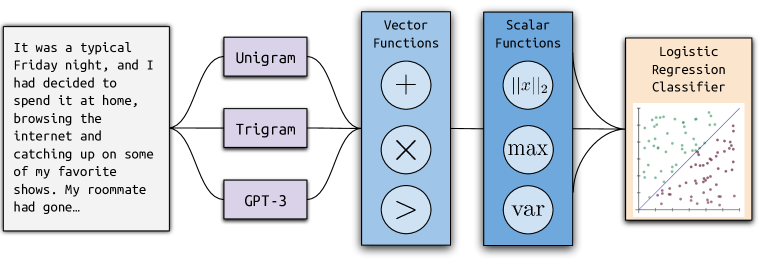
- Pass each document through a series of weaker language models to obtain per-token probabilities.
- Define a structured search over a space of vector and scalar feature functions that combine model probabilities.
- Train a logistic regression classifier on the selected features plus seven handcrafted features.
- Use probability vectors from weaker models (unigram, Kneser–Ney trigram, ada and davinci) as inputs to feature construction.
- Avoid reliance on high-capacity sequence models to improve robustness to distribution shifts.
Experimental results
Research questions
- RQ1Can AI-generated text be detected without access to the target model's token probabilities (black-box detection)?
- RQ2How well does the detector generalize across domains, prompts, and unseen models?
- RQ3Are structured-feature and weaker-model probability approaches robust to edits and paraphrasing?
- RQ4What is the impact of document length on detection performance?
- RQ5How does the method perform on non-native English text?
Key findings
- Ghostbuster achieves 99.0 F1 on in-domain detection across three domains.
- Out-of-domain average F1 is 97.0, outperforming DetectGPT by 39.6 and GPTZero by 7.5 on average.
- Generalization across prompts yields 99.5 F1, better than RoBERTa and GPTZero.
- Across models (including Claude), Ghostbuster attains 92.2 F1 on Claude with some degradation compared to ChatGPT-based data.
- Ablations show structured search and inclusion of neural-LM probabilities (ada, davinci) are crucial for performance; handcrafted features have limited impact alone.
- Performance improves with longer documents and is less reliable for very short texts (≤100 tokens).
- Code and three new datasets are released for benchmarking.
Read this paper
Open the full text in the Nubint reader and ask about any passage as you read.
Read this paper on NubintThis review was generated by AI from the original paper. Please check the paper before citing it.