
[Paper Review] GistNet: a Geometric Structure Transfer Network for Long-Tailed Recognition
GistNet proposes a geometric structure transfer framework for long-tailed recognition by leveraging overfitting to popular classes through a novel classifier architecture that uses class-specific centers and shared displacement vectors to encode class geometry. The GIST training algorithm combines class-balanced and random sampling to transfer geometric structure from high-shot to few-shot classes, achieving state-of-the-art performance without manual class weighting or explicit class grouping.
The problem of long-tailed recognition, where the number of examples per class is highly unbalanced, is considered. It is hypothesized that the well known tendency of standard classifier training to overfit to popular classes can be exploited for effective transfer learning. Rather than eliminating this overfitting, e.g. by adopting popular class-balanced sampling methods, the learning algorithm should instead leverage this overfitting to transfer geometric information from popular to low-shot classes. A new classifier architecture, GistNet, is proposed to support this goal, using constellations of classifier parameters to encode the class geometry. A new learning algorithm is then proposed for GeometrIc Structure Transfer (GIST), with resort to a combination of loss functions that combine class-balanced and random sampling to guarantee that, while overfitting to the popular classes is restricted to geometric parameters, it is leveraged to transfer class geometry from popular to few-shot classes. This enables better generalization for few-shot classes without the need for the manual specification of class weights, or even the explicit grouping of classes into different types. Experiments on two popular long-tailed recognition datasets show that GistNet outperforms existing solutions to this problem.
Motivation & Objective
- To address long-tailed recognition by transferring geometric structure from high-shot to low-shot classes instead of combating overfitting.
- To eliminate the need for manual class weighting or heuristic recipes in training deep classifiers under long-tailed data distributions.
- To develop a data-driven method that naturally leverages the inherent overfitting tendency of standard training to improve generalization for few-shot classes.
- To design a classifier architecture that explicitly models class geometry through constellations of parameters, including class-specific centers and shared displacements.
Proposed method
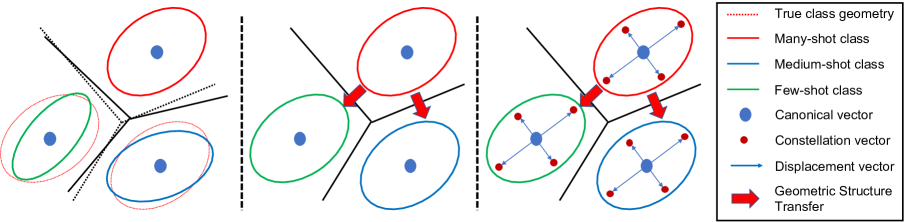
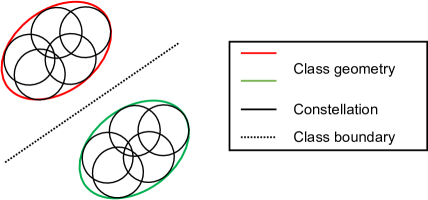
- GistNet uses a classifier architecture with class-specific centers and shared displacement vectors to encode class geometry, forming a 'constellation' of parameters.
- The model employs a hybrid training strategy using both class-balanced and random mini-batches to learn different components: centers via class-balanced sampling, and displacements via random sampling.
- The GeometrIc Structure Transfer (GIST) loss combines cross-entropy with a geometric regularization that encourages shared displacement vectors to inherit the natural geometry of well-learned many-shot classes.
- The displacement vectors are learned through random sampling, which exploits the standard classifier's overfitting to popular classes, enabling transfer of geometric structure to low-shot classes.
- The method avoids explicit class weighting by relying on the dual sampling strategy to decouple center learning (class-specific) from geometry learning (shared).
- The parameter constellation is defined as $ \mathbf{w}_{kj} = \mathbf{w}_k + \delta_j $, where $ \mathbf{w}_k $ is the class center and $ \delta_j $ are shared displacements, forming a geometric structure invariant to class frequency.
Experimental results
Research questions
- RQ1Can overfitting to popular classes in standard training be leveraged rather than mitigated to improve few-shot generalization?
- RQ2Can geometric structure from well-learned many-shot classes be effectively transferred to low-shot classes without manual class weighting?
- RQ3Does a shared displacement vector representation enable better generalization for few-shot classes compared to standard classifiers?
- RQ4How robust is the GistNet architecture to variations in the number of displacement vectors or their functional form?
Key findings
- GistNet achieves state-of-the-art performance on two long-tailed recognition benchmarks, outperforming existing methods without manual class weighting.
- The ablation study shows that combining class-balanced and random sampling is critical: removing the random sampling loss (COS+CS+GIST) harms few-shot performance by overfitting centers to many-shot data.
- Using rotation or learned functions $ g $ for parameter constellations yields minimal performance gains compared to simple addition, indicating that geometric constraints matter more than implementation details.
- The optimal number of displacement vectors $ m $ is 4, with performance saturating or slightly improving at $ m=8 $ for few-shot classes, suggesting geometry transfer is most beneficial for low-resource classes.
- t-SNE visualization confirms that GistNet produces better-separated and more consistent class boundaries, especially for few-shot classes, compared to baseline models.
- Inference analysis shows that 79.2% of classes use all four displacement vectors for at least 10% of test samples, indicating the model does not collapse to a single constellation.
Read this paper
Open the full text in the Nubint reader and ask about any passage as you read.
Read this paper on NubintThis review was generated by AI from the original paper. Please check the paper before citing it.