
[Paper Review] Git-Theta: A Git Extension for Collaborative Development of Machine Learning Models
Git-Theta is a Git extension that enables collaborative, version-controlled development of machine learning models by treating model checkpoints as structured parameter groups rather than blobs. It supports communication-efficient updates, automatic merging of model changes, and fine-grained version tracking, reducing storage and transfer costs while enabling collaborative model evolution—demonstrated by a 0.27 GB storage footprint for LoRA updates and 1024 kB for vocabulary changes.
Currently, most machine learning models are trained by centralized teams and are rarely updated. In contrast, open-source software development involves the iterative development of a shared artifact through distributed collaboration using a version control system. In the interest of enabling collaborative and continual improvement of machine learning models, we introduce Git-Theta, a version control system for machine learning models. Git-Theta is an extension to Git, the most widely used version control software, that allows fine-grained tracking of changes to model parameters alongside code and other artifacts. Unlike existing version control systems that treat a model checkpoint as a blob of data, Git-Theta leverages the structure of checkpoints to support communication-efficient updates, automatic model merges, and meaningful reporting about the difference between two versions of a model. In addition, Git-Theta includes a plug-in system that enables users to easily add support for new functionality. In this paper, we introduce Git-Theta's design and features and include an example use-case of Git-Theta where a pre-trained model is continually adapted and modified. We publicly release Git-Theta in hopes of kickstarting a new era of collaborative model development.
Motivation & Objective
- To address the lack of collaborative version control in machine learning model development, where models are typically trained in isolation and treated as monolithic blobs.
- To enable fine-grained, communication-efficient tracking of model parameter changes, inspired by recent research on low-rank adaptation and parameter-efficient tuning.
- To support automatic merging of independently trained model updates, allowing collaborative evolution of models without full retraining.
- To integrate seamlessly into existing Git-based software development workflows by extending Git with model-aware versioning capabilities.
- To provide a pluggable architecture that supports extensibility for new update types, merging strategies, and checkpoint formats.
Proposed method
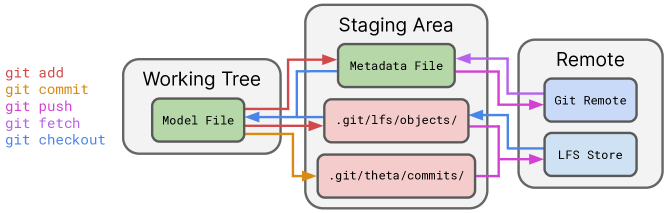
- Git-Theta extends Git to treat model checkpoints as collections of parameter group tensors, enabling version control at the parameter level rather than as monolithic files.
- It leverages parameter-efficient fine-tuning methods (e.g., LoRA, adapters) to represent updates as small, sparse tensors, drastically reducing storage and communication overhead.
- The system uses Git LFS and TensorStore for efficient storage and compression of model checkpoints, especially beneficial for high-precision to low-precision conversions.
- It introduces a plug-in system that allows users to define new update types, merging strategies, and checkpoint formats, enhancing extensibility.
- Git-Theta enables automatic merging of model updates by manipulating parameter group values, similar to Git’s merge logic but applied to model parameters.
- It provides meaningful diff reporting between model versions by comparing parameter group changes, offering insights into model evolution.
Experimental results
Research questions
- RQ1Can model development be made collaborative and version-controlled using existing Git infrastructure, with fine-grained tracking of parameter-level changes?
- RQ2Can communication-efficient updates (e.g., LoRA, adapters) be natively supported in a version control system to reduce storage and transfer costs?
- RQ3Can automatic merging of independently trained model updates be achieved at scale, preserving model performance and enabling collaborative evolution?
- RQ4How does the storage and performance overhead of Git-Theta compare to traditional blob-based model tracking systems like DVC or MLflow?
- RQ5To what extent can Git-Theta be extended to support diverse model architectures, update types, and merging strategies through a plug-in architecture?
Key findings
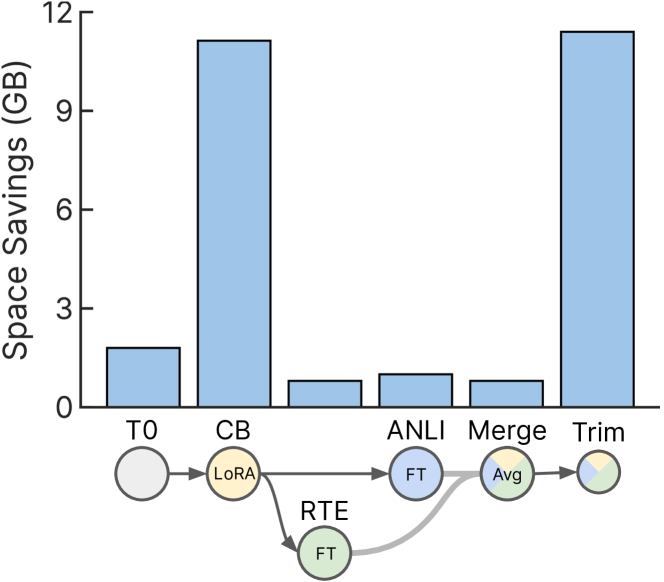
- Git-Theta reduced storage for a LoRA-based update to just 0.27 GB, demonstrating significant efficiency gains over blob-based systems.
- A model update involving removal of vocabulary indices required only 1024 kB of storage, highlighting the system’s ability to track sparse, non-dense changes efficiently.
- Processing times were reduced when fewer parameters were modified, indicating performance benefits from selective parameter updates.
- The system successfully merged model updates from different contributors—e.g., combining RTE and ANLI fine-tuned models—resulting in improved performance on RTE, as predicted by prior research.
- Git-Theta’s use of TensorStore enabled effective compression, especially in the first commit, reducing storage costs for high-precision model checkpoints.
- The system demonstrated that collaborative model development is feasible with Git-Theta, as shown in a real-world example where a T0 3B model was incrementally updated and merged across multiple tasks.
Read this paper
Open the full text in the Nubint reader and ask about any passage as you read.
Read this paper on NubintThis review was generated by AI from the original paper. Please check the paper before citing it.