
[Paper Review] GLIGEN: Open-Set Grounded Text-to-Image Generation
GLIGEN introduces a method to enable pretrained text-to-image diffusion models to generate images conditioned on diverse grounding inputs—such as bounding boxes, keypoints, reference images, and spatial maps—by freezing the original model weights and injecting trainable gated Transformer layers that fuse grounding signals. The approach achieves state-of-the-art zero-shot performance on layout-to-image generation benchmarks, generalizing effectively to open-vocabulary, novel spatial configurations and unseen concepts.
Large-scale text-to-image diffusion models have made amazing advances. However, the status quo is to use text input alone, which can impede controllability. In this work, we propose GLIGEN, Grounded-Language-to-Image Generation, a novel approach that builds upon and extends the functionality of existing pre-trained text-to-image diffusion models by enabling them to also be conditioned on grounding inputs. To preserve the vast concept knowledge of the pre-trained model, we freeze all of its weights and inject the grounding information into new trainable layers via a gated mechanism. Our model achieves open-world grounded text2img generation with caption and bounding box condition inputs, and the grounding ability generalizes well to novel spatial configurations and concepts. GLIGEN's zero-shot performance on COCO and LVIS outperforms that of existing supervised layout-to-image baselines by a large margin.
Motivation & Objective
- To extend pretrained text-to-image diffusion models with controllability through diverse grounding inputs beyond natural language.
- To preserve the vast concept knowledge of the original model while injecting new localization and visual grounding capabilities.
- To enable zero-shot generalization to novel objects and spatial configurations not seen during training.
- To improve image generation quality and controllability by scheduling the use of grounding information during inference.
- To unify training data formats from detection and grounding tasks to enhance model generalization.
Proposed method
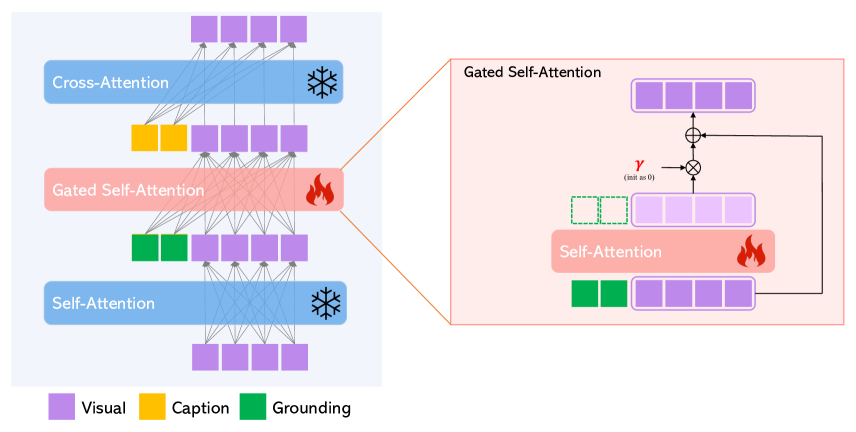
- Freeze all weights of a pretrained text-to-image diffusion model to prevent knowledge forgetting.
- Inject trainable gated Transformer layers that accept grounding inputs (e.g., bounding boxes, keypoints, reference images) and fuse them with text embeddings.
- Use a scheduled fusion mechanism that gradually integrates grounding signals during training via a learnable gating function.
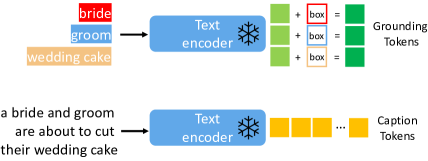
- Encode each grounded entity’s phrase and spatial location using a shared text encoder, enabling zero-shot generalization across concepts.
- Train the model on a unified dataset combining object detection and grounding annotations, following the GLIP framework for improved generalization.
- Enable flexible inference via scheduled sampling, where grounding layers are used in early denoising steps and gradually deactivated to balance control and image quality.
Experimental results
Research questions
- RQ1Can pretrained text-to-image diffusion models be effectively extended to accept diverse grounding inputs such as bounding boxes, keypoints, and reference images without catastrophic forgetting?
- RQ2How well does the model generalize to novel objects and spatial configurations not seen during training, particularly in open-vocabulary settings?
- RQ3What is the impact of training data scale and format unification (detection + grounding) on zero-shot generalization performance?
- RQ4Can scheduled sampling during inference improve both image quality and grounding fidelity?
- RQ5To what extent can the model leverage visual features from reference images to improve generation beyond text-only conditioning?
Key findings
- GLIGEN achieves state-of-the-art zero-shot performance on COCO and LVIS layout-to-image generation benchmarks, significantly outperforming existing supervised baselines.
- The model generalizes effectively to open-vocabulary concepts, including rare and unseen objects, due to shared text space and unified training data.
- Scaling up the training data leads to consistent improvements in zero-shot performance, especially for rare concepts.
- Scheduled sampling enables better image quality and improved generalization, allowing models trained on human keypoints to generate non-human objects like robots.
- The model successfully generates images with precise spatial control using diverse inputs such as depth maps, edge maps, and semantic maps, demonstrating strong versatility.
- GLIGEN improves grounding fidelity over vanilla Stable Diffusion, reducing the tendency to overlook specific objects or mislocate them spatially.
Read this paper
Open the full text in the Nubint reader and ask about any passage as you read.
Read this paper on NubintThis review was generated by AI from the original paper. Please check the paper before citing it.