
[Paper Review] GLPanoDepth: Global-to-Local Panoramic Depth Estimation
GLPanoDepth proposes a global-to-local deep learning framework for monocular panoramic depth estimation using a novel Cubemap Vision Transformer (CViT) to extract distortion-free global features from equirectangular panoramas, combined with a convolutional branch for local details and a gated fusion module for feature integration, achieving state-of-the-art performance on multiple benchmarks.
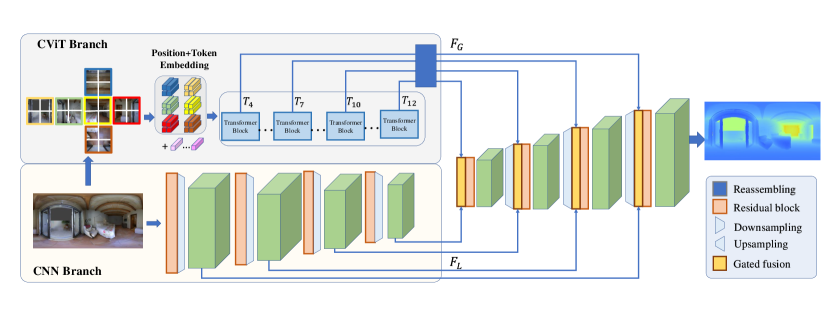
In this paper, we propose a learning-based method for predicting dense depth values of a scene from a monocular omnidirectional image. An omnidirectional image has a full field-of-view, providing much more complete descriptions of the scene than perspective images. However, fully-convolutional networks that most current solutions rely on fail to capture rich global contexts from the panorama. To address this issue and also the distortion of equirectangular projection in the panorama, we propose Cubemap Vision Transformers (CViT), a new transformer-based architecture that can model long-range dependencies and extract distortion-free global features from the panorama. We show that cubemap vision transformers have a global receptive field at every stage and can provide globally coherent predictions for spherical signals. To preserve important local features, we further design a convolution-based branch in our pipeline (dubbed GLPanoDepth) and fuse global features from cubemap vision transformers at multiple scales. This global-to-local strategy allows us to fully exploit useful global and local features in the panorama, achieving state-of-the-art performance in panoramic depth estimation.
Motivation & Objective
- Address the challenge of limited global context modeling in fully-convolutional networks for panoramic depth estimation.
- Overcome the space-varying distortion inherent in equirectangular projections of omnidirectional images.
- Leverage the long-range dependency modeling of vision transformers while preserving local spatial structures through a dedicated CNN branch.
- Develop a two-branch architecture that fuses global and local features at multiple scales to improve depth prediction quality.
- Achieve state-of-the-art performance on panoramic depth estimation benchmarks without strong assumptions about scene orientation or gravity alignment.
Proposed method
- Propose Cubemap Vision Transformers (CViT), a vision transformer variant that projects spherical panoramas into cubemaps to eliminate equirectangular distortion and enable global feature extraction.
- Design a two-stream network: one branch uses CViT to extract global, distortion-free features from cubemap projections, and the other uses standard convolutional layers to capture local, high-frequency details.
- Implement a multi-scale gated fusion module to progressively combine features from both branches, enabling dynamic feature weighting based on spatial context.
- Utilize a RefineNet-based feature fusion block to upsample and refine the final depth prediction from multi-stage features.
- Train the end-to-end network using standard depth supervision with a loss function that includes regression and edge-aware components.
- Apply data augmentation and normalization techniques to improve generalization, especially on challenging datasets with sparse depth annotations.
Experimental results
Research questions
- RQ1Can a vision transformer-based architecture effectively model long-range dependencies in omnidirectional panoramic images while avoiding distortion from equirectangular projection?
- RQ2How does the integration of global features from a distortion-free cubemap-based transformer with local features from a convolutional network improve panoramic depth estimation?
- RQ3What is the relative contribution of global context modeling versus local texture preservation in achieving high-accuracy depth maps from monocular panoramas?
- RQ4Does a gated fusion mechanism outperform simple concatenation in combining global and local features for depth prediction?
- RQ5To what extent does the performance of the proposed method depend on dataset size and diversity, particularly in low-data regimes?
Key findings
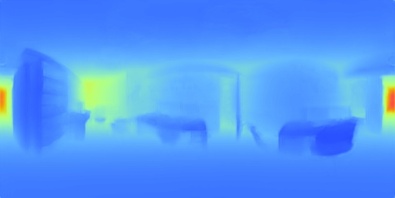
- GLPanoDepth achieves state-of-the-art performance on multiple panoramic depth estimation benchmarks, including NYUv2, KITTI, and Stanford2D3D.
- The ablation study confirms that removing the CNN branch (Ours(CViT)) leads to significant loss of fine-grained details, especially in small structures like chair legs and bookshelf edges.
- Replacing CViT with standard ViT (Ours(ViT+CNN)) results in inferior performance due to unmitigated distortion in equirectangular input, demonstrating the necessity of cubemap projection.
- The gated fusion module outperforms simple concatenation in both quantitative metrics and qualitative results, producing sharper edges and better foreground-background separation.
- The model converges faster and achieves better generalization when using the gated fusion module, indicating improved training stability and feature learning efficiency.
- The method shows limitations on small datasets like Stanford2D3D (1,413 images), where a single CViT branch fails to converge, highlighting the need for large-scale training data for transformer-based models.
Read this paper
Open the full text in the Nubint reader and ask about any passage as you read.
Read this paper on NubintThis review was generated by AI from the original paper. Please check the paper before citing it.