
[Paper Review] GMS-3DQA: Projection-based Grid Mini-patch Sampling for 3D Model Quality Assessment
This paper proposes GMS-3DQA, a no-reference 3D quality assessment method that uses multi-projection grid mini-patch sampling to reduce computational cost while maintaining high accuracy. By rendering six perpendicular projections, sampling mini-patches from them, and fusing them into a single quality mini-patch map (QMM), the method enables efficient Swin-Transformer-based feature extraction, achieving state-of-the-art performance with 3.28× faster inference and fewer parameters than prior methods.
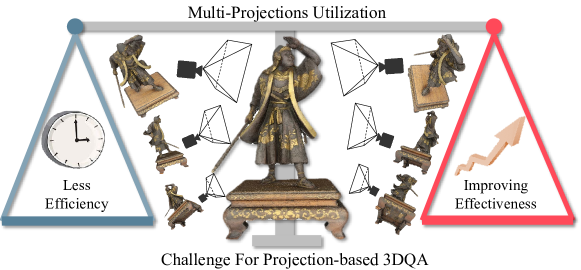
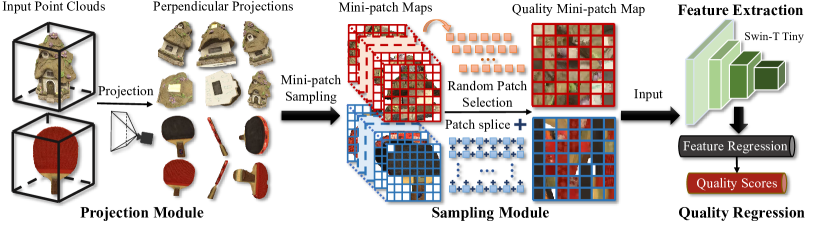
Nowadays, most 3D model quality assessment (3DQA) methods have been aimed at improving performance. However, little attention has been paid to the computational cost and inference time required for practical applications. Model-based 3DQA methods extract features directly from the 3D models, which are characterized by their high degree of complexity. As a result, many researchers are inclined towards utilizing projection-based 3DQA methods. Nevertheless, previous projection-based 3DQA methods directly extract features from multi-projections to ensure quality prediction accuracy, which calls for more resource consumption and inevitably leads to inefficiency. Thus in this paper, we address this challenge by proposing a no-reference (NR) projection-based extit{\underline{G}rid \underline{M}ini-patch \underline{S}ampling \underline{3D} Model \underline{Q}uality \underline{A}ssessment (GMS-3DQA)} method. The projection images are rendered from six perpendicular viewpoints of the 3D model to cover sufficient quality information. To reduce redundancy and inference resources, we propose a multi-projection grid mini-patch sampling strategy (MP-GMS), which samples grid mini-patches from the multi-projections and forms the sampled grid mini-patches into one quality mini-patch map (QMM). The Swin-Transformer tiny backbone is then used to extract quality-aware features from the QMMs. The experimental results show that the proposed GMS-3DQA outperforms existing state-of-the-art NR-3DQA methods on the point cloud quality assessment databases. The efficiency analysis reveals that the proposed GMS-3DQA requires far less computational resources and inference time than other 3DQA competitors. The code will be available at https://github.com/zzc-1998/GMS-3DQA.
Motivation & Objective
- To address the high computational cost and long inference time of existing projection-based 3D quality assessment (3DQA) methods.
- To reduce redundancy in multi-projection feature extraction while preserving sufficient quality information for accurate assessment.
- To develop an efficient, no-reference 3DQA framework that maintains high performance across diverse 3D model types and distortions.
- To enable effective cross-domain generalization with minimal labeled data in target domains.
Proposed method
- Rendering six perpendicular projections from a 3D model to ensure comprehensive coverage of geometric and visual quality information.
- Applying a multi-projection grid mini-patch sampling strategy (MP-GMS) to extract non-overlapping mini-patches from each projection.
- Fusing sampled mini-patches from all six views into a single quality mini-patch map (QMM) to aggregate multi-view quality patterns.
- Using a Swin-Transformer tiny backbone to extract hierarchical, quality-aware features from the QMM for final quality prediction.
- Training the model end-to-end on large-scale 3DQA databases to learn perceptually aligned quality representations.
- Optimizing for efficiency by reducing the number of input tokens and computational operations compared to processing full projections.
Experimental results
Research questions
- RQ1Can a projection-based 3DQA method achieve high accuracy while significantly reducing computational cost and inference time?
- RQ2How effective is the proposed grid mini-patch sampling strategy in reducing redundancy across multi-projection inputs?
- RQ3To what extent does the quality mini-patch map (QMM) improve performance and robustness compared to processing individual projections?
- RQ4Can the proposed method generalize well across different 3D data formats (e.g., point clouds vs. meshes) with limited labeled data in the target domain?
- RQ5How does the proposed method compare to both no-reference and full-reference 3DQA baselines in terms of accuracy and efficiency?
Key findings
- GMS-3DQA achieves state-of-the-art performance on both point cloud and mesh quality assessment databases, with SRCC of 0.75 on SJTU and 0.60 on WPC in cross-domain evaluation.
- The method is 3.28 times faster than the fastest competing 3DQA method on CPU, with significantly fewer parameters and FLOPs.
- On the SJTU-PCQA and WPC databases, GMS-3DQA significantly outperforms 14 and 15 no-reference metrics, respectively, in statistical tests.
- GMS-3DQA trained on the TMQ database achieves competitive performance (SRCC: 0.75 on SJTU, 0.60 on WPC) compared to the best intra-database models, indicating strong domain generalization.
- The method is statistically indistinguishable from full-reference methods on PCQA databases, confirming its high perceptual accuracy.
- The QMM-based approach reduces redundancy and improves robustness by aggregating quality patterns across multiple viewpoints.
Read this paper
Open the full text in the Nubint reader and ask about any passage as you read.
Read this paper on NubintThis review was generated by AI from the original paper. Please check the paper before citing it.