
[Paper Review] Goal Driven Discovery of Distributional Differences via Language Descriptions
This paper introduces D5, a goal-driven natural language generation task that automatically discovers relevant differences between two text corpora using user-specified exploration goals. Using a diagnostic benchmark (SynD5) and a real-world meta-dataset (OpenD5), the authors show that language models can generate valid and goal-relevant discoveries—improving relevance by 31% and accuracy by 12% over non-goal-conditioned baselines—while uncovering novel insights across domains like health, politics, and NLP.
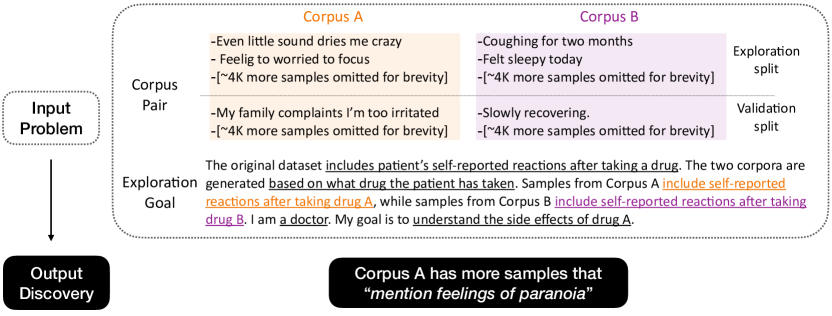
Mining large corpora can generate useful discoveries but is time-consuming for humans. We formulate a new task, D5, that automatically discovers differences between two large corpora in a goal-driven way. The task input is a problem comprising a research goal "$ extit{comparing the side effects of drug A and drug B}$" and a corpus pair (two large collections of patients' self-reported reactions after taking each drug). The output is a language description (discovery) of how these corpora differ (patients taking drug A "$ extit{mention feelings of paranoia}$" more often). We build a D5 system, and to quantitatively measure its performance, we 1) contribute a meta-dataset, OpenD5, aggregating 675 open-ended problems ranging across business, social sciences, humanities, machine learning, and health, and 2) propose a set of unified evaluation metrics: validity, relevance, novelty, and significance. With the dataset and the unified metrics, we confirm that language models can use the goals to propose more relevant, novel, and significant candidate discoveries. Finally, our system produces discoveries previously unknown to the authors on a wide range of applications in OpenD5, including temporal and demographic differences in discussion topics, political stances and stereotypes in speech, insights in commercial reviews, and error patterns in NLP models.
Motivation & Objective
- To formalize exploratory text analysis as a goal-driven natural language generation task (D5) that discovers meaningful differences between two corpora.
- To address the lack of standardized evaluation for open-ended, goal-oriented discovery in text corpora.
- To develop and evaluate a system that leverages language models to generate valid and relevant discoveries based on user-specified goals.
- To create diagnostic and open-ended evaluation frameworks—SynD5 and OpenD5—to assess D5 system performance across synthetic and real-world problems.
- To enable automated, scalable discovery of distributional differences in large text corpora, including previously unknown patterns in demographics, political stances, and NLP error patterns.
Proposed method
- Formalize D5 as a natural language generation task: input is a goal and two corpus splits (exploration and validation), output is a natural language predicate describing a valid, relevant difference.
- Build SynD5, a diagnostic benchmark with 1,000 synthetic D5 problems where ground-truth differences are known, enabling automated evaluation of discovery accuracy.
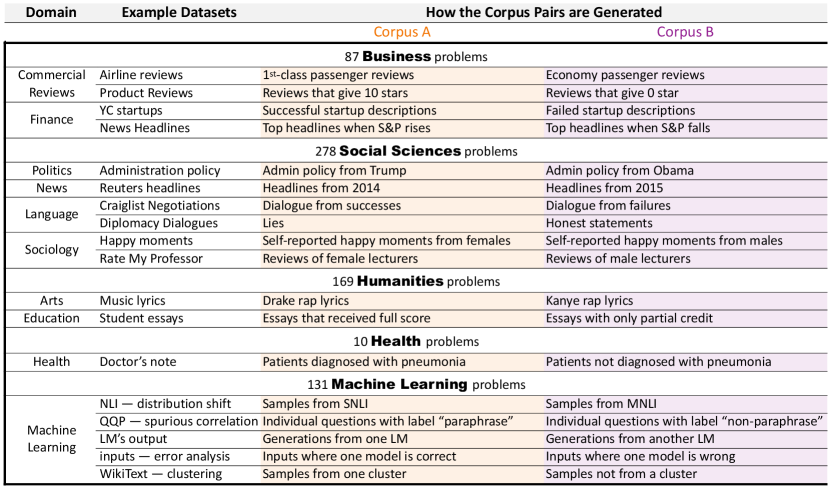
- Construct OpenD5, a meta-dataset of 675 real-world, open-ended D5 problems across domains like health, social sciences, and NLP, containing 4.4M text samples.
- Train and evaluate a goal-conditioned language model that uses the exploration goal to guide hypothesis generation about corpus differences.
- Design a self-supervised learning method using OpenD5 (without reference answers) to improve model performance in generating valid hypotheses.
- Manually evaluate a subset of OpenD5 outputs to assess relevance and validity, providing qualitative insights into real-world utility.
Experimental results
Research questions
- RQ1Can language models effectively use user-specified goals to generate relevant and valid discoveries about differences between two text corpora?
- RQ2How does goal-conditioning improve the performance of D5 systems compared to non-goal-conditioned baselines?
- RQ3To what extent can D5 systems uncover novel, previously unknown differences in real-world corpora?
- RQ4What are the limitations of current evaluation metrics in promoting diverse, causal, or expert-knowledge-rich discoveries?
- RQ5Can self-supervised learning on a large repository of D5 problems improve the validity of generated discoveries without human-annotated references?
Key findings
- The goal-conditioned D5 system achieved 12% higher accuracy in recovering known differences on the SynD5 diagnostic benchmark compared to a non-goal-conditioned baseline.
- On the OpenD5 meta-dataset, the goal-conditioned system produced relevant candidate discoveries 31% more often than the non-goal-conditioned baseline.
- The system discovered novel, previously unknown patterns, including demographic differences in discussion topics, political stances in speeches, and error patterns in NLP models.
- Manual evaluation confirmed that the system generates meaningful, contextually relevant discoveries across diverse domains such as health, business, and social media.
- Evaluation metrics revealed limitations: they do not encourage diversity, cannot assess causal claims, and struggle with discoveries requiring deep expert knowledge.
- Self-supervised fine-tuning on OpenD5 improved the model’s ability to generate valid hypotheses, demonstrating feasibility for training without gold-standard references.
Better researchstarts right now
From reading papers to final review, dramatically reduce your research time.
No credit card · Free plan available
This review was created by AI and reviewed by human editors.