
[Paper Review] GPQA: A Graduate-Level Google-Proof Q&A Benchmark
GPQA is a 448-question graduate-level Q&A benchmark across biology, physics, and chemistry with expert validation and non-expert validation to test scalable oversight; GPT-4 barely surpasses non-experts, while experts reach about 65% accuracy.
We present GPQA, a challenging dataset of 448 multiple-choice questions written by domain experts in biology, physics, and chemistry. We ensure that the questions are high-quality and extremely difficult: experts who have or are pursuing PhDs in the corresponding domains reach 65% accuracy (74% when discounting clear mistakes the experts identified in retrospect), while highly skilled non-expert validators only reach 34% accuracy, despite spending on average over 30 minutes with unrestricted access to the web (i.e., the questions are "Google-proof"). The questions are also difficult for state-of-the-art AI systems, with our strongest GPT-4 based baseline achieving 39% accuracy. If we are to use future AI systems to help us answer very hard questions, for example, when developing new scientific knowledge, we need to develop scalable oversight methods that enable humans to supervise their outputs, which may be difficult even if the supervisors are themselves skilled and knowledgeable. The difficulty of GPQA both for skilled non-experts and frontier AI systems should enable realistic scalable oversight experiments, which we hope can help devise ways for human experts to reliably get truthful information from AI systems that surpass human capabilities.
Motivation & Objective
- Measure objectivity and difficulty of graduate-level questions in biology, physics, and chemistry.
- Create a validation pipeline with experts and non-experts to assess ground-truth difficulty under unrestricted web access.
- Provide datasets (Extended, Main/GPQA, Diamond) to enable scalable oversight experiments with varying quality.
- Evaluate modern foundation models and human validators to benchmark current capabilities and limitations.
Proposed method
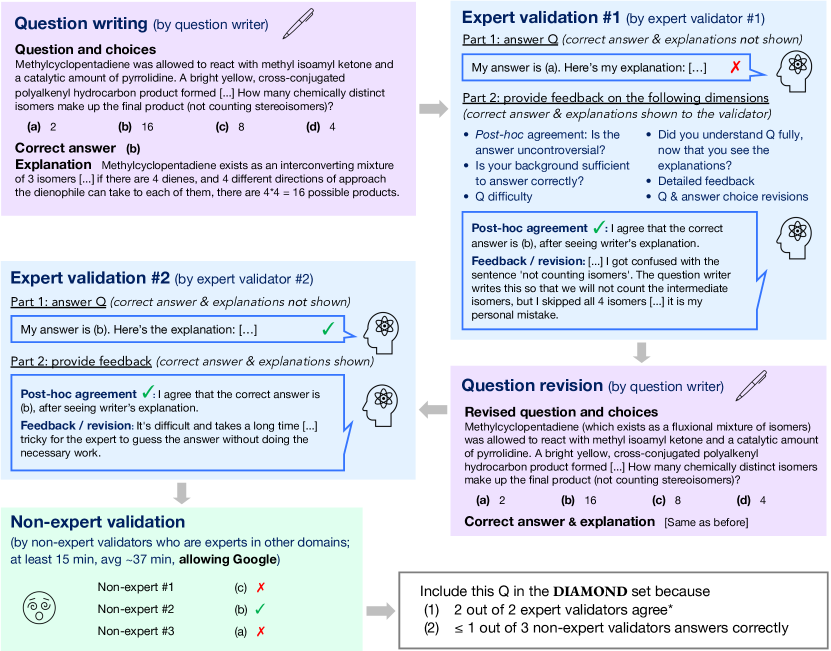
- Four-stage data collection: question writing, expert validation, question revision, and non-expert validation.
- Incentivized contractor-based pipeline with PhD-level writers and validators and substantial bonuses for quality and difficulty.
- Three datasets: GPQA Extended (546), GPQA Main (448), GPQA Diamond (198) derived by filtering on expert/non-expert performance.
- Baseline model evaluation in closed-book and open-book settings using zero-shot, few-shot, and chain-of-thought prompting, plus GPT-4 with search.
Experimental results
Research questions
- RQ1How objective are graduate-level Q&A items across biology, physics, and chemistry as judged by domain experts?
- RQ2How difficult are these questions for skilled non-experts with unrestricted internet access?
- RQ3How do current LLM baselines (including GPT-4 with and without web search) perform on GPQA subsets?
- RQ4Can scalable oversight methods be studied with datasets where non-experts struggle relative to domain experts?
Key findings
- Expert validators achieve about 65-66% accuracy on the first validation and about 64-65% on the revised questions (95% CIs ~±4%).
- Non-expert validators achieve ~34% accuracy on the extended set and ~30% on the main set, with open internet access; GPT-4 few-shot CoT reaches ~39% overall.
- GPT-4 with search reaches ~39% extended accuracy and exhibits high abstention on the main set (backoff to CoT prompts).
- GPQA Extended shows lower non-expert accuracy and higher expert-domain variance than GPQA Main/Diamond, which are filtered sets with higher expert consensus.
- GPT-4 with search largely lags behind expert validators but outperforms non-experts, highlighting ongoing challenges for scalable oversight.

Read this paper
Open the full text in the Nubint reader and ask about any passage as you read.
Read this paper on NubintThis review was generated by AI from the original paper. Please check the paper before citing it.