
[Paper Review] GPT-4 as an Agronomist Assistant? Answering Agriculture Exams Using Large Language Models
The paper evaluates GPT-4, GPT-3.5, and Llama models on agriculture questions from CCA, Embrapa, and AgriExams datasets, using RAG and Ensemble Refinement to boost performance, with GPT-4 achieving the highest accuracy and potential to pass agronomy exams.
Large language models (LLMs) have demonstrated remarkable capabilities in natural language understanding across various domains, including healthcare and finance. For some tasks, LLMs achieve similar or better performance than trained human beings, therefore it is reasonable to employ human exams (e.g., certification tests) to assess the performance of LLMs. We present a comprehensive evaluation of popular LLMs, such as Llama 2 and GPT, on their ability to answer agriculture-related questions. In our evaluation, we also employ RAG (Retrieval-Augmented Generation) and ER (Ensemble Refinement) techniques, which combine information retrieval, generation capabilities, and prompting strategies to improve the LLMs' performance. To demonstrate the capabilities of LLMs, we selected agriculture exams and benchmark datasets from three of the largest agriculture producer countries: Brazil, India, and the USA. Our analysis highlights GPT-4's ability to achieve a passing score on exams to earn credits for renewing agronomist certifications, answering 93% of the questions correctly and outperforming earlier general-purpose models, which achieved 88% accuracy. On one of our experiments, GPT-4 obtained the highest performance when compared to human subjects. This performance suggests that GPT-4 could potentially pass on major graduate education admission tests or even earn credits for renewing agronomy certificates. We also explore the models' capacity to address general agriculture-related questions and generate crop management guidelines for Brazilian and Indian farmers, utilizing robust datasets from the Brazilian Agency of Agriculture (Embrapa) and graduate program exams from India. The results suggest that GPT-4, ER, and RAG can contribute meaningfully to agricultural education, assessment, and crop management practice, offering valuable insights to farmers and agricultural professionals.
Motivation & Objective
- Assess the capability of large language models to answer agriculture-related questions from major producer countries (USA, Brazil, India).
- Investigate the impact of retrieval Augmented Generation (RAG) and Ensemble Refinement (ER) on model performance.
- Explore the potential of GPT-4 to pass agronomy certification-style exams and provide crop management guidance.
Proposed method
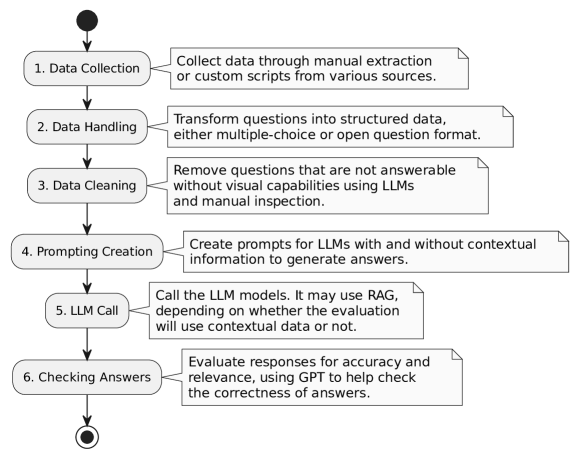
- Collect and structure domain-specific questions from CCA, Embrapa, and AgriExams datasets.
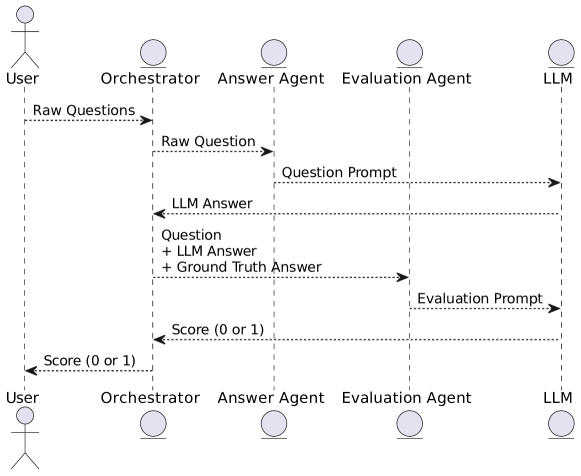
- Apply prompt engineering with context provisioning and two-agent (Answer, Evaluation) setup orchestrated by an Orchestrator.
- Use RAG and ER techniques to enhance answers, with context from Llama Index for USA/India datasets.
- Evaluate answers against ground truth using a dedicated evaluation prompt and scoring mechanism.
- Compare multiple models (Llama2-13B, Llama2-70B, GPT-3.5, GPT-4) across scenarios with and without RAG/ER/preambles.
- Analyze trade-offs between accuracy gains and computational costs.
Experimental results
Research questions
- RQ1How well do GPT-4, GPT-3.5, and Llama models answer agriculture-related questions from diverse datasets (CCA, Embrapa, AgriExams)?
- RQ2What is the impact of retrieval (RAG) and ensemble refinement (ER) on model accuracy in agriculture QA tasks?
- RQ3Can LLMs pass agronomy certification-style exams and provide actionable crop management guidance?
- RQ4How do context provisioning (preambles, Llama Index) influence model performance on domain-specific agriculture questions?
Key findings
- GPT-4 achieves the highest baseline accuracy on video-based and text-based agriculture questions among the models tested.
- Preambles and ER improve GPT-4 performance on CCA text questions (e.g., from 79% to 84% in some scenarios).
- RAG substantially boosts GPT-3.5 and GPT-4 performance on multiple-choice CCA questions, with GPT-4 reaching up to 97% in certain setups.
- ER provides gains for GPT-4 and GPT-3.5 on text-based questions, though gains vary by model and scenario.
- Across sampled multiple-choice questions, combining RAG and ER yields the strongest performance (GPT-4: 97% in one scenario).
- GPT-4’s performance sometimes approaches or surpasses human performance on certain datasets, suggesting potential for exams and agronomy certification contexts.
Read this paper
Open the full text in the Nubint reader and ask about any passage as you read.
Read this paper on NubintThis review was generated by AI from the original paper. Please check the paper before citing it.