
[Paper Review] GPT as Knowledge Worker: A Zero-Shot Evaluation of (AI)CPA Capabilities
The paper experimentally evaluates GPT-3.5 (text-davinci-003) on two CPA-style assessments derived from AICPA Blueprints, measuring zero-shot performance across finance, law, accounting, and ethics tasks. It reports modest arithmetic challenges but shows near 57% accuracy overall on Assessment 2 and strong non-entailment with top-two answer correctness.
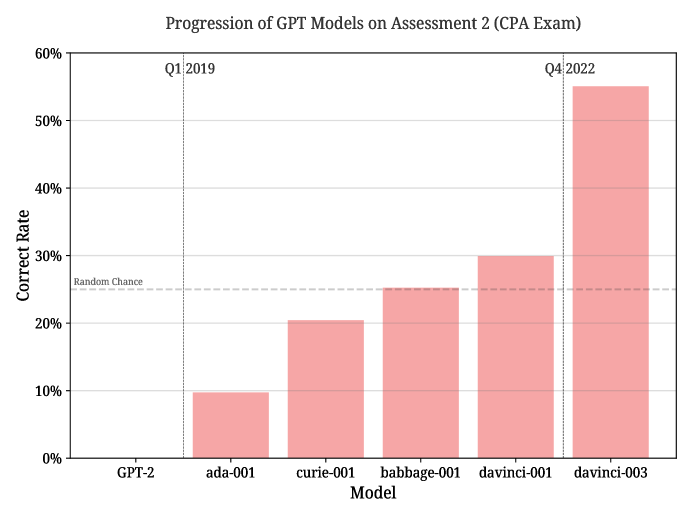
The global economy is increasingly dependent on knowledge workers to meet the needs of public and private organizations. While there is no single definition of knowledge work, organizations and industry groups still attempt to measure individuals' capability to engage in it. The most comprehensive assessment of capability readiness for professional knowledge workers is the Uniform CPA Examination developed by the American Institute of Certified Public Accountants (AICPA). In this paper, we experimentally evaluate OpenAI's `text-davinci-003` and prior versions of GPT on both a sample Regulation (REG) exam and an assessment of over 200 multiple-choice questions based on the AICPA Blueprints for legal, financial, accounting, technology, and ethical tasks. First, we find that `text-davinci-003` achieves a correct rate of 14.4% on a sample REG exam section, significantly underperforming human capabilities on quantitative reasoning in zero-shot prompts. Second, `text-davinci-003` appears to be approaching human-level performance on the Remembering & Understanding and Application skill levels in the Exam absent calculation. For best prompt and parameters, the model answers 57.6% of questions correctly, significantly better than the 25% guessing rate, and its top two answers are correct 82.1% of the time, indicating strong non-entailment. Finally, we find that recent generations of GPT-3 demonstrate material improvements on this assessment, rising from 30% for `text-davinci-001` to 57% for `text-davinci-003`. These findings strongly suggest that large language models have the potential to transform the quality and efficiency of future knowledge work.
Motivation & Objective
- Assess GPT-3.5 (text-davinci-003) zero-shot performance on knowledge-work tasks based on the AICPA Uniform CPA Examination Blueprints.
- Evaluate capabilities across four CPA sections (AUD, BEC, FAR, REG) and two assessment designs.
- Provide open-source data and prompts to enable replication and further research.
- Compare GPT-3.5 performance to older GPT-3 generations and human baselines where available.
Proposed method
- Two assessments mirroring CPA Exam structure: Assessment 1 (Regulation-focused with arithmetic reasoning) and Assessment 2 (208 synthetic MCQs across all four Blueprints sections).
- Zero-shot prompting of text-davinci-003 with varied prompts, contextualization, and justification strategies; multiple hyperparameters (temperature 0.0/0.5/1.0; best_of 1/2/4).
- Comparison against older GPT-3 models (text-davinci-001, curie, babbage, ada) to show progression.
- Open-source source code and questions for Assessment 2; replication details provided in supplementary information.
Experimental results
Research questions
- RQ1Can GPT-3.5 perform as a knowledge worker across multidisciplinary CPA domains in a zero-shot setting?
- RQ2How does zero-shot GPT-3.5 performance vary by CPA section (AUD, BEC, FAR, REG) and by assessment design (quantitative vs. qualitative tasks)?
- RQ3What is the impact of prompt engineering and model hyperparameters on zero-shot performance in professional knowledge tasks?
- RQ4How does GPT-3.5’s top-two answer accuracy compare to single-answer accuracy and guessing baselines across sections?
Key findings
- GPT-3.5 achieves 14.4% correct on Assessment 1’s Regulation-focused, arithmetic-heavy tasks, underperforming human test-takers on quantitative reasoning.
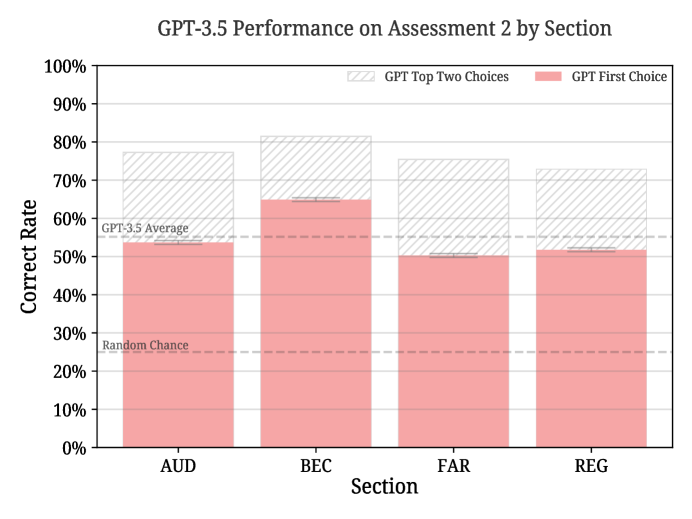
- On Assessment 2 (208 MCQs across all sections), GPT-3.5 attains 51.1%-57.6% correct, averaging ~57% with top-two correct ~82%.
- Performance by section in best prompt/parameters: AUD 57.1% (top-two 84.9%), BEC 69.7% (85.7%), FAR 51.0% (82.4%), REG 53.1% (75.8%).
- GPT-3.5 shows strong non-entailment (top-two correctness) and improved explanations, though hallucination of references occurs in about 37% of explanations.
- Progression across GPT-3 generations shows text-davinci-003 substantially exceeds text-davinci-001 and earlier models in this knowledge-work task set.
Read this paper
Open the full text in the Nubint reader and ask about any passage as you read.
Read this paper on NubintThis review was generated by AI from the original paper. Please check the paper before citing it.