
[Paper Review] GPT-Driver: Learning to Drive with GPT
GPT-Driver repurposes GPT-3.5 as a motion planner by treating planning as language modeling, using a prompting-reasoning-finetuning strategy to produce precise trajectories and interpretable chain-of-thought in autonomous driving on nuScenes.
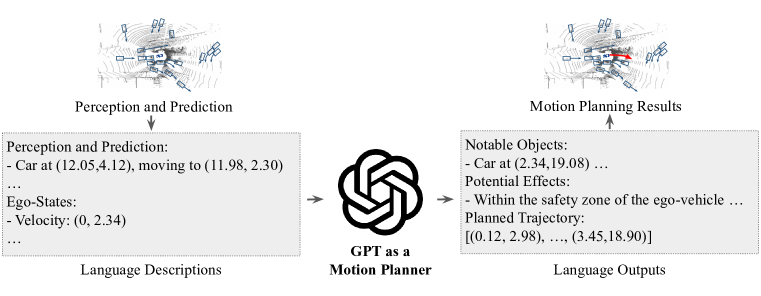
We present a simple yet effective approach that can transform the OpenAI GPT-3.5 model into a reliable motion planner for autonomous vehicles. Motion planning is a core challenge in autonomous driving, aiming to plan a driving trajectory that is safe and comfortable. Existing motion planners predominantly leverage heuristic methods to forecast driving trajectories, yet these approaches demonstrate insufficient generalization capabilities in the face of novel and unseen driving scenarios. In this paper, we propose a novel approach to motion planning that capitalizes on the strong reasoning capabilities and generalization potential inherent to Large Language Models (LLMs). The fundamental insight of our approach is the reformulation of motion planning as a language modeling problem, a perspective not previously explored. Specifically, we represent the planner inputs and outputs as language tokens, and leverage the LLM to generate driving trajectories through a language description of coordinate positions. Furthermore, we propose a novel prompting-reasoning-finetuning strategy to stimulate the numerical reasoning potential of the LLM. With this strategy, the LLM can describe highly precise trajectory coordinates and also its internal decision-making process in natural language. We evaluate our approach on the large-scale nuScenes dataset, and extensive experiments substantiate the effectiveness, generalization ability, and interpretability of our GPT-based motion planner. Code is now available at https://github.com/PointsCoder/GPT-Driver.
Motivation & Objective
- Transform motion planning into a language modeling problem by encoding inputs and outputs as language tokens.
- Leverage GPT-3.5 with a prompting-reasoning-finetuning strategy to improve numerical precision and decision transparency.
- Demonstrate the approach on the nuScenes dataset and compare with state-of-the-art motion planners.
- Assess generalization, few-shot learning capability, and interpretability of the GPT-based planner.
Proposed method
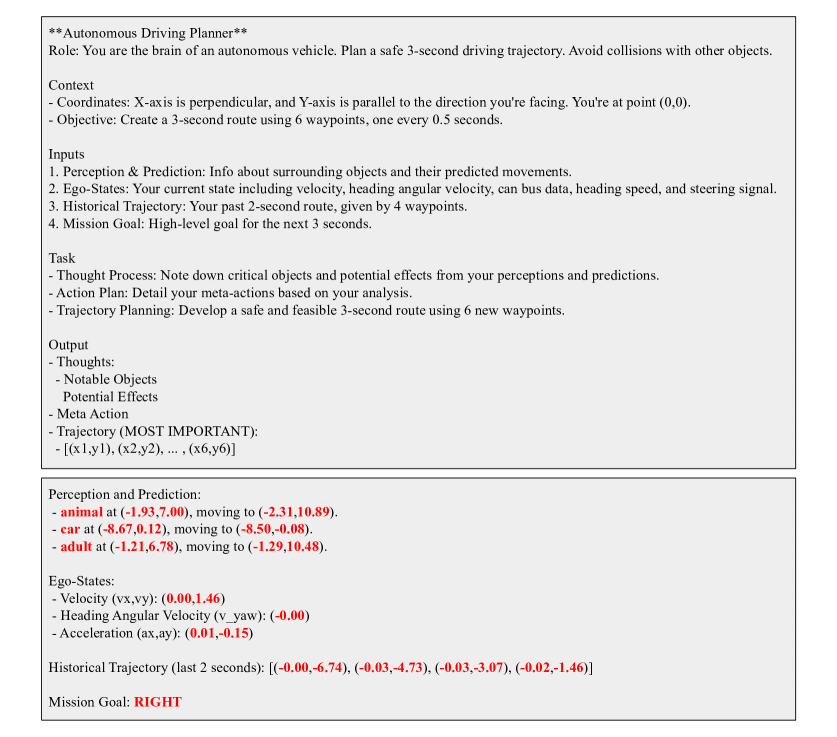
- Represent observations and ego-states as language prompts via a GPT-3.5 tokenizer-based encoding.
- Formulate trajectory generation as predicting a sequence of tokens corresponding to waypoint coordinates.
- Use a prompting-reasoning-finetuning pipeline to elicit chain-of-thought reasoning and then generate a trajectory in language.
- Fine-tune the LLM outputs with human driving trajectories to align with real-world behavior.
- Provide both the planned trajectory and the model’s reasoning process to enhance interpretability.
Experimental results
Research questions
- RQ1Can large language models (LLMs) be used for high-precision, low-level motion planning in autonomous driving?
- RQ2Does transforming planning into a language modeling problem improve generalization and interpretability over traditional planners?
- RQ3What is the impact of prompting, reasoning, and fine-tuning strategies on trajectory accuracy and safety?
Key findings
- GPT-Driver significantly improves L2 error over prior methods on nuScenes across 1s, 2s, and 3s horizons.
- The approach achieves competitive collision rates, indicating safety on par with state-of-the-art planners.
- Fine-tuning outperforms in-context learning for this task, demonstrating strong data efficiency and generalization.
- GPT-Driver demonstrates few-shot generalization, performing well with limited training data compared to UniAD.
- The model provides interpretable outputs by including chain-of-thought-like reasoning alongside trajectories.
Read this paper
Open the full text in the Nubint reader and ask about any passage as you read.
Read this paper on NubintThis review was generated by AI from the original paper. Please check the paper before citing it.