
[Paper Review] GPTAraEval: A Comprehensive Evaluation of ChatGPT on Arabic NLP
The paper conducts large-scale automated and human evaluation of ChatGPT (GPT-3.5-turbo) on 44 Arabic NLP tasks across 60+ datasets, showing ChatGPT underperforms compared to smaller finetuned Arabic models, especially on dialectal Arabic, with GPT-4 generally outperforming ChatGPT.
ChatGPT's emergence heralds a transformative phase in NLP, particularly demonstrated through its excellent performance on many English benchmarks. However, the model's efficacy across diverse linguistic contexts remains largely uncharted territory. This work aims to bridge this knowledge gap, with a primary focus on assessing ChatGPT's capabilities on Arabic languages and dialectal varieties. Our comprehensive study conducts a large-scale automated and human evaluation of ChatGPT, encompassing 44 distinct language understanding and generation tasks on over 60 different datasets. To our knowledge, this marks the first extensive performance analysis of ChatGPT's deployment in Arabic NLP. Our findings indicate that, despite its remarkable performance in English, ChatGPT is consistently surpassed by smaller models that have undergone finetuning on Arabic. We further undertake a meticulous comparison of ChatGPT and GPT-4's Modern Standard Arabic (MSA) and Dialectal Arabic (DA), unveiling the relative shortcomings of both models in handling Arabic dialects compared to MSA. Although we further explore and confirm the utility of employing GPT-4 as a potential alternative for human evaluation, our work adds to a growing body of research underscoring the limitations of ChatGPT.
Motivation & Objective
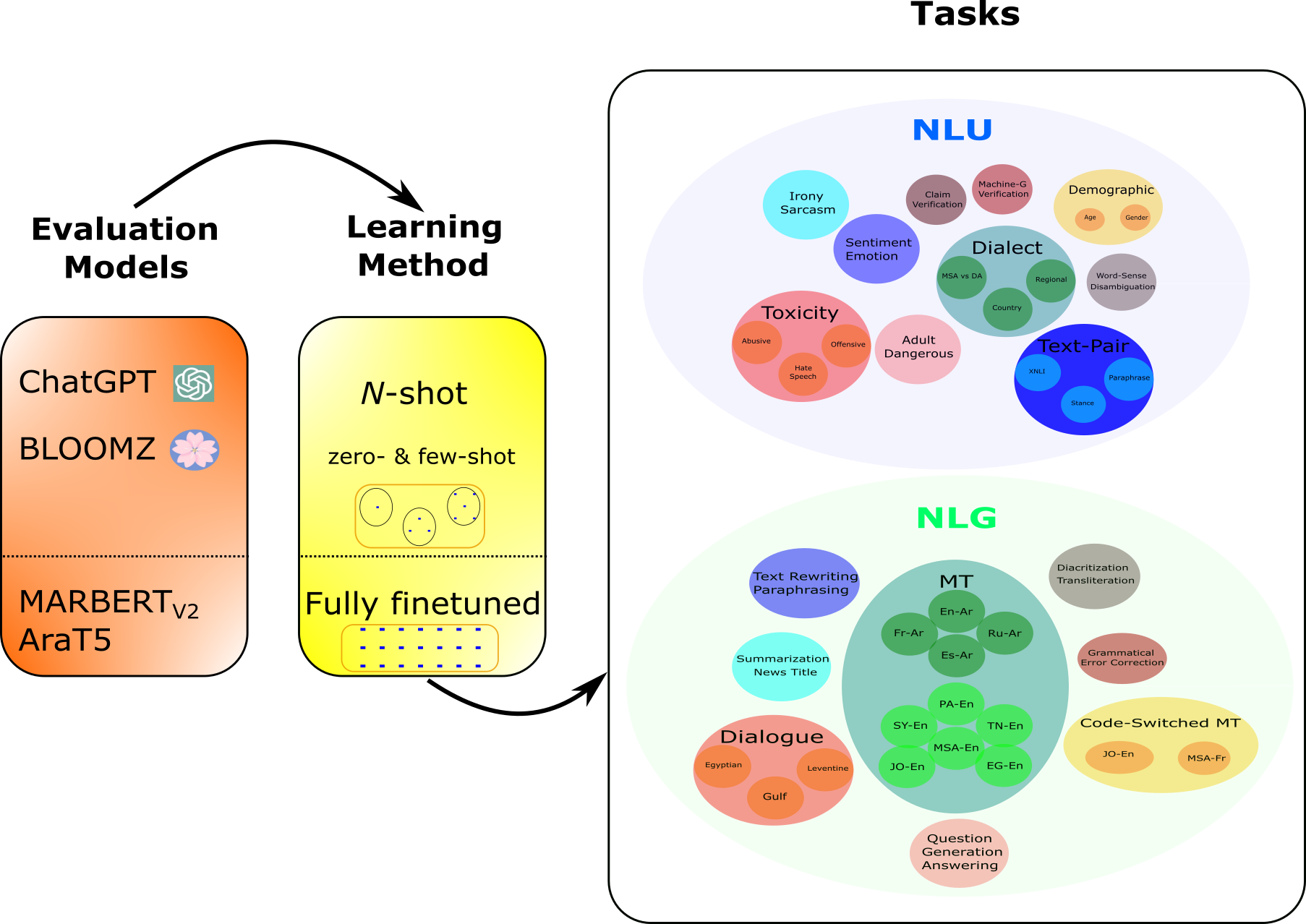
- Assess ChatGPT’s performance across a wide range of Arabic NLU and NLG tasks and datasets.
- Compare ChatGPT against BLOOMZ and finetuned Arabic baselines (MARBERT V2, AraT5).
- Analyze performance differences between Modern Standard Arabic (MSA) and dialectal Arabic (DA).
- Evaluate the reliability of human versus GPT-4-based evaluation for Arabic generation tasks.
Proposed method
- Use 44 Arabic NLP tasks spanning 60+ datasets for NLU and NLG.
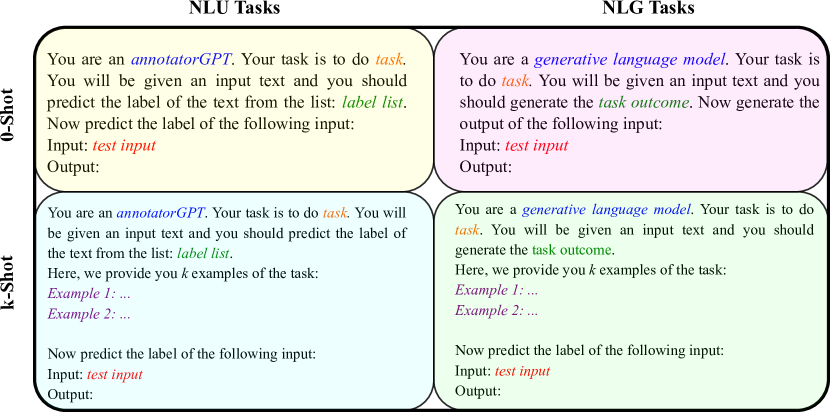
- Evaluate ChatGPT (gpt-3.5-turbo-0301) under 0-, 3-, 5-, and 10-shot prompts with an English universal prompt template.
- Compare with BLOOMZ-7.1B (Arabic-inclusive finetuned) and finetuned MARBERT V2 and AraT5 baselines.
- Perform macro-F1 for NLU and task-appropriate metrics for NLG.
- Conduct dialect-focused evaluation using an in-house MSA vs DA classifier and ORCA-linked tasks, and compare ChatGPT with GPT-4 on DA vs MSA.
- In addition to automatic metrics, perform human evaluations on eight NLG tasks and use GPT-4 as an evaluator benchmark.
Experimental results
Research questions
- RQ1How does ChatGPT perform on a broad Arabic NLP benchmark relative to Arabic-specific finetuned models?
- RQ2Does ChatGPT struggle with dialectal Arabic compared to Modern Standard Arabic?
- RQ3Is GPT-4 consistently stronger than ChatGPT on Arabic NLU/NLG tasks, including dialectal varieties?
- RQ4Can GPT-4 provide reliable automated evaluation aligned with human judgments for Arabic generation tasks?
Key findings
- ChatGPT generally underperforms compared with smaller finetuned Arabic models across most tasks.
- MARBERT V2 often yields substantially higher macro-F1 scores than ChatGPT on NLU tasks.
- In dialectal Arabic, ChatGPT’s performance lags behind MSA and is generally surpassed by GPT-4, with GPT-4 showing more robust results across several DA tasks.
- On NLG tasks, AraT5 typically outperforms both ChatGPT and BLOOMZ, while ChatGPT surpasses BLOOMZ on many tasks but remains below AraT5.
- Paraphrase and some text-pair tasks show strong gains for ChatGPT with more shots, sometimes surpassing the fully finetuned MARBERT V2, though not consistently across all tasks.
- GPT-4 evaluation of model outputs aligns with human evaluation to a notable extent, suggesting GPT-4 as a viable proxy for human assessment in Arabic generation tasks.
Read this paper
Open the full text in the Nubint reader and ask about any passage as you read.
Read this paper on NubintThis review was generated by AI from the original paper. Please check the paper before citing it.