
[Paper Review] Gradient based Feature Attribution in Explainable AI: A Technical Review
A comprehensive survey of gradient-based feature attribution methods for neural networks, proposing a four-group taxonomy, detailing algorithmic progress, evaluation approaches, and key challenges.
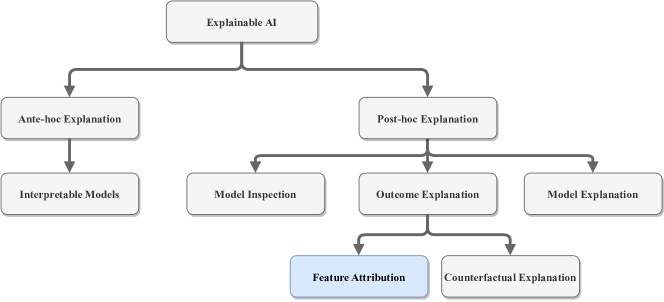
The surge in black-box AI models has prompted the need to explain the internal mechanism and justify their reliability, especially in high-stakes applications, such as healthcare and autonomous driving. Due to the lack of a rigorous definition of explainable AI (XAI), a plethora of research related to explainability, interpretability, and transparency has been developed to explain and analyze the model from various perspectives. Consequently, with an exhaustive list of papers, it becomes challenging to have a comprehensive overview of XAI research from all aspects. Considering the popularity of neural networks in AI research, we narrow our focus to a specific area of XAI research: gradient based explanations, which can be directly adopted for neural network models. In this review, we systematically explore gradient based explanation methods to date and introduce a novel taxonomy to categorize them into four distinct classes. Then, we present the essence of technique details in chronological order and underscore the evolution of algorithms. Next, we introduce both human and quantitative evaluations to measure algorithm performance. More importantly, we demonstrate the general challenges in XAI and specific challenges in gradient based explanations. We hope that this survey can help researchers understand state-of-the-art progress and their corresponding disadvantages, which could spark their interest in addressing these issues in future work.
Motivation & Objective
- Survey gradient-based explainability methods focused on neural networks.
- Propose a taxonomy to categorize gradient-based feature attribution approaches.
- Summarize technique details and chronological evolution of these methods.
- Review evaluation strategies and identify general and gradient-specific challenges.
Proposed method
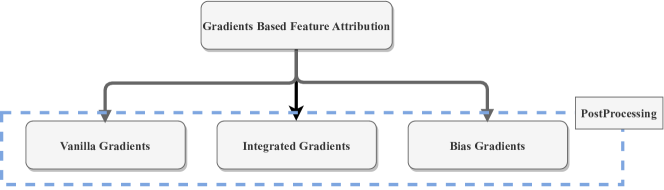
- Classify gradient-based attributions into four groups: vanilla gradients, integrated gradients, bias-gradient based explanations, and denoising post-processing.
- Describe algorithmic details and evolution of methods within each group.
- Explain baseline and path integral approaches used in gradient-based explanations.
- Discuss evaluation methodologies, including human and objective metrics, for attribution methods.
- Highlight axiomatic properties (e.g., sensitivity, completeness, implementation invariance) guiding method design.
Experimental results
Research questions
- RQ1What are the main gradient-based approaches to feature attribution for neural networks?
- RQ2How can gradient-based methods be categorized, and what are the core techniques within each category?
- RQ3How are gradient-based explanations evaluated, and what are the standard metrics?
- RQ4What general and gradient-specific challenges limit gradient-based XAI, and where can future work improve?
- RQ5How do integrated gradients and its variants address issues like saturation and baseline choice?
Key findings
- Introduces a novel four-group taxonomy for gradient-based feature attribution: vanilla gradients, integrated gradients, bias gradients, and post-processing denoising.
- Provides a detailed chronological overview of technique details and evolution within each group.
- Outlines widely used evaluation metrics including human and objective measures for comparing explanations.
- Identifies general XAI challenges and gradient-specific issues to guide future research.
- Synthesizes connections between gradient-based methods and axiomatic properties guiding attribution quality.
Read this paper
Open the full text in the Nubint reader and ask about any passage as you read.
Read this paper on NubintThis review was generated by AI from the original paper. Please check the paper before citing it.