
[Paper Review] GRAG: Graph Retrieval-Augmented Generation
GRAG retrieves query-relevant textual subgraphs with soft pruning and dual prompting (hard text prompts plus soft graph prompts) to augment LLMs for graph-based multi-hop reasoning, outperforming traditional RAG methods and reducing hallucinations.
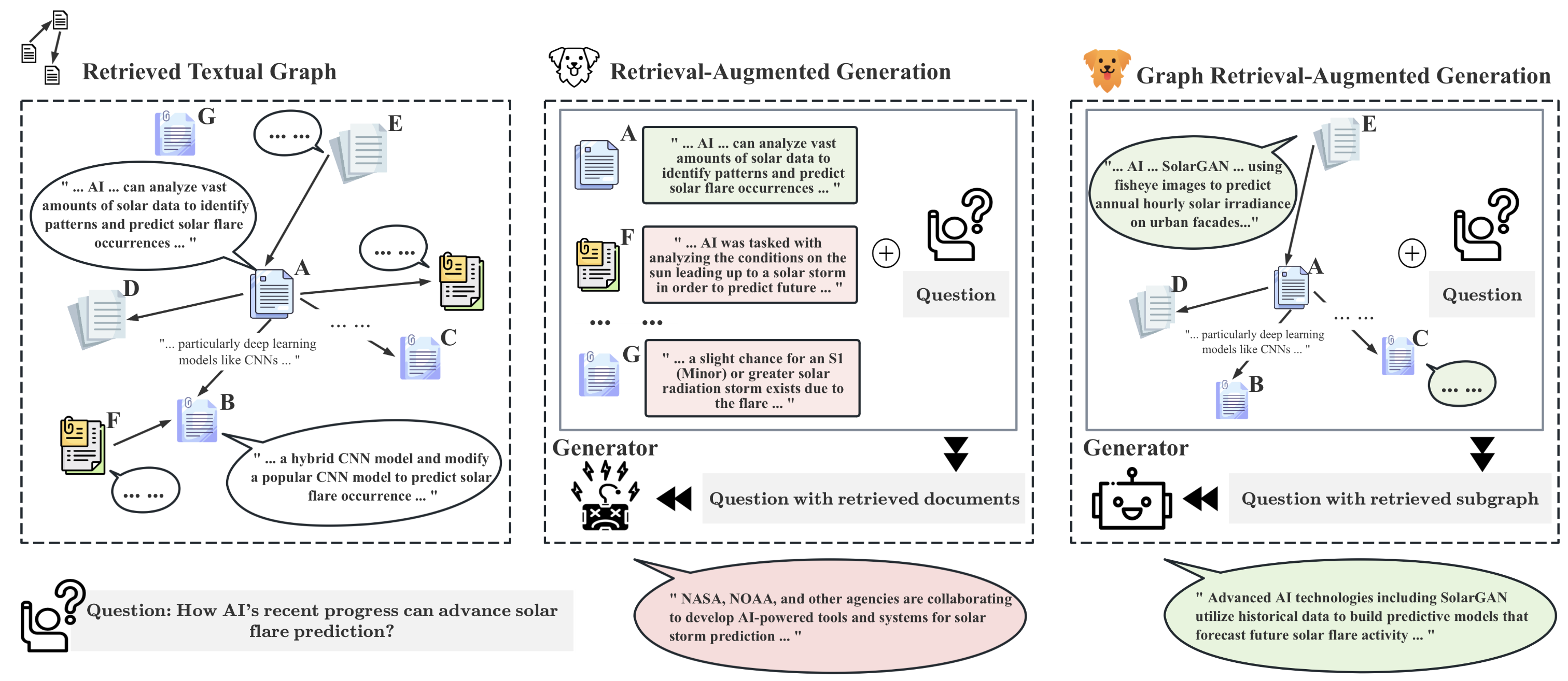
Naive Retrieval-Augmented Generation (RAG) focuses on individual documents during retrieval and, as a result, falls short in handling networked documents which are very popular in many applications such as citation graphs, social media, and knowledge graphs. To overcome this limitation, we introduce Graph Retrieval-Augmented Generation (GRAG), which tackles the fundamental challenges in retrieving textual subgraphs and integrating the joint textual and topological information into Large Language Models (LLMs) to enhance its generation. To enable efficient textual subgraph retrieval, we propose a novel divide-and-conquer strategy that retrieves the optimal subgraph structure in linear time. To achieve graph context-aware generation, incorporate textual graphs into LLMs through two complementary views-the text view and the graph view-enabling LLMs to more effectively comprehend and utilize the graph context. Extensive experiments on graph reasoning benchmarks demonstrate that in scenarios requiring multi-hop reasoning on textual graphs, our GRAG approach significantly outperforms current state-of-the-art RAG methods. Our datasets as well as codes of GRAG are available at https://github.com/HuieL/GRAG.
Motivation & Objective
- Motivate robust reasoning over textual graphs where topology matters beyond text alone.
- Propose an efficient subgraph retrieval mechanism to cope with NP-hard subgraph search.
- Preserve both textual content and graph topology during retrieval and generation.
- Introduce a prompting strategy that lossy-free converts textual subgraphs to hierarchical descriptions for LLMs.
Proposed method
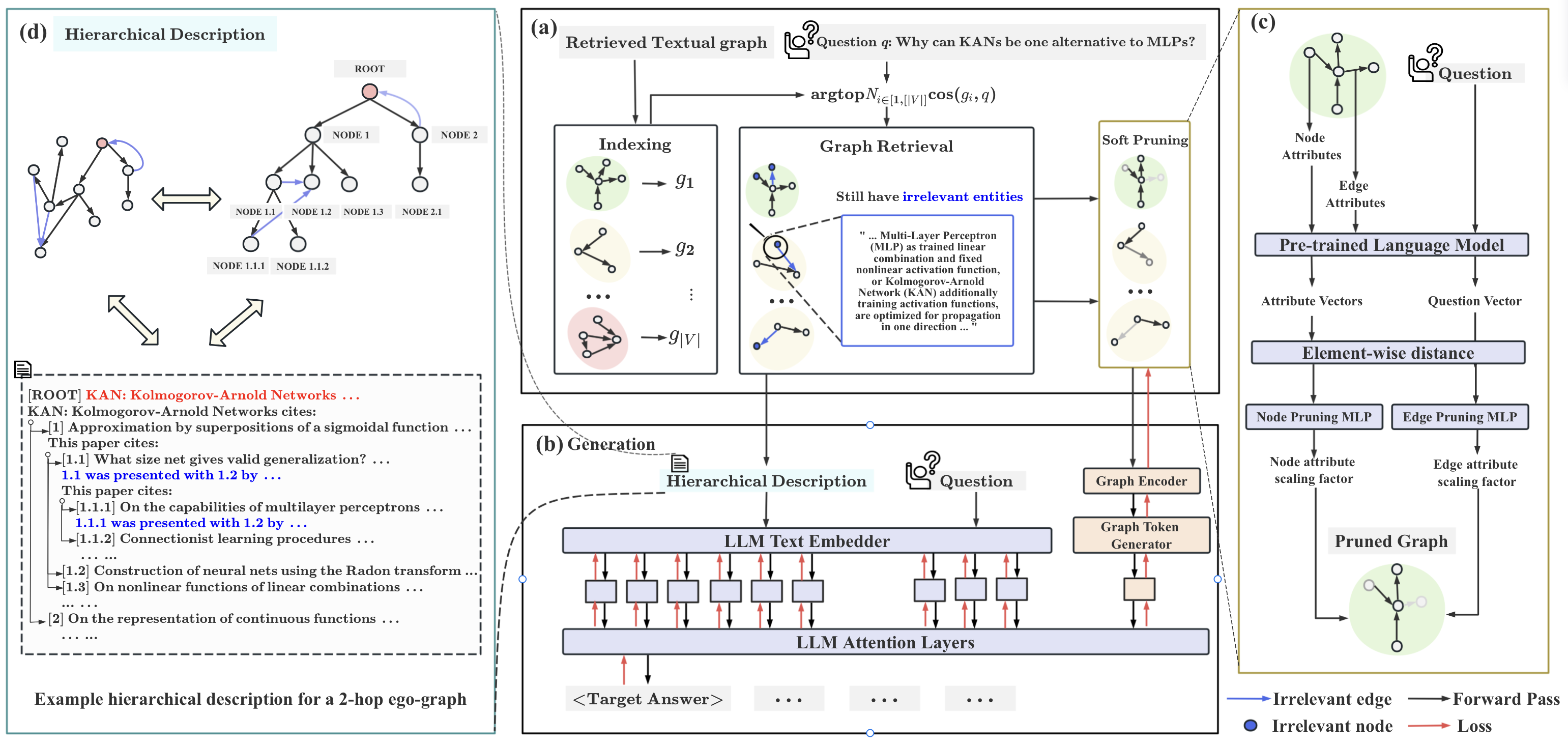
- Index k-hop ego-graphs and encode them as graph embeddings using a pre-trained language model.
- Retrieve top-N textual subgraphs by cosine similarity between question embedding and subgraph embeddings.
- Apply soft pruning to scale node/edge contributions via relevance scalars learned from question-subgraph distance.
- Generate answers by combining hard prompts (hierarchical textual descriptions of subgraphs) with soft prompts (graph embeddings) and align graph embeddings to LLM text vectors via GNNs and MLPs.
Experimental results
Research questions
- RQ1How to efficiently retrieve query-relevant subgraphs in large textual graphs without exhaustive search?
- RQ2How to preserve and integrate both textual and topological information during generation?
- RQ3Can a frozen LLM augmented with retrieved subgraphs outperform fine-tuned LLM baselines on graph reasoning tasks?
- RQ4Does soft prompting effectively guide graph-aware generation without incurring huge training costs?
Key findings
- GRAG outperforms state-of-the-art RAG baselines and LLM-only approaches on graph multi-hop reasoning benchmarks (WebQSP and ExplaGraphs).
- A frozen LLM with GRAG surpasses fine-tuned LLMs on all tasks and with lower training cost.
- Soft pruning and subgraph-level retrieval reduce hallucinations and improve factual grounding, evidenced by higher valid-entity引用 in human evaluation.
- Using retrieved subgraphs as soft graph tokens yields better performance than using only text or exhaustive subgraph search.
- Cross-dataset transfer shows GRAG trained on one dataset can improve performance on another (e.g., WebQSP to ExplaGraphs).
Read this paper
Open the full text in the Nubint reader and ask about any passage as you read.
Read this paper on NubintThis review was generated by AI from the original paper. Please check the paper before citing it.