
[Paper Review] Grand Challenge On Detecting Cheapfakes
This paper presents a grand challenge focused on detecting out-of-context (OOC) cheapfakes—misrepresented use of genuine images with false or conflicting captions—using an augmented version of the COSMOS dataset. It proposes two tasks: detecting conflicting image-caption triplets (OOC vs. NOOC) and identifying fake individual captions, with evaluation via public and hidden test splits, aiming to support fact-checkers through automated detection tools.
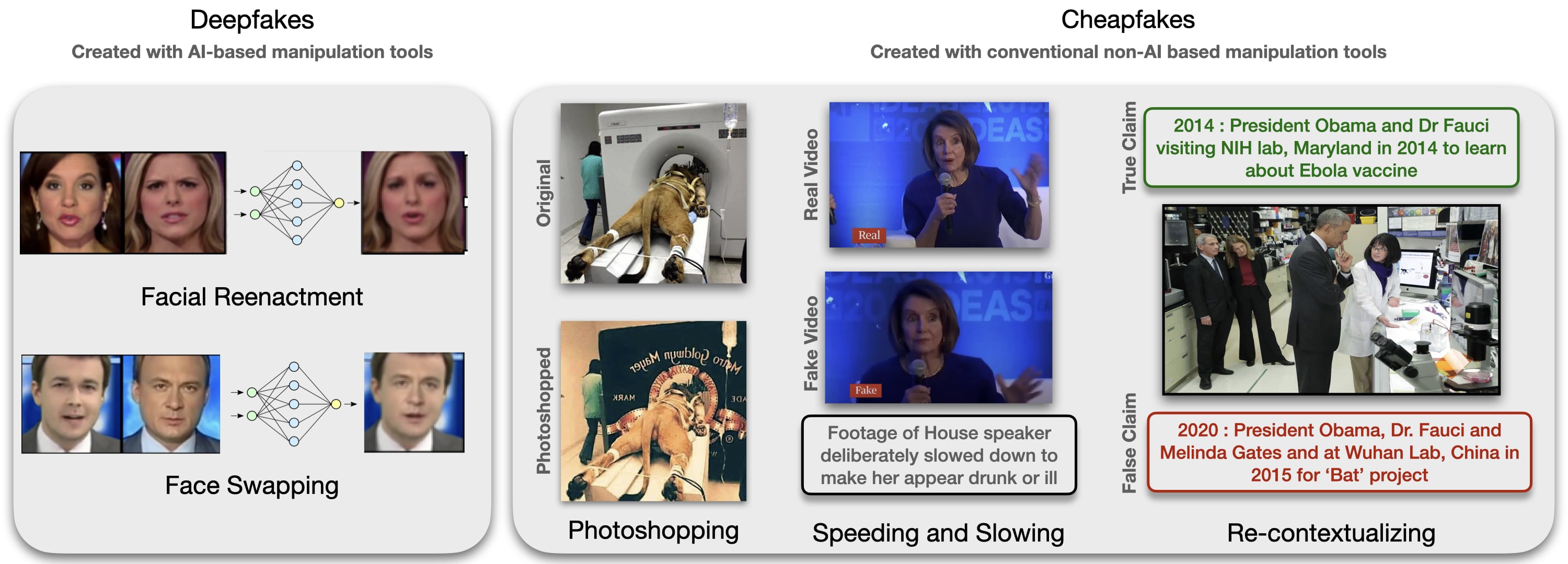
Cheapfake is a recently coined term that encompasses non-AI ("cheap") manipulations of multimedia content. Cheapfakes are known to be more prevalent than deepfakes. Cheapfake media can be created using editing software for image/video manipulations, or even without using any software, by simply altering the context of an image/video by sharing the media alongside misleading claims. This alteration of context is referred to as out-of-context (OOC) misuse of media. OOC media is much harder to detect than fake media, since the images and videos are not tampered. In this challenge, we focus on detecting OOC images, and more specifically the misuse of real photographs with conflicting image captions in news items. The aim of this challenge is to develop and benchmark models that can be used to detect whether given samples (news image and associated captions) are OOC, based on the recently compiled COSMOS dataset.
Motivation & Objective
- Address the growing threat of cheapfakes—non-AI manipulated media like re-contextualized images—that are more prevalent than deepfakes but less studied.
- Focus on out-of-context (OOC) misuse of real images, where genuine photos are paired with false or unrelated captions to mislead audiences.
- Develop automated models to detect OOC misuse in news media, supporting fact-checkers by identifying conflicting image-caption pairs.
- Provide a benchmark for detecting both conflicting triplets (Image, Caption1, Caption2) and individual fake captions in isolation.
- Maintain a sustainable, evolving challenge framework with public training/validation/test splits and a hidden test set for evaluation.
Proposed method
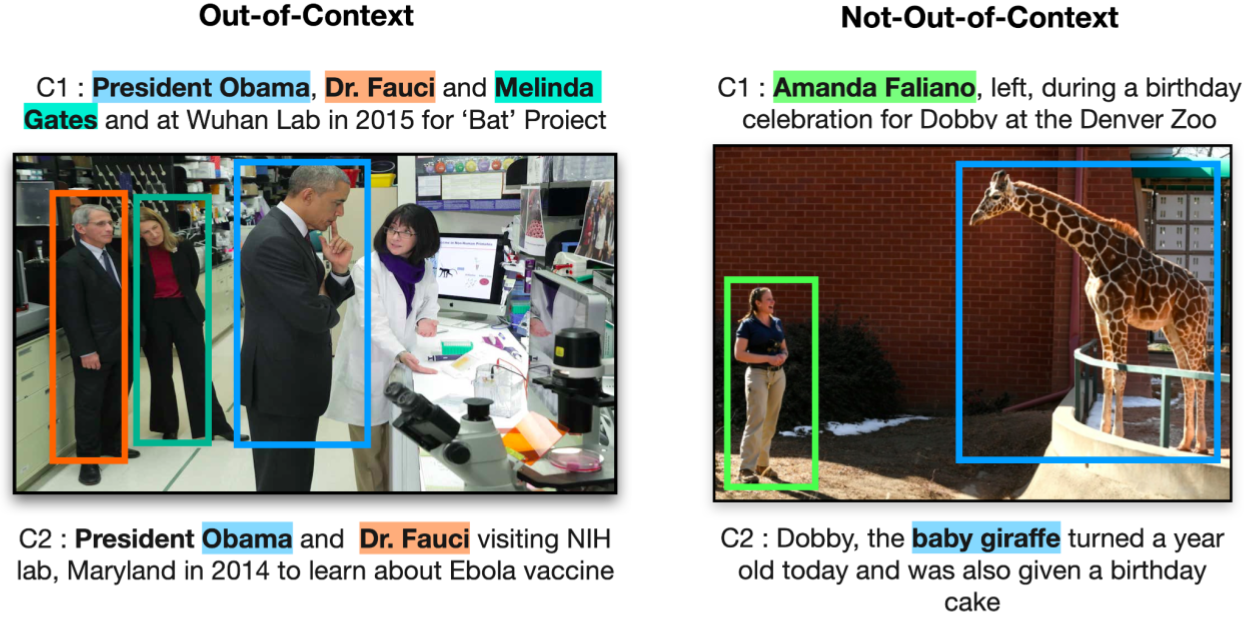
- Use an augmented version of the COSMOS dataset, which contains real-world news posts with images and two associated captions.
- For Task 1, classify image-caption triplets as OOC (1) if the two captions describe conflicting events despite referring to the same image, or NOOC (0) if they are semantically consistent.
- For Task 2, classify individual image-caption pairs as fake (1) or real (0), without prior knowledge of the image's origin.
- Participants are required to submit models as Docker containers, standard Python projects with requirements.txt, or Jupyter notebooks, with input paths configurable for public and hidden test sets.
- Evaluation is performed on a hidden test split not publicly released, ensuring fair benchmarking of generalization performance.
- The challenge supports reproducibility and compatibility through standardized submission formats and version-controlled software dependencies.
Experimental results
Research questions
- RQ1Can models effectively detect out-of-context misuse of real images where two captions associated with the same image describe conflicting events?
- RQ2How well can models identify individual fake captions when no alternative caption is available for comparison?
- RQ3To what extent can automated systems generalize to unseen OOC misuse cases beyond the public training and validation splits?
- RQ4How do different architectures and techniques compare in detecting subtle semantic inconsistencies between image and caption?
- RQ5Can the proposed challenge framework support long-term, sustainable benchmarking of cheapfake detection methods across evolving media manipulation trends?
Key findings
- The challenge uses an augmented version of the COSMOS dataset, with a public split for training and validation, and a hidden test split for final evaluation.
- Participants are evaluated on both public and hidden test sets, with model performance on the hidden split determining final rankings.
- The public test split allows participants to validate their models before final submission, ensuring robustness and reproducibility.
- The challenge has been previously held at ACM MMSys 2021 and ACM ACM-MM 2022, establishing a track record of benchmarking OOC misuse detection.
- Human evaluators achieved only around 65% accuracy in detecting fake captions without search engines, highlighting the difficulty of the task.
- The challenge supports multiple submission formats (Docker, Python, Jupyter) with strict dependency management to ensure reproducibility and compatibility.
Read this paper
Open the full text in the Nubint reader and ask about any passage as you read.
Read this paper on NubintThis review was generated by AI from the original paper. Please check the paper before citing it.