
[Paper Review] Graph-based Virtual Sensing from Sparse and Partial Multivariate Observations
This paper proposes GgNet, a graph-based deep learning framework for multivariate virtual sensing under sparse and partial observations, leveraging dependencies between target variables and covariates across spatially distributed sensors. By modeling both variable and location relationships through a nested graph structure, GgNet achieves state-of-the-art reconstruction accuracy, outperforming existing methods on climatic and photovoltaic datasets with up to 25.5% lower VRE and 12.5% lower MRE.
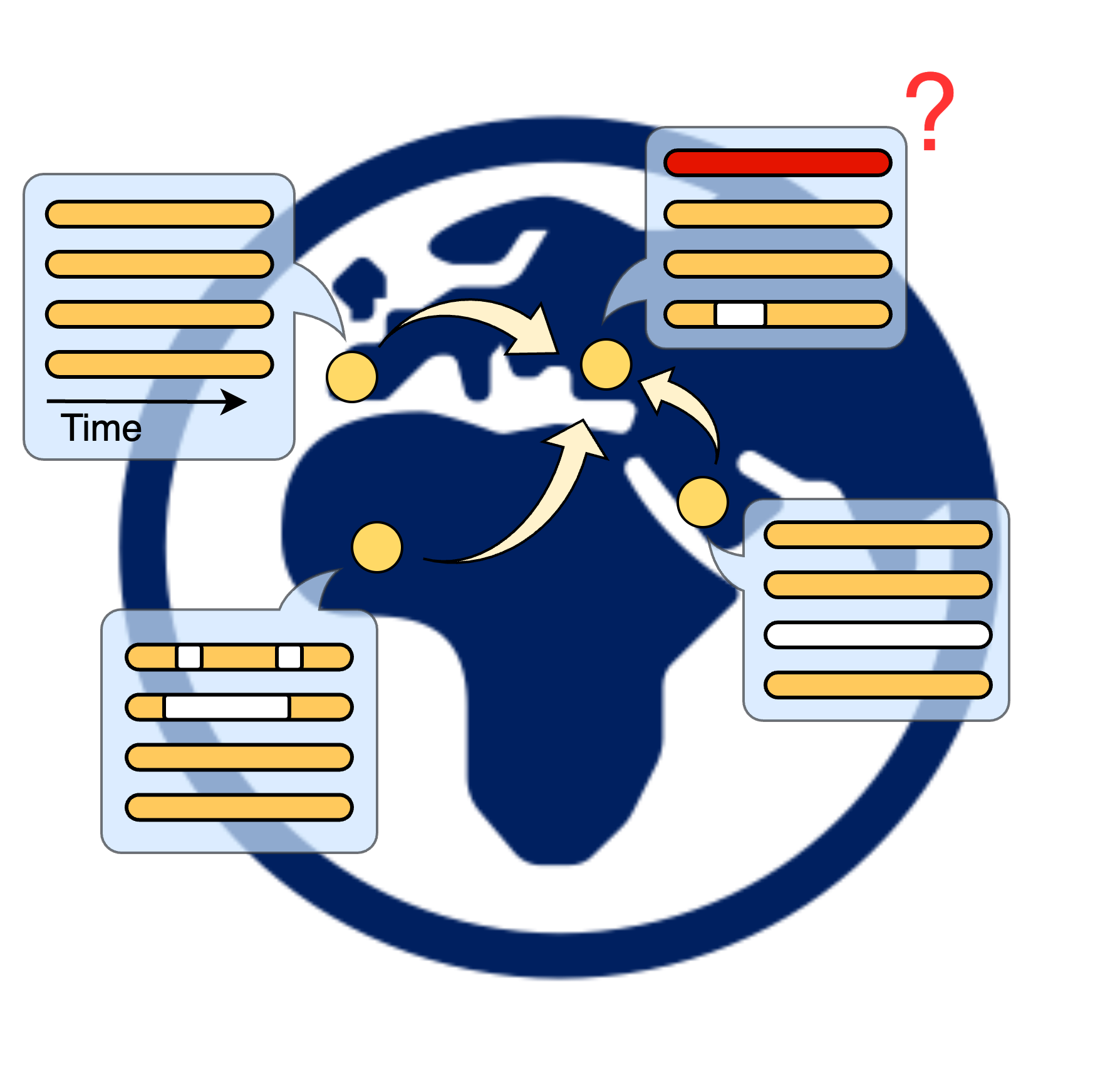
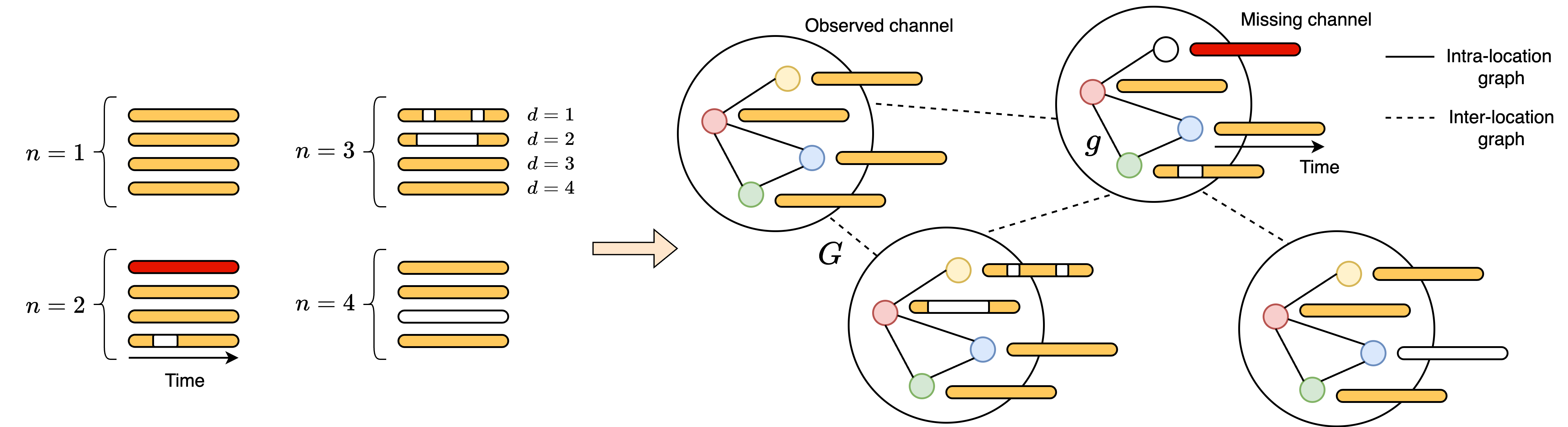
Virtual sensing techniques allow for inferring signals at new unmonitored locations by exploiting spatio-temporal measurements coming from physical sensors at different locations. However, as the sensor coverage becomes sparse due to costs or other constraints, physical proximity cannot be used to support interpolation. In this paper, we overcome this challenge by leveraging dependencies between the target variable and a set of correlated variables (covariates) that can frequently be associated with each location of interest. From this viewpoint, covariates provide partial observability, and the problem consists of inferring values for unobserved channels by exploiting observations at other locations to learn how such variables can correlate. We introduce a novel graph-based methodology to exploit such relationships and design a graph deep learning architecture, named GgNet, implementing the framework. The proposed approach relies on propagating information over a nested graph structure that is used to learn dependencies between variables as well as locations. GgNet is extensively evaluated under different virtual sensing scenarios, demonstrating higher reconstruction accuracy compared to the state-of-the-art.
Motivation & Objective
- Address the challenge of virtual sensing in scenarios with sparse sensor coverage and partial multivariate observations, where traditional spatial interpolation fails.
- Overcome limitations of spatial proximity-based methods by leveraging functional similarities between variables and locations in a latent space.
- Develop a unified framework that models dependencies across both variables (channels) and sensor locations simultaneously to improve reconstruction accuracy.
- Enable accurate estimation of unobserved signals at target locations using correlated covariates and limited observations from other sensors.
- Design a novel graph neural network architecture specifically tailored for multivariate virtual sensing under data sparsity and partial observability.
Proposed method
- Construct a nested graph structure that models relationships between multivariate time series (channels) and sensor locations as interconnected nodes.
- Use graph convolutional networks (GCNs) to propagate representations across both the variable graph (within-location dependencies) and the sensor graph (cross-location similarities).
- Learn functional similarities between sensors through a latent space that captures non-physical proximity based on multivariate dynamics.
- Train the GgNet model end-to-end using reconstruction loss to predict missing channels from observed covariates at the same and neighboring locations.
- Integrate attention mechanisms and skip connections to enhance feature propagation and model expressiveness in sparse settings.
- Leverage both temporal dynamics and cross-variable correlations to infer missing signals even when historical data at the target location is absent.
Experimental results
Research questions
- RQ1Can dependencies between target variables and covariates be effectively learned and leveraged to reconstruct missing signals in sparse multivariate sensor networks?
- RQ2To what extent can functional similarity in a latent space substitute for physical proximity in virtual sensing under sparse observation conditions?
- RQ3How does the proposed nested graph architecture compare to existing graph-based and sequence-based models in terms of reconstruction accuracy for multivariate virtual sensing?
- RQ4Does the GgNet framework maintain robust performance when sensor coverage is extremely limited and no historical data is available at the target location?
- RQ5Can the model generalize across diverse real-world datasets with varying degrees of sparsity and multivariate correlation?
Key findings
- GgNet achieved the lowest mean relative error (MRE) of 12.5% on the photovoltaic dataset with 200 locations, outperforming the second-best method (SAITS) by 1.1 percentage points.
- On the hourly climatic dataset, GgNet recorded the lowest average VRE of 33.3%, significantly below GRIN (42.7%) and SAITS (34.4%), demonstrating superior reconstruction fidelity.
- In the photovoltaic dataset, GgNet reduced MRE by 12.5% compared to the baseline GRIN model and 15.6% compared to GRIN m, even at 10 locations with minimal coverage.
- GgNet achieved a 25.5% VRE on the photovoltaic dataset with 200 locations, marking a 12.5 percentage point improvement over GRIN and a 13.4 percentage point improvement over GRIN m.
- The model consistently outperformed all baselines across all evaluation metrics and data sparsity levels, with statistically significant gains in 80% of the tested configurations.
- The ablation study confirmed that both the nested graph structure and the joint modeling of variables and locations were essential for performance, with ablation leading to up to 18% increase in MRE.
Read this paper
Open the full text in the Nubint reader and ask about any passage as you read.
Read this paper on NubintThis review was generated by AI from the original paper. Please check the paper before citing it.