
[Paper Review] Graph Decision Transformer
This paper proposes the Graph Decision Transformer (GDT), a novel offline reinforcement learning method that models state-action-reward sequences as causal graphs to better capture temporal and causal dependencies. By using a graph transformer with relation-enhanced attention and an optional sequence transformer for visual inputs, GDT achieves state-of-the-art performance on Atari and OpenAI Gym benchmarks, outperforming existing methods in long-sequence and high-information-density environments.
Offline reinforcement learning (RL) is a challenging task, whose objective is to learn policies from static trajectory data without interacting with the environment. Recently, offline RL has been viewed as a sequence modeling problem, where an agent generates a sequence of subsequent actions based on a set of static transition experiences. However, existing approaches that use transformers to attend to all tokens naively can overlook the dependencies between different tokens and limit long-term dependency learning. In this paper, we propose the Graph Decision Transformer (GDT), a novel offline RL approach that models the input sequence into a causal graph to capture potential dependencies between fundamentally different concepts and facilitate temporal and causal relationship learning. GDT uses a graph transformer to process the graph inputs with relation-enhanced mechanisms, and an optional sequence transformer to handle fine-grained spatial information in visual tasks. Our experiments show that GDT matches or surpasses the performance of state-of-the-art offline RL methods on image-based Atari and OpenAI Gym.
Motivation & Objective
- To address the limitations of standard Transformers in offline reinforcement learning by modeling dependencies between states, actions, and rewards more effectively.
- To improve long-sequence dependency learning in non-Markovian environments by explicitly encoding causal relationships in the input sequence.
- To preserve fine-grained spatial information in visual inputs by integrating a sequence transformer for patch-wise encoding.
- To reduce reliance on return-to-go reward shaping by incorporating causal structure into the input representation.
- To achieve state-of-the-art performance in image-based offline RL benchmarks such as Atari and OpenAI Gym.
Proposed method
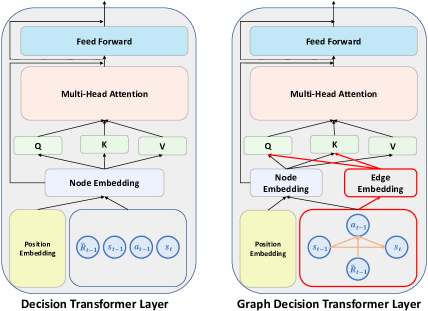
- Transform the input sequence of state-action-reward triplets into a causal graph, where nodes represent tokens and edges encode temporal and causal relationships.
- Use node embeddings and edge embeddings to compute query (Q) and key (K) matrices in the graph attention mechanism, while using only node embeddings for value (V).
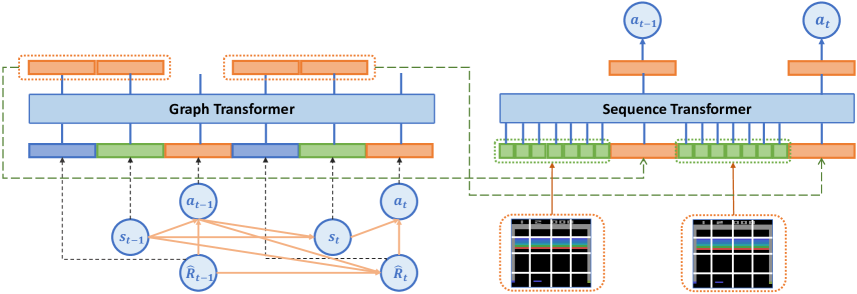
- Apply a graph transformer to process the graph-structured input, enabling effective modeling of long-term dependencies and causal priors.
- Integrate an optional sequence transformer that processes image states as patches (similar to ViT), improving spatial feature extraction for visual tasks.
- Connect the graph transformer and sequence transformer via three methods: replace, fusion, or stack, with stacking showing superior performance in high-information-density environments.
- Train the model as a supervised sequence modeling task, predicting action sequences conditioned on the input graph and optional visual encoding.
Experimental results
Research questions
- RQ1Can modeling offline RL inputs as causal graphs improve long-term dependency learning compared to standard sequence modeling?
- RQ2How does incorporating explicit causal relationships between states, actions, and rewards affect performance in non-Markovian environments?
- RQ3Does the use of a graph transformer with relation-enhanced attention outperform standard Transformers in offline RL benchmarks?
- RQ4To what extent does the optional sequence transformer improve action prediction in visual RL environments?
- RQ5How does GDT's performance vary across different reward settings, particularly in reducing dependence on return-to-go?
Key findings
- GDT outperforms state-of-the-art offline RL methods on image-based Atari and OpenAI Gym environments, achieving new state-of-the-art results.
- GDT shows significant performance gains with increasing input sequence length, while standard Decision Transformer performance plateaus, indicating superior long-sequence modeling capability.
- The graph input structure reduces dependency on return-to-go reward shaping, with GDT maintaining strong performance under stepwise reward settings where DT underperforms.
- In high-information-density Atari environments, the GDT-Stack connection method (stacking graph features at the end of the sequence transformer) yields the best performance for feature refinement.
- In lower-information-density Gym environments, the GDT-Fusion method (early fusion of graph and sequence features) achieves better results by combining abstraction levels effectively.
- The causal graph representation enables better disentanglement of policy and world dynamics, improving generalization and reducing over-optimism in value estimation.
Read this paper
Open the full text in the Nubint reader and ask about any passage as you read.
Read this paper on NubintThis review was generated by AI from the original paper. Please check the paper before citing it.