
[Paper Review] Graph-level Representation Learning with Joint-Embedding Predictive Architectures
This paper proposes Graph-JEPA, the first Joint-Embedding Predictive Architecture for graph-level self-supervised representation learning. It predicts masked subgraph embeddings using context subgraphs without data augmentation or negative samples, achieving competitive performance on graph classification and regression tasks through a novel hyperbolic coordinate prediction objective that captures hierarchical graph concepts.
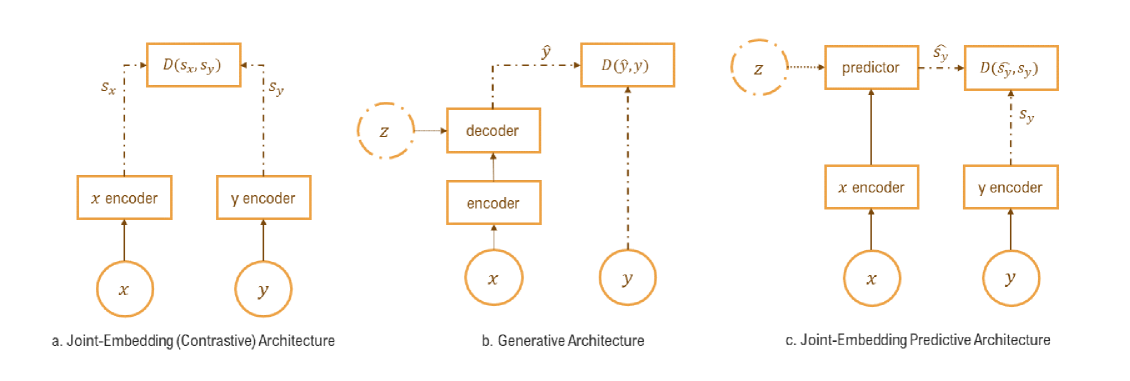
Joint-Embedding Predictive Architectures (JEPAs) have recently emerged as a novel and powerful technique for self-supervised representation learning. They aim to learn an energy-based model by predicting the latent representation of a target signal y from the latent representation of a context signal x. JEPAs bypass the need for negative and positive samples, traditionally required by contrastive learning while avoiding the overfitting issues associated with generative pretraining. In this paper, we show that graph-level representations can be effectively modeled using this paradigm by proposing a Graph Joint-Embedding Predictive Architecture (Graph-JEPA). In particular, we employ masked modeling and focus on predicting the latent representations of masked subgraphs starting from the latent representation of a context subgraph. To endow the representations with the implicit hierarchy that is often present in graph-level concepts, we devise an alternative prediction objective that consists of predicting the coordinates of the encoded subgraphs on the unit hyperbola in the 2D plane. Through multiple experimental evaluations, we show that Graph-JEPA can learn highly semantic and expressive representations, as shown by the downstream performance in graph classification, regression, and distinguishing non-isomorphic graphs. The code is available at https://github.com/geriskenderi/graph-jepa.
Motivation & Objective
- To address the limitations of contrastive and generative self-supervised learning in graphs, such as reliance on data augmentation and negative samples or overfitting due to distribution estimation.
- To develop a JEPA-based framework for graph-level representation learning that operates in latent space and avoids explicit reconstruction or contrastive objectives.
- To design a predictive objective that captures hierarchical graph-level concepts by predicting subgraph coordinates on the unit hyperbola in 2D latent space.
- To evaluate the effectiveness of Graph-JEPA on standard graph benchmark datasets for both classification and regression tasks.
- To ablate key design choices, including positional encoding, attention mechanisms, and subgraph sampling strategies.
Proposed method
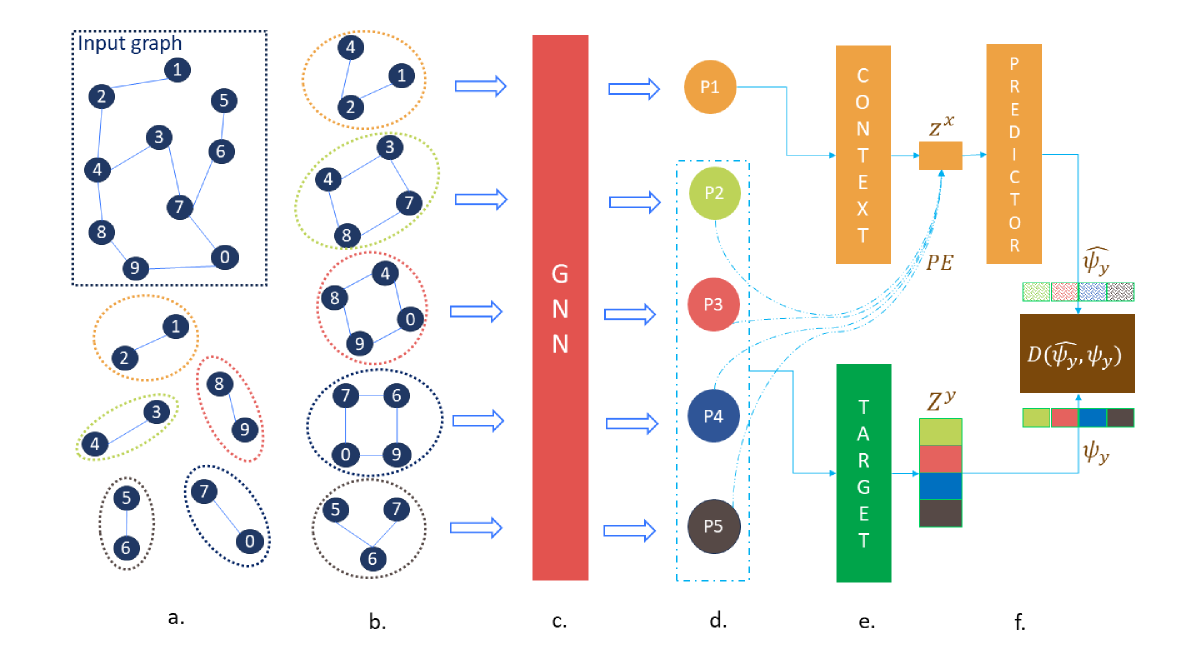
- Graph-JEPA uses masked modeling to predict the latent representation of randomly selected target subgraphs based on context subgraphs extracted from the input graph.
- Subgraph representations are pooled to form a global graph-level embedding, enabling downstream classification and regression.
- A novel prediction objective is introduced that encodes target subgraph embeddings as coordinates on the unit hyperbola in 2D space, modeling hierarchical graph concepts.
- The model employs a predictor network that maps context subgraph representations to predict the latent embedding of the target subgraph, using a joint-embedding paradigm.
- Relative Wavelet Spectral Embeddings (RWSE) are used as positional encodings, with ablation studies comparing node-level vs. patch-level RWSE.
- The architecture uses Hadamard self-attention to provide inductive bias for graph-structured data, with ablation against standard self-attention.
Experimental results
Research questions
- RQ1Can a JEPA-based approach effectively learn graph-level representations without data augmentation or negative samples?
- RQ2Does predicting subgraph coordinates on the unit hyperbola improve performance over standard latent reconstruction in graph SSL?
- RQ3How do different subgraph sampling strategies—structured (METIS) vs. random—affect model performance and stability?
- RQ4What is the impact of positional encoding type (node-level vs. patch-level RWSE) on Graph-JEPA's performance?
- RQ5How does the choice of distance function (Euclidean vs. hyperbolic) influence the model’s generalization across different graph datasets?
Key findings
- Graph-JEPA achieves state-of-the-art performance on graph classification tasks, with 91.25±5.75% accuracy on MUTAG and 73.68±3.24% on IMDB-B, outperforming contrastive and generative baselines.
- On the ZINC regression benchmark, Graph-JEPA achieves a mean absolute error (MAE) of 0.434±0.01, significantly outperforming the next best method (0.471±0.01) with Euclidean distance.
- Using the hyperbolic distance function improves performance on MUTAG and REDDIT-M, with 89.43±5.67% accuracy compared to 87.04±6.01% with Euclidean.
- The ablation study shows that node-level (global) RWSE consistently outperforms patch-level (relative) RWSE, which introduces higher variance due to overlapping neighbor information.
- Replacing Hadamard self-attention with standard self-attention leads to slightly better but more unstable performance, indicating that inductive bias improves training consistency.
- Random subgraph sampling performs comparably to METIS-based sampling but is less generalizable; METIS is recommended for better inductive bias and stability across diverse graphs.
Read this paper
Open the full text in the Nubint reader and ask about any passage as you read.
Read this paper on NubintThis review was generated by AI from the original paper. Please check the paper before citing it.