
[Paper Review] Graph Neural Networks with Learnable and Optimal Polynomial Bases
Introduces FavardGNN to learn an orthonormal polynomial basis via Favard’s theorem and OptBasisGNN to implicitly obtain an optimal basis for polynomial graph filters, achieving strong results on both small and large-scale datasets.
Polynomial filters, a kind of Graph Neural Networks, typically use a predetermined polynomial basis and learn the coefficients from the training data. It has been observed that the effectiveness of the model is highly dependent on the property of the polynomial basis. Consequently, two natural and fundamental questions arise: Can we learn a suitable polynomial basis from the training data? Can we determine the optimal polynomial basis for a given graph and node features? In this paper, we propose two spectral GNN models that provide positive answers to the questions posed above. First, inspired by Favard's Theorem, we propose the FavardGNN model, which learns a polynomial basis from the space of all possible orthonormal bases. Second, we examine the supposedly unsolvable definition of optimal polynomial basis from Wang & Zhang (2022) and propose a simple model, OptBasisGNN, which computes the optimal basis for a given graph structure and graph signal. Extensive experiments are conducted to demonstrate the effectiveness of our proposed models. Our code is available at https://github.com/yuziGuo/FarOptBasis.
Motivation & Objective
- Investigate how the choice of polynomial basis affects spectral GNN performance.
- Develop a learnable orthonormal polynomial basis using Favard’s theorem (FavardGNN).
- Propose an efficient method to obtain an optimal polynomial basis (OptBasisGNN) without eigendecomposition.
- Assess scalability to large graphs via a scalable OptBasisGNN variant.
- Empirically validate improvements on small to large graph benchmarks.
Proposed method
- Derive a three-term recurrence form for orthonormal polynomial bases and learn the recurrence coefficients (beta, gamma, alpha) to construct a FavardGNN basis (Algorithm 1 & 2).
- Define optimal basis per Wang & Zhang (2022) and implement OptBasisGNN which implicitly yields an optimal vector basis accompanied by corresponding polynomials (Algorithm 4/5).
- Leverage orthonormality to minimize cross-basis influence and enable efficient filtering via b(P) with learned coefficients (Equation (2)).
- Provide scalable variants that decouple feature propagation and transformation for large graphs (Section 4.4).
- Offer practical PyTorch-style pseudocode and implementation notes for parallel channel processing and caching basis vectors.
Experimental results
Research questions
- RQ1Can we learn a suitable polynomial basis from data rather than fixing a predefined basis?
- RQ2Can an optimal polynomial basis be efficiently computed for a given graph and signal without heavy eigendecomposition?
- RQ3Do FavardGNN and OptBasisGNN improve predictive performance across small and large graph benchmarks?
- RQ4How does the scalable OptBasisGNN perform on billion-edge graphs compared to baselines?
Key findings
- FavardGNN learns a flexible orthonormal polynomial basis by treating Recurrence coefficients as trainable, improving performance across several datasets.
- OptBasisGNN computes an optimal polynomial basis implicitly via a vector-basis accompaniment, achieving O(K|E|) time complexity and competitive accuracy.
- On small datasets (Chameleon, Squirrel, Actor, Citeseer, Pubmed), FavardGNN and OptBasisGNN outperform many strong baselines.
- On large datasets (ogbn-arxiv, ogbn-papers100M, Pokec, Wiki), the scaled-up OptBasisGNN matches or surpasses state-of-the-art spectral methods, with notable gains on Wiki.
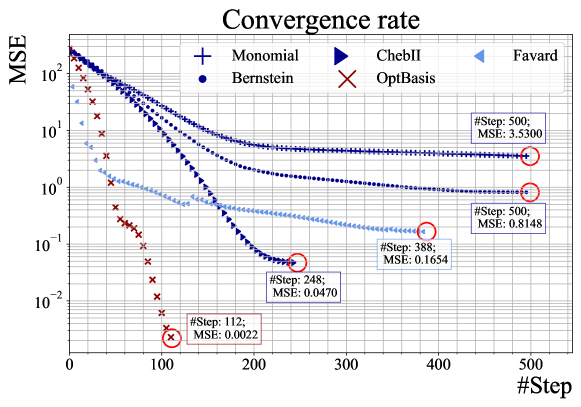
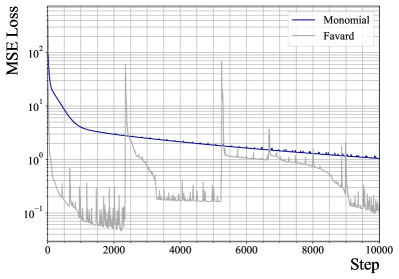
- In multi-channel filtering tasks, OptBasis (and Favard) demonstrate superior convergence and lower MSE than monomial, Bernstein, BernNet, and ChebNet-based bases.
Read this paper
Open the full text in the Nubint reader and ask about any passage as you read.
Read this paper on NubintThis review was generated by AI from the original paper. Please check the paper before citing it.