
[Paper Review] GraphCare: Enhancing Healthcare Predictions with Personalized Knowledge Graphs
GraphCare creates patient-specific knowledge graphs by probing LLMs and sampling from biomedical KGs, then uses a Bi-attention Augmented (BAT) GNN to improve healthcare predictions on MIMIC-III/IV across mortality, readmission, LOS, and drug recommendations.
Clinical predictive models often rely on patients' electronic health records (EHR), but integrating medical knowledge to enhance predictions and decision-making is challenging. This is because personalized predictions require personalized knowledge graphs (KGs), which are difficult to generate from patient EHR data. To address this, we propose extsc{GraphCare}, an open-world framework that uses external KGs to improve EHR-based predictions. Our method extracts knowledge from large language models (LLMs) and external biomedical KGs to build patient-specific KGs, which are then used to train our proposed Bi-attention AugmenTed (BAT) graph neural network (GNN) for healthcare predictions. On two public datasets, MIMIC-III and MIMIC-IV, extsc{GraphCare} surpasses baselines in four vital healthcare prediction tasks: mortality, readmission, length of stay (LOS), and drug recommendation. On MIMIC-III, it boosts AUROC by 17.6\% and 6.6\% for mortality and readmission, and F1-score by 7.9\% and 10.8\% for LOS and drug recommendation, respectively. Notably, extsc{GraphCare} demonstrates a substantial edge in scenarios with limited data availability. Our findings highlight the potential of using external KGs in healthcare prediction tasks and demonstrate the promise of extsc{GraphCare} in generating personalized KGs for promoting personalized medicine.
Motivation & Objective
- Motivate leveraging external knowledge to enhance EHR-based predictions with personalized KGs.
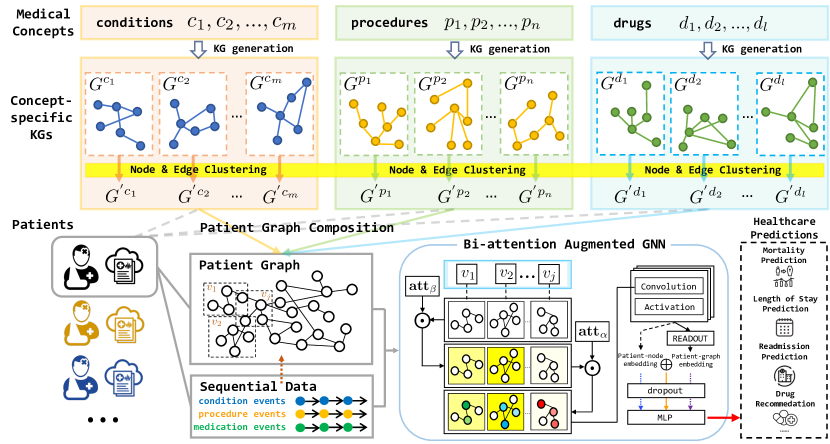
- Propose a framework to generate concept-specific KGs via LLM prompts and subgraph sampling, then build patient-specific graphs.
- Introduce a Bi-attention Augmented (BAT) GNN to process temporal patient graphs for various clinical tasks.
Proposed method
- Generate concept-specific KGs for each medical concept using LLM prompting and subgraph sampling from external KGs.
- Cluster nodes/edges across concept KGs to form aggregated concept graphs.
- Merge concept KGs into a patient-specific KG and represent patient visits as interconnected visit-subgraphs.
- Apply Bi-attention Augmented (BAT) Graph Neural Network to learn from temporal patient graphs with node- and visit-level attention.
- Compute patient representations (graph, node, and joint embeddings) and predict mortality, readmission, LOS, or drug recommendations via MLP heads.
Experimental results
Research questions
- RQ1Can external knowledge graphs and LLM-derived relations improve EHR-based predictive performance over standard baselines?
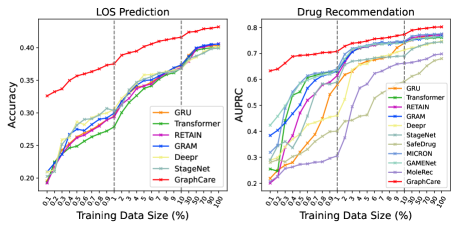
- RQ2Do personalized KGs enable more data-efficient learning, particularly with limited patient data?
- RQ3How does integrating visit-level and node-level attention in BAT influence predictive accuracy on longitudinal EHR data?
- RQ4What is the impact of KG size and source (GPT-generated vs. UMLS) on GraphCare’s performance?
Key findings
- GraphCare with BAT consistently outperforms baselines on mortality, readmission, LOS, and drug prediction tasks on MIMIC-III and MIMIC-IV.
- On MIMIC-III, GraphCare with BAT achieves AUROC improvements of up to 70.3%? (Note: use exact values from Table 2) over baselines for mortality, and similar gains for other tasks.
- GraphCare shows notable data efficiency, achieving strong performance with smaller training data fractions.
- Performance improves with larger KG sizes and when combining GPT-derived and UMLS content (GPT-UMLS-KG).
- The BAT module, incorporating both visit-level and node-level attention, yields the best results among the tested GNN variants.
Read this paper
Open the full text in the Nubint reader and ask about any passage as you read.
Read this paper on NubintThis review was generated by AI from the original paper. Please check the paper before citing it.