
[Paper Review] GraphPatcher: Mitigating Degree Bias for Graph Neural Networks via Test-time Augmentation
GraphPatcher is a test-time augmentation framework that mitigates degree bias in graph neural networks by iteratively generating virtual nodes to patch corrupted ego-graphs of low-degree nodes, improving their performance without degrading high-degree node accuracy. It enhances GNNs on low-degree nodes by up to 6.5% and overall performance by up to 3.6%, outperforming state-of-the-art baselines while remaining model-agnostic and plug-and-play.
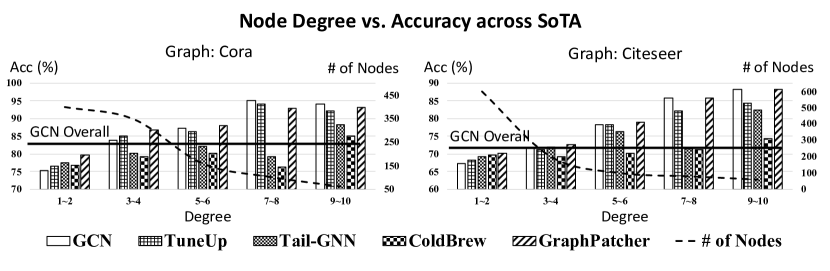
Recent studies have shown that graph neural networks (GNNs) exhibit strong biases towards the node degree: they usually perform satisfactorily on high-degree nodes with rich neighbor information but struggle with low-degree nodes. Existing works tackle this problem by deriving either designated GNN architectures or training strategies specifically for low-degree nodes. Though effective, these approaches unintentionally create an artificial out-of-distribution scenario, where models mainly or even only observe low-degree nodes during the training, leading to a downgraded performance for high-degree nodes that GNNs originally perform well at. In light of this, we propose a test-time augmentation framework, namely GraphPatcher, to enhance test-time generalization of any GNNs on low-degree nodes. Specifically, GraphPatcher iteratively generates virtual nodes to patch artificially created low-degree nodes via corruptions, aiming at progressively reconstructing target GNN's predictions over a sequence of increasingly corrupted nodes. Through this scheme, GraphPatcher not only learns how to enhance low-degree nodes (when the neighborhoods are heavily corrupted) but also preserves the original superior performance of GNNs on high-degree nodes (when lightly corrupted). Additionally, GraphPatcher is model-agnostic and can also mitigate the degree bias for either self-supervised or supervised GNNs. Comprehensive experiments are conducted over seven benchmark datasets and GraphPatcher consistently enhances common GNNs' overall performance by up to 3.6% and low-degree performance by up to 6.5%, significantly outperforming state-of-the-art baselines. The source code is publicly available at https://github.com/jumxglhf/GraphPatcher.
Motivation & Objective
- To address the persistent performance gap in GNNs between low-degree and high-degree nodes, especially under real-world power-law degree distributions.
- To overcome the limitation of existing methods that degrade high-degree node performance by creating artificial out-of-distribution training scenarios.
- To develop a model-agnostic, plug-and-play framework that enhances GNNs at test time without retraining or architectural changes.
- To maintain or improve GNN performance on high-degree nodes while significantly boosting performance on low-degree nodes through iterative virtual node generation.
- To enable effective degree bias mitigation for both supervised and self-supervised GNNs in practical deployment settings.
Proposed method
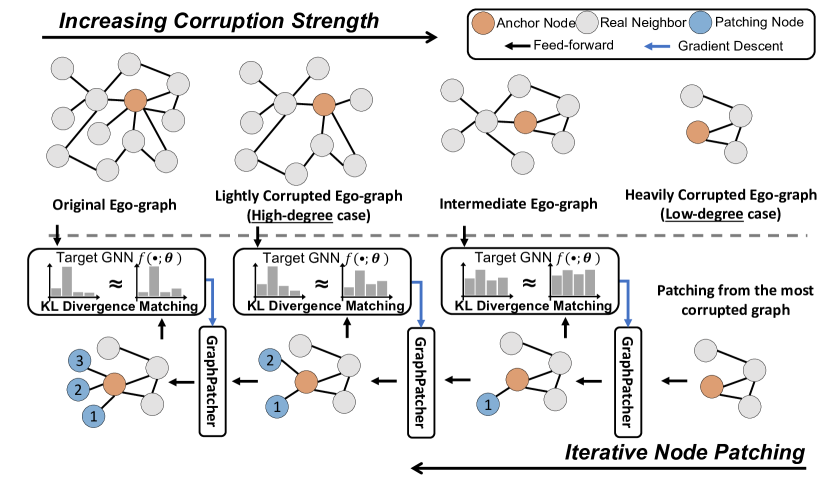
- GraphPatcher generates a sequence of ego-graphs with increasing corruption strength to simulate progressively degraded neighborhood information.
- It iteratively generates virtual nodes to patch the most corrupted ego-graphs, aiming to align the frozen GNN’s predictions on the patched graph with those on the corrupted version.
- The virtual nodes are optimized via a differentiable objective that minimizes the prediction discrepancy between the corrupted and patched ego-graphs.
- The framework is applied at test time, requiring no updates to the target GNN, making it model-agnostic and deployable as a plug-in module.
- It uses a multi-stage optimization process with multiple sampled ego-graphs per corruption level to stabilize training and improve generalization.
- The method is inspired by iterative diffusion processes but is specifically tailored to improve downstream GNN performance rather than data fidelity.
Experimental results
Research questions
- RQ1Can a test-time augmentation framework improve GNN performance on low-degree nodes without degrading performance on high-degree nodes?
- RQ2How can virtual node generation be optimized to preserve the original GNN’s inductive bias while enhancing predictions on sparse neighborhoods?
- RQ3To what extent can a model-agnostic, plug-and-play framework mitigate degree bias across diverse graph datasets and GNN architectures?
- RQ4Does the proposed method generalize to both supervised and self-supervised GNNs, including state-of-the-art models like GRAND?
- RQ5How does the iterative virtual node generation strategy compare to existing data augmentation or graph generation techniques in terms of performance and efficiency?
Key findings
- GraphPatcher improves GNN performance on low-degree nodes by up to 6.5% across seven benchmark datasets, significantly outperforming existing baselines.
- It enhances overall GNN performance by up to 3.6%, demonstrating consistent gains across diverse graph types and architectures.
- The framework maintains or even improves the original GNN’s performance on high-degree nodes, avoiding the performance trade-off seen in prior methods.
- GraphPatcher is effective for both supervised and self-supervised GNNs, including state-of-the-art models like GRAND, where it further boosts performance beyond existing SoTA.
- The method is model-agnostic and requires no retraining or architectural changes, enabling seamless integration into existing production pipelines.
- The additional computational cost is manageable, as all ego-graphs are pre-generated to avoid redundant computation during optimization.
Better researchstarts right now
From reading papers to final review, dramatically reduce your research time.
No credit card · Free plan available
This review was created by AI and reviewed by human editors.