
[Paper Review] GRASP: A Grid-Based Benchmark for Evaluating Commonsense Spatial Reasoning
GRASP is a large-scale, grid-based benchmark with 16,000 structured environments designed to evaluate commonsense spatial reasoning (CSR) in LLMs by requiring agents to navigate, collect energy, and return to the start within step limits. Despite advanced capabilities, GPT-4o underperforms compared to greedy search agents, revealing persistent limitations in efficient spatial planning and resource optimization.
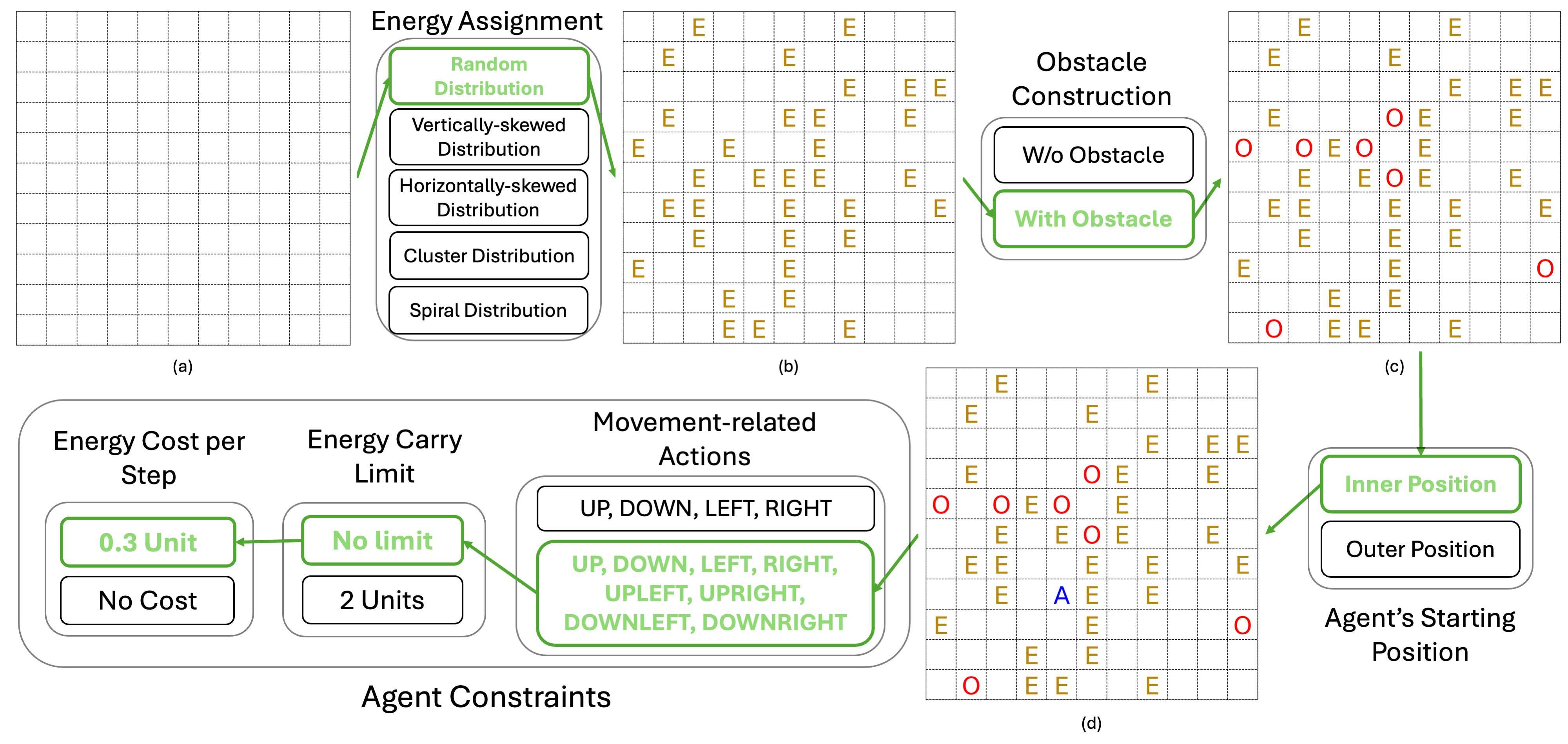
Spatial reasoning, an important faculty of human cognition with many practical applications, is one of the core commonsense skills that is not purely language-based and, for satisfying (as opposed to optimal) solutions, requires some minimum degree of planning. Existing benchmarks of Commonsense Spatial Reasoning (CSR) tend to evaluate how Large Language Models (LLMs) interpret text-based spatial $ extit{descriptions}$ rather than directly evaluate a plan produced by the LLM in response to a $ extit{specific}$ spatial reasoning problem. In this paper, we construct a large-scale benchmark called GRASP, which consists of 16,000 grid-based environments where the agent is tasked with an energy collection problem. These environments include 100 grid instances instantiated using each of the 160 different grid settings, involving five different energy distributions, two modes of agent starting position, and two distinct obstacle configurations, as well as three kinds of agent constraints. Using GRASP, we compare classic baseline approaches, such as random walk and greedy search methods, with advanced LLMs like GPT-3.5-Turbo, GPT-4o, and GPT-o1-mini. The experimental results indicate that even these advanced LLMs struggle to consistently achieve satisfactory solutions.
Motivation & Objective
- To address the gap in existing benchmarks that focus on interpreting spatial descriptions rather than evaluating actual planning and navigation in spatial tasks.
- To develop a scalable, structured benchmark that evaluates how well LLMs can reason about spatial layouts and generate effective plans for resource collection.
- To assess the real-world applicability of LLMs in commonsense spatial reasoning by simulating realistic constraints like obstacles, energy limits, and movement costs.
- To compare classic algorithms (random walk, greedy search) with state-of-the-art LLMs (GPT-3.5-Turbo, GPT-4o) in a unified evaluation framework.
Proposed method
- Construct 16,000 grid-based environments using 160 distinct grid settings, each with 100 instances, varying energy distributions, obstacle placements, starting positions, and agent constraints.
- Represent spatial layouts via text-rendered grids using newline characters and horizontal alignment to encode spatial relationships without visual input.
- Define a task where agents must collect energy within a fixed number of steps, avoid obstacles, and return to the start to drop collected energy.
- Apply three types of agent constraints: movement options (orthogonal vs. diagonal), energy-carrying capacity limits, and step costs.
- Use zero-shot prompting to evaluate LLMs (GPT-3.5-Turbo, GPT-4o) on generating navigation plans without fine-tuning.
- Evaluate performance based on total energy collected, path efficiency, obstacle avoidance, and return-to-start completion.
Experimental results
Research questions
- RQ1Can LLMs like GPT-3.5-Turbo and GPT-4o generate effective, efficient navigation plans in grid-based spatial reasoning tasks without fine-tuning?
- RQ2How do LLM-based agents compare to classic baseline algorithms (random walk, greedy search) in terms of energy collection and path efficiency?
- RQ3To what extent do LLMs recognize and exploit spatial patterns such as clustered or spiral energy distributions for improved planning?
- RQ4What are the failure modes of LLMs in spatial reasoning, such as ignoring nearby energy, repeatedly attempting to move through obstacles, or failing to return to the start?
- RQ5How do constraints like limited energy capacity and step costs affect the performance and planning behavior of LLMs in spatial tasks?
Key findings
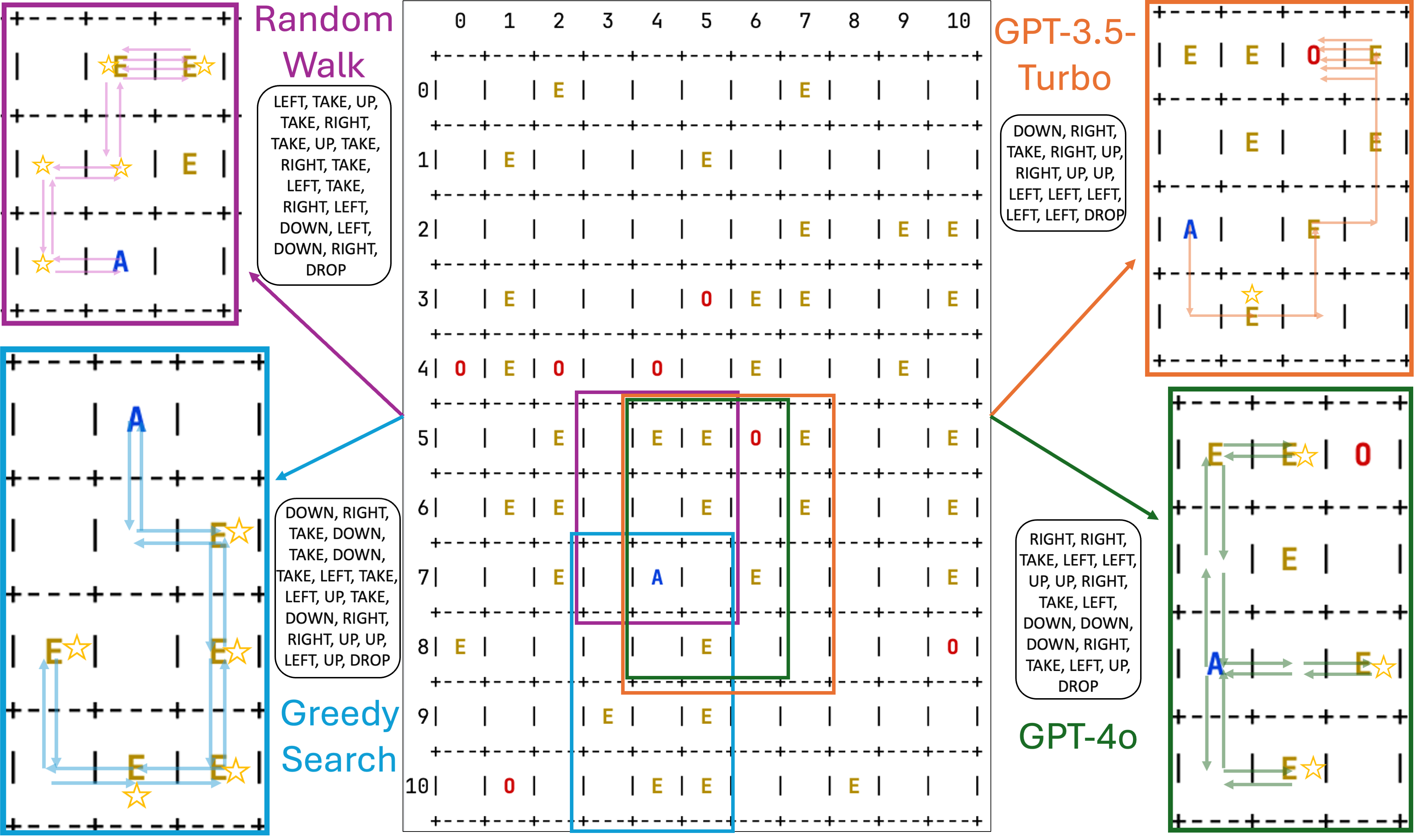
- GPT-3.5-Turbo underperforms even the random walk baseline, frequently failing to avoid obstacles, collect energy, or return to the start.
- GPT-4o performs comparably to the random walk agent but is less efficient than the greedy search agent, indicating suboptimal path planning despite better navigation awareness.
- Even GPT-4o misses nearby energy cells and takes unnecessary steps, revealing inefficiencies in spatial prioritization and route optimization.
- LLMs often fail to execute the return-to-start action after collecting energy, suggesting a lack of understanding of task completion requirements.
- The models frequently hallucinate actions, such as attempting to 'TAKE' energy from empty cells or moving through obstacles, indicating weak grounding in spatial structure.
- Despite recognizing spatial relationships, LLMs struggle to translate this understanding into efficient, goal-directed plans, highlighting a gap in commonsense spatial reasoning.
Read this paper
Open the full text in the Nubint reader and ask about any passage as you read.
Read this paper on NubintThis review was generated by AI from the original paper. Please check the paper before citing it.